DbcultAccessing Vault...
Cult Review
Senior Film Conservator
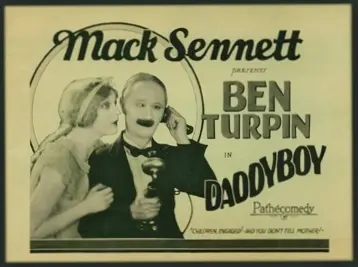
Is Daddy Boy a forgotten masterpiece of the silent era? Short answer: No, it is a functional, high-energy gag-delivery system that prioritizes movement over meaning. This film is specifically for historians of the 1920s comedy scene and fans of Johnny Burke’s vaudevillian energy; it is absolutely not for those who require narrative logic or emotional depth in their cinema.
If you are looking for a quick burst of historical slapstick, Daddy Boy offers a fascinating, if uneven, window into the transition of stage comedy to the screen. It doesn't possess the soul of a Chaplin feature or the architectural genius of a Keaton short, but it has a raw, unpolished vigor. You should watch it if you want to see the specific comedic chemistry of the mid-20s, but skip it if you find repetitive physical humor tiresome.
1) This film works because of Johnny Burke’s absolute physical commitment to the 'man-child' persona, which creates a constant sense of unpredictability.
2) This film fails because the writing team—despite having four credited writers—relies on tired tropes that were already becoming clichés by 1924.
3) You should watch it if you are studying the evolution of silent comedy troupes or the specific screen presence of Ben Turpin.
The structure of Daddy Boy is fascinatingly messy. In an era where films like Anna Karenina (1920) were pushing for high-drama narrative density, Daddy Boy remains stubbornly committed to the 'bit.' The plot exists merely as a clothesline upon which the writers hang increasingly absurd physical confrontations.
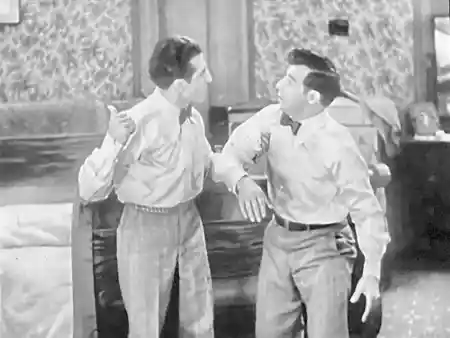
Consider the scene where Johnny Burke interacts with William McCall. The height and weight difference alone is used as a visual punchline. Burke moves with a frantic, bird-like energy, while McCall remains the immovable object. It is a classic dynamic, yet here it feels slightly more aggressive than the work of their contemporaries. There is a mean streak in the comedy that reflects the rougher edges of the 1920s short film circuit.
The pacing is relentless. Unlike the more measured beats found in Thirty a Week, Daddy Boy refuses to let the audience breathe. This is both its greatest strength and its most exhausting flaw. Every frame is packed with potential movement. If a character isn't falling, they are preparing to fall. It is a primitive form of action cinema that values the 'stunt' over the 'story.'
Johnny Burke is an acquired taste. Unlike the subtle pathos of Lloyd or the stoicism of Keaton, Burke is loud—even in a silent medium. His facial expressions are broad, his gestures are sweeping, and his energy is often overwhelming. In Daddy Boy, he plays a character that feels like a precursor to the modern 'adult-infant' trope seen in 21st-century comedies.
One specific moment involving a household mishap highlights Burke’s style. He doesn't just fail to perform a task; he fails with a level of theatricality that suggests he is performing for a live audience in the back row of a theater. It is a performance rooted in the Vaudeville tradition. While this makes for great individual clips, it can be draining over the course of the film’s runtime.
Contrast this with the presence of Alma Bennett. Bennett provides a necessary grounding element. While Burke is spiraling into chaos, she maintains a level of screen poise that prevents the film from descending into total abstraction. She isn't given much to do other than react, but her reactions are the audience's anchor. Without her, the film would be a series of disconnected tremors.
It is an anomaly that a short film of this nature required four credited writers: Jimmy Starr, Al Giebler, Phil Whitman, and Jefferson Moffitt. Jimmy Starr, who would later become a famous Hollywood columnist, likely brought a sense of topical wit, while Giebler was known as a seasoned gag man. The result of this collaboration is a film that feels like a 'best-of' reel rather than a singular vision.
The gags in Daddy Boy feel like they were pulled from different sensibilities. Some are sophisticated visual puns, while others are bottom-of-the-barrel slapstick. This lack of tonal consistency is a hallmark of the era’s 'gag-room' approach to filmmaking. It is the antithesis of the auteur theory. It works. But it’s flawed.
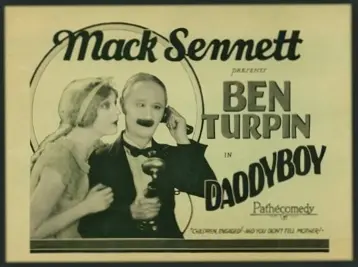
When compared to more focused narratives like His Father's Son, the narrative shortcomings of Daddy Boy become apparent. There is no real character growth here. Burke starts as a nuisance and ends as a slightly more battered nuisance. For the audience of 1924, this was enough. For a modern viewer, the lack of stakes can make the experience feel hollow.
We have to talk about Ben Turpin. His appearance in any film of this era instantly shifts the gravity of the scene. Turpin’s famous crossed eyes were more than just a physical trait; they were a brand. In Daddy Boy, his presence acts as a seal of approval for the slapstick community. He doesn't need to do much—just standing there, looking in two directions at once, is enough to elicit a laugh from a conditioned audience.
However, his inclusion also highlights how much the film relies on 'types.' Each actor is a tool for a specific kind of laugh. There is no room for the nuanced character work found in something like The Mysteries of Myra. Daddy Boy is a machine designed to produce a specific physiological response: the chuckle. It is efficient, if not particularly artistic.
From a technical standpoint, the cinematography is standard for the mid-20s. The lighting is flat, designed to ensure that every physical movement is clearly visible. There is no attempt at the atmospheric shadows found in Beasts of Paradise. The camera stays at a safe distance, acting as a proscenium arch for the actors to perform within.
The editing is where the film finds its rhythm. The cuts are quick, timed to the landing of a punch or the breaking of a plate. This 'staccato' editing style is what keeps the film moving. It prevents the viewer from dwelling too long on the thinness of the premise. It is a masterclass in how to use tempo to mask a lack of substance.
This is a question of intent. If you are a casual moviegoer, the answer is a firm no. The humor is dated, and the 'Daddy Boy' character can be grating. However, if you are a student of film history, Daddy Boy is a vital piece of the puzzle. It shows the bridge between the early, primitive 'chase' films and the more sophisticated features of the late 1920s.
It is also a chance to see Johnny Burke at the height of his powers. While he never reached the heights of the 'Big Three' (Chaplin, Keaton, Lloyd), he was a significant figure in the secondary tier of silent comedy. Watching him here is like watching a high-level athlete perform a routine they have mastered over a thousand stage shows. It is professional, polished, and entirely predictable.
Pros:
Cons:
Daddy Boy is a loud, sweaty, and unashamed piece of entertainment from a bygone era. It doesn't ask much of its audience, and it gives exactly what it promises: a series of people falling over and hitting each other. While it lacks the grace of the era's best work, like North of 36, it possesses a certain blue-collar charm. It is a work of craft, not art. It is a relic that reminds us that even a hundred years ago, audiences just wanted to see a man make a fool of himself for twenty minutes. It succeeds in that mission, even if it leaves no lasting impression once the lights come up.
IMDb 4.8
1936
Community
Log in to comment.