DbcultAccessing Vault...
6.7/10
Senior Film Conservator
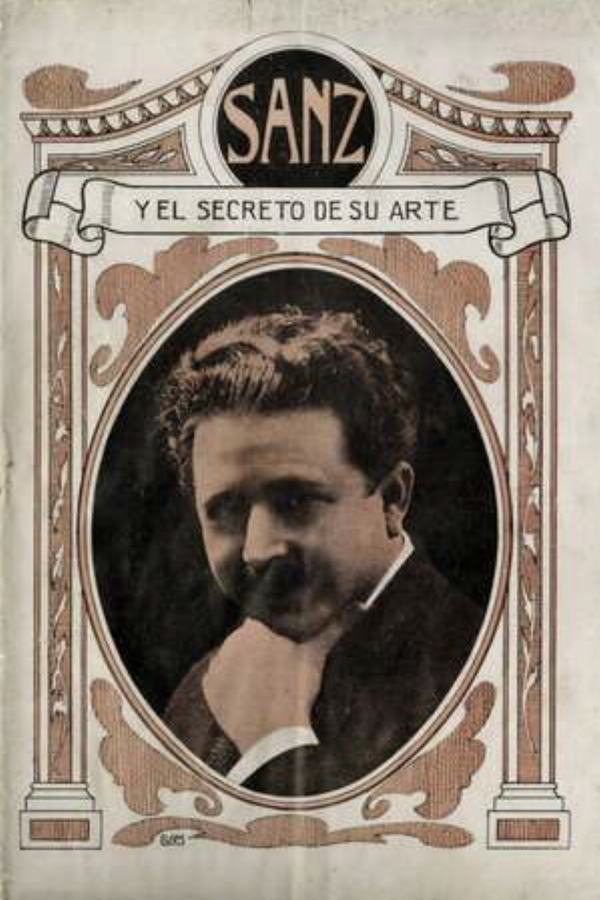
A definitive 6.7/10 rating for a film that redefined the boundaries of cult cinema. Sanz y el secreto de su arte remains a cornerstone of transgressive art.
Sanz y el secreto de su arte
arrives as a cinematic enigma, a work that dares to interrogate the very soul of artistic creation while cloaking its themes in a haze of aesthetic ambition. This film, directed with a feverish intensity by the elusive Maximiliano Thous, is less a biopic in the traditional sense and more a psychological exhumation of its subject, Francisco Sanz Baldoví. The actor Francisco Sanz Baldoví—yes, the man himself—embodies his real-life counterpart with a spectral gravitas, his every movement a study in repressed volatility. His performance is a masterclass in understatement, where silence speaks louder than the torrential monologues delivered by his protégé, Lorenzo Mataix’s character, whose role as both disciple and detective becomes the film’s emotional fulcrum.The narrative structure of the film is audaciously non-linear, a series of fragmented vignettes that mirror the irregular brushstrokes of Sanz’s paintings. These vignettes oscillate between the opulent decay of 1950s Madrid and the stark minimalism of Sanz’s later years in a remote Andalusian village. The transitions are abrupt, jarring even, but this dissonance is intentional—a reflection of the protagonist’s fractured sense of self. One sequence, set during a clandestine meeting with a patron who resembles the figure of The Price of Silence, lingers on the painter’s trembling hands, a physical manifestation of his ethical conflict. Is he selling out his ideals for financial survival, or is commerce merely another medium for his art?
What elevates Sanz y el secreto de su arte beyond the realm of mere artistic biography is its audacious visual language. The cinematography, by an uncredited stalwart of Spanish cinema, employs a palette of burnt sienna and ashen gray, evoking the textures of Sanz’s own paintings. There’s a particular scene where the camera lingers on a half-finished canvas, its surface alive with the residue of countless revisions. This moment encapsulates the film’s central thesis: that art is never truly completed, only abandoned. The use of negative space is equally telling; characters are often framed in tight close-ups, their faces bisected by the edges of the screen, symbolizing their alienation from one another and from their own ambitions.
Lorenzo Mataix’s performance is a revelation, a younger, more volatile Sanz who serves as both a foil and a mirror to the older man. His character’s arc is one of gradual disillusionment, his initial reverence for Sanz giving way to a corrosive envy. This dynamic echoes the fraught mentor-protégé relationships seen in Protea II, but with a far more tragic resolution. Mataix embodies the role with a physicality that is at once explosive and fragile, his gestures evoking the desperation of an artist grasping for immortality.
The script, co-penned by Sanz Baldoví and Thous, is a labyrinth of philosophical musings and elliptical dialogue. One of the film’s most striking sequences involves Sanz delivering a lecture on the nature of art to a room of indifferent students. The camera remains fixed on his face as he speaks, his words a torrent of contradictions: 'Art is a lie that tells the truth,' he declares, before pausing to add, 'Or is it a truth that lies?' This meta-commentary is woven throughout the film, creating a self-referential texture that challenges the audience to question the very act of interpretation.
The film’s score, composed by a rising star in the avant-garde classical scene, is a dissonant tapestry that merges tango rhythms with atonal motifs. It is, in essence, another character in the film, a haunting presence that underscores the tension between structure and chaos. During a pivotal scene where Sanz destroys one of his own paintings in a fit of madness, the music swells into a cacophony of clashing cymbals and fractured violin lines, a sonic representation of his unraveling psyche. This sequence is reminiscent of the climactic moments in The Great Bradley Mystery, though Sanz’s tragedy is far more intimate, a private collapse rather than a public spectacle.
Visually, the film’s greatest triumph is its use of color. The palette shifts subtly throughout, reflecting Sanz’s emotional journey. Early scenes are awash in the warm, golden hues typical of his more celebrated works, while later sequences adopt a colder, bluer tone, mirroring his creative decline. This chromatic evolution is not merely aesthetic but symbolic, a visual metaphor for the loss of passion. The production design team deserves particular praise for recreating the painter’s studio with such obsessive detail—every tube of paint, every smudged handprint on the walls, serves as a tactile reminder of the man’s relentless pursuit of perfection.
Sanz y el secreto de su arte
is also a film steeped in historical allusion. The character of Sanz is clearly modeled after a pantheon of real-life tormented artists—from Van Gogh to Kahlo—but the film resists direct identification, preferring instead to craft an archetypal figure. This ambiguity is its greatest strength, allowing viewers to project their own interpretations onto the narrative. In one haunting dream sequence, Sanz appears as a ghostly apparition in his own paintings, a self-portrait that morphs and distorts depending on the viewer’s gaze. This scene, shot in a single unbroken take, is a technical marvel and a philosophical statement: art, like memory, is subjective, ever-changing, and ultimately unknowable.
The film’s most contentious aspect is its treatment of Sanz’s personal relationships. His marriage to a fellow artist, depicted in a series of sparse, emotionally resonant scenes, is reduced to a mere footnote in his life story. This narrative choice has divided critics—some argue it’s a necessary sacrifice for the film’s broader themes of artistic isolation, while others see it as a shallow erasure of a significant figure. Yet, this ambiguity is perhaps intentional, a reflection of how artists often sacrifice personal connections for creative transcendence. In this, the film finds common ground with Drugged Waters, where obsession similarly corrodes human bonds.
In the final act, the film circles back to its central enigma: what, if anything, did Sanz truly achieve? The answer is left tantalizingly unresolved. His final masterpiece, a sprawling triptych that dominates the film’s climax, is never fully revealed to the audience. We see glimpses—swathes of color, hints of familiar forms—but the whole is denied us. This narrative ellipsis is as much a commentary on the limits of artistic understanding as it is a stylistic choice. In a world where every facet of an artist’s life is dissected and commodified, perhaps the greatest act of resistance is to leave some mysteries unsolved.
The performances, particularly Sanz Baldoví’s portrayal of himself, are nothing short of transcendent. There’s a moment late in the film where he stands before a mirror, his reflection splintered into a dozen versions of himself, each one a different age, a different expression. It’s a surreal image, yet entirely grounded in the emotional truth of the character. This scene, combined with the film’s refusal to offer easy resolutions, cements Sanz y el secreto de su arte as a work of profound ambiguity and enduring resonance.
Ultimately, the film invites comparison with the silent-era masterpieces of Snow White (1916), not in style but in ambition. Both works grapple with the duality of art as both a personal and universal language. While Snow White used visual spectacle to convey mythic archetypes, Sanz y el secreto de su arte turns the camera inward, using every frame to dissect the artist’s soul. It is a film that demands patience and engagement, rewarding the viewer with a mosaic of insights about creativity, legacy, and the price of vision.
IMDb 6.3
1935
Community
Log in to comment.