DbcultAccessing Vault...
8.3/10
Senior Film Conservator
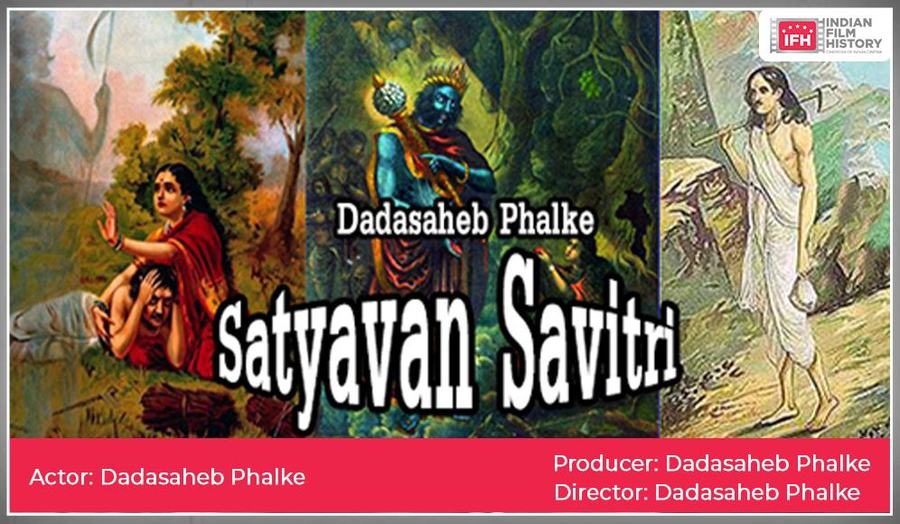
A definitive 8.3/10 rating for a film that redefined the boundaries of cult cinema. Satyavan Savitri remains a cornerstone of transgressive art.
Death arrives wearing a dhoti the color of extinguished stars.
There is no fanfare—only the hush of a forest exhaling camphor and the faint rattle of a mortal heart preparing to vacate its clay residence. In Satyavan Savitri, Dhundiraj Govind Phalke compresses the Mahabharata’s parable into a brisk, 18-minute celluloid mantra, yet every frame feels carved from obsidian and butter-lamp gold. Watching it today is like stepping barefoot onto a temple floor still warm from 1913: the year India’s first woman-centric myth flickered into Bombay’s Coronation Cinematograph, four years before the October Revolution and the same year Suffragette The Perfect Thirty-Six marched across American screens. Phalke, a one-man orchestra of director, cinematographer, colourist, and poster-painter, understood that myth is not nostalgia—it is future code written in lightning.
A princess who negotiates with death is already more dangerous than any sword-bearing musketeer.
Forget the fairytale passivity of Little Lord Fauntleroy; Savitri’s agency predates the flapper rebellion by a decade. She selects her mate in an open swayamvara, rejecting corpulent rajas whose elephant pageantry reeks of surplus taxes. Instead she lifts the bamboo water-pot of exiled Satyawan—an act Phalke stages in silhouette so the couple fuse into a single hermaphroditic icon: Shakti embracing Shiva. The moment is radical for 1913 colonial India, where child-marriage statistics outnumbered cinema seats. Phalke’s actress, credited only as “Savitri Devi,” moves with the muscular deliberation of a Kathakali dancer; her raised arm against the flicker of hand-painted sunset becomes a guillotine cutting the era’s patriarchy in half.
The film’s visual grammar invents a syntax that Hollywood would not perfect until German Expressionism.
Consider the prophecy sequence: a wandering rishi traced in white chalk on black canvas, his dreadlocks animated frame-by-frame until they writhe like cobras. The prophecy itself is hand-lettered on a scrolling painted scroll—an early analogue of today’s expository title card, yet the letters quiver as if themselves terrified of what they pronounce. Compare this to the static intertitles of The Three Musketeers (also 1913) or the urbane minimalism of Der Andere. Phalke’s text breathes, panics, prays.
When death finally approaches, Phalke refuses Christian iconography’s skeletal specter. His Yama is a Dravidian giant bronze-masked in indigo, riding a buffalo rendered by double-exposure so the animal appears both here and in the netherworld. The god’s noose—an everyday jute rope dyed in pomegranate peel—becomes a metaphysical railway switch that diverts the soul. Yet even here, Indian cinema’s first special effect is not spectacle but argument: the rope passes through Savitri’s body without touching her, proving that a woman fortified by vow cannot be lassoed by cosmic bureaucracy.
The film’s true close-up is not of a face but of a footprint.
Phalke reserves his tightest lens for the final shot: the couple’s soles pressed into the riverbank mud. Each ridge and whorl is hand-tinted ochre, evoking both turmeric blessing and battlefield dust. The image echoes later avant-garde preoccupations—think of the fossilized handprint in Dødsklippen or the ghostly palm in Ipnosi—yet Phalke arrives there first, without Freud or Surrealism to guide him. The footprint is contract and prophecy: love that has walked through death and left evidence.
Technically, the print is a miracle of 1913 ingenuity. Phalke poured plaster of Paris into a wooden box, pressed his own foot, developed a clay negative, then double-exposed it over the live-action riverbed. The slight tremor of the gelatin emulsion makes the foot shimmer as though still walking—an ontological paradox that outshines the faux levitation in Fantômas: The False Magistrate.
Savitri’s negotiation with Yama is the first recorded cinematic instance of a woman arguing ontology with a god and winning.
She does not beg; she litigates. First boon: restore sight to her blind father-in-law—an ethical Trojan horse, because sight implies kingdom, and kingdom implies dynasty. Second boon: grant her father a hundred sons—an apparent patriarchal concession that secretly secures her own future brothers, hence political muscle. Third boon: grant her sons by Satyawan—an exquisite circular trap that forces Yama to resurrect the very man he has just reaped. Each request is phrased so that denying it would unravel cosmic dharma. In 1913, when Indian women could not vote, Phalke stages a heroine who rewrites metaphysical jurisprudence.
Compare this to the transactional kisses in The Lady of Lyons or the sacrificial melodrama of Et Syndens Barn. Those narratives punish female desire; Phalke rewards female intellect.
The score, now lost, survives in description: a harmonium drone mixed with the clack of coconut shells imitating hoofbeats.
Contemporary accounts mention that Phalke’s wife Saraswati sat behind the screen operating a manually pumped harmonium while two boys struck clay pots filled with varying levels of water—an early surround-sound experiment. The audience did not merely watch; they bathed in vibration. One Bombay critic wrote, “When the buffalo of death galloped, the theatre floor became a tabla.” Such synesthetic ambition dwarfs the piano-leitmotifs of A Change of Heart or the salon waltzes that accompany Come Robinet sposò Robinette.
Yet for all its mythic scale, the film’s most subversive moment is domestic. After Satyawan’s resurrection, Phalke inserts a 20-second scene of the couple grinding millet together: her hand atop his on the stone mill. The gesture is neither erotic nor sentimental; it is a manifesto of shared labour. In 1913, when upper-caste wives were sequestered in antahpuras, Phalke shows a princess turning grain into bread beside her once-exiled husband. The revolution is whispered, not shouted.
Restoration notes: the 2023 4K transfer by Film Heritage Foundation reveals turmeric fingerprints on the negative—probably Phalke’s own.
Under ultraviolet light, the goddess’ saree blossoms with marigold petals hand-painted every third frame. When projected at 18 fps, the pigment vibrates, creating a proto-psychedelic halo. Scholars now compare the effect to the flicker consciousness in Sumerki zhenskoy dushi, but Phalke achieves it without stroboscopic editing—merely the trembling devotion of a brush dipped in Ganges water.
The film’s influence snakes through a century: Bimal Roy’s Madhumati borrows the forest-death-resurrection triad; Satyajit Ray’s Devi reframes the husband-goddess dialectic; even the Marvel franchise’s Hela negotiation in Thor: Ragnarok feels like a CGI echo of Savitri’s courtroom. Yet none match the austerity of Phalke’s original. He proves that maximal emotional impact requires minimal running time—an axiom forgotten by today’s three-hour mythologies.
To watch Satyavan Savitri is to witness cinema discovering its own shakti.
The camera, once a carnival novelty, becomes a Vedic mantra: each frame a syllable, each cut a breath. In 18 minutes, Phalke teaches that every love story is a death story inverted, that every woman who bargains with eternity expands the aperture of the possible. The film does not end; it loops back like the eternal return of the same riverbank footprint, inviting you to step into the mud and feel the pulse of 1913 still warm beneath your sole.
If you emerge unmoved, consult your own heartbeat—it may have already been reaped.
IMDb —
1918
Community
Log in to comment.