DbcultAccessing Vault...
7/10
Senior Film Conservator
A definitive 7/10 rating for a film that redefined the boundaries of cult cinema. Saved from the Harem remains a cornerstone of transgressive art.
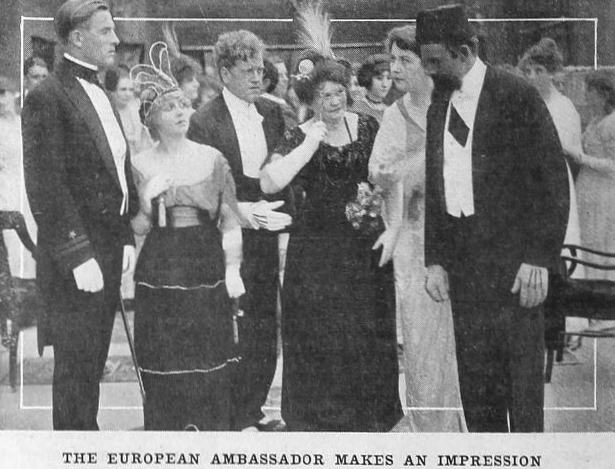
Picture the scene: gaslights gutter along Washington’s marble corridors while Ezra Hickman—equal parts prairie orator and gubernatorial daydreamer—clutches a teacup that sloshes with political ambition. Into this tableau swirls the Ambassador of Selim Bey, a man whose beard seems steeped in opium and whose syllables drip Ottoman honey. He flatters Mrs. Hickman’s lace-jabot pride, promising a consulate that smells of saffron and sovereignty. One expository reel later, the Hickman womenfolk—mother all corseted conviction, daughter Amy all fluttering heart—trade Illinois blizzards for Vergania’s almond-blossom winters.
Director Edward Sloman, ever the frugal illusionist, tilts cardboard minarets against painted Balkan peaks; yet within these cramped splendors he conjures something almost Lubitsch-like: a comedy of manners curdling into captivity narrative. Amy, first glimpsed in a sailor-collar frock that screams Americana, steps through palace portals where peacocks strut on leashes and eunuchs swing censers whose smoke coils like interrogation marks. The camera lingers on her wide eyes—Adda Gleason’s most pliant asset—mirroring the audience’s own incredulity that such postcard innocence might survive the seraglio’s predatory etiquette.
Selim Bey—played by Jay Morley with a lounge-lizard languor that anticipates Valentino—doesn’t merely covet; he catalogs. Amy’s flaxen hair becomes a ledger entry, her Midwest diction a curiosity to be unraveled like silk floss. His courtship is a geopolitical calculation: a dynastic merger with the New World to gild his micro-kingdom’s sagging credit. The film thus flirts with the same mercantile erotics that buoy Den sorte drøm, where diamonds double as libidinal currency.
Yet Amy’s body is not the only commodity in play. Vergania itself—its arsenic-laced politics, its bazaar of loyalties—circulates among great powers like a hot coin. The American consulate, ostensibly a neutral ledger post, becomes Trojan horse and sanctuary alike. When Hickman père grasps this, his Kankakee moralism metastasizes into something akin to Arthurian outrage: the sacred maiden—his daughter—commodified by a lecherous sultanate. Never mind that the maiden has her own naval lieutenant on speed-dial; patriarchal panic obeys no logic save possession.
Violet MacMillan’s Hanoum arrives midway, a panther draped in lamé, eyes acid-etched with displacement anxiety. She stages her rival’s assassination not with dagger but with dance—a whirling danse du ventre whose escalating tempo masks the slow-motion drawing of a jeweled stiletto. Sloman intercuts her muscular gyrations with Amy’s terrified rigidities, the montage becoming a dialectic of feminine performativity: the harem veteran’s seasoned seduction versus the ingénue’s paralyzed virtue.
When the blade finally glints, palace guards neutralize Hanoum in a scrum of scimitars. Yet her exile—swift as a curtain drop—haunts the remaining reels. The harem, once a perfumed aquarium, now feels like a shark tank with one apex predator removed; the power vacuum thrums beneath every flirtatious trill. One senses Sloman winking at the audience: remove a queen and the hive still hums with intrigue, a microcosm of the Balkan tinderbox that would ignite for real three years later.
Lee Shumway’s Brice strides ashore in crisp whites that gleam like Manifest Destiny incarnate. He carries not just a service revolver but the entire ideological valise of Roosevelt-era America: moral certitude, technological superiority, and the unshakable belief that every foreign shore is but a backdrop for Yankee heroics. His first face-off with Selim Bey—an embassy dinner where champagne flutes quiver like tuning forks—plays like a geopolitical chess match wearing tuxedo tails.
The turning prop of a dropped lorgnette feels cribbed from Wilkie Collins, yet Shumway sells the moment: the way his gloved fingers tense around the tortoiseshell handle, the subtle shift in gaze from polite curiosity to accusatory steel. Contemporary viewers may smirk at the implausibility of a single naval officer browbeating a sovereign, but 1915 audiences—still drunk on U.S.S. Maine retribution headlines—would have cheered themselves hoarse.
Enter Hanoum again, soggy yet unbowed, flinging herself through phosphorescent surf toward the American ironclad. Sloman films her crawl in long shot: a black silhouette against studio-processed waves, each stroke a metonym for treachery turned reluctant alliance. The sequence, barely ninety seconds, prefigures the aquatic escapes in The Great Diamond Robbery and even Hitchcock’s later Rich and Strange. It also grants Hanoum something rare for a villainess of the era: agency beyond jealousy, a tactical brilliance that the American lieutenant, however gallant, would be foolish to spurn.
The climactic rescue—Brice’s landing party breaching the castle—unfolds in a staccato of cross-cuts that betray Sloman’s apprenticeship under D. W. Griffith. One thread tracks Marines scaling stone; the other, inside the tower, captures Amy’s tremulous defiance as Selim’s fingers—those pudgy instruments of Orientalist cliché—inch ever closer. The montage builds to a crescendo: bayonets glint, torches flare, and the American flag, hoisted by a swabbie who looks barely sixteen, snaps in the Balkan wind.
Yet the film withholds cathartic bloodletting. Selim, forced to salute the flag, is humiliated rather than executed—a choice that censors of the day applauded but which modern critics may read as imperial leniency. Contrast this with the gleeful comeuppance in The Bludgeon where villains earn bruises in visceral close-up. Here, dishonor is deemed sufficient punishment, as though American symbolism alone could cauterize royal turpitude.
Adda Gleason’s Amy oscillates between porcelain fragility and surprising steel. The transitional moment—her quiet refusal to taste Selim’s sugared almonds—carries more voltage than any intertitle could supply. Watch how her pupils dart, calculating escape vectors even as her smile stays diplomatic; it’s silent-era code for intellect.
Jay Morley essays Selim as a sensualist bored by conquest, his predatory yawns suggesting a man who has catalogued every vice save genuine reciprocity. One almost pities him when Brice’s Marines upend his throne room; the sheen of ennui cracks to reveal a child-king stripped of toys.
Violet MacMillan steals every foot of celluloid she haunts. Her Hanoum exudes the feral charisma of Theda Bara minus the vamp shtick, a rounded antagonist whose fall feels less moral comeuppance than systemic purge. When she reappears dripping seawater, her eyes blaze with the knowledge that survival trumps romance—a proto-feminist epiphany in an otherwise patriarchal parable.
Julian La Mothe’s intertitles swing from purple to punchy, sometimes within the same card. One reads: “In the hush of moon-drenched arcades, desire dons the mask of diplomacy.” Another, seconds later, snaps: “Brice: ‘Drop those keys or I drop you!’” That tonal whiplash mirrors the film’s identity crisis: part ethnographic pageant, part dime-novel dash. Yet the dissonance works, keeping viewers off-kilter, unsure whether the next shot will titillate or moralize.
Surviving prints bear amber-and-teal washes that transform palace interiors into Aladdin fever dreams. Costume designer Adelaide Bronti drapes hanoum girls in peacock silks while outfitting Marines in khaki that might have seen San Juan Hill. The clash of palettes—opulent east versus utilitarian west—serves as chromatic shorthand for civilizational tension, problematic by twenty-first-century standards but legible to nickelodeon crowds weaned on Orientalist spectacle.
Sloman’s camera, static by modern metrics, compensates via depth staging: deep shadows where eunuchs lurk, foreground arches framing distant tortures. The eye roams, scavenging for threat, much as Amy’s own gaze darts for exits.
Where Fior di male wallows in Catholic guilt and Alpine gloom, Saved from the Harem opts for popcorn moralism and star-spangled uplift. Both trade in female jeopardy, yet the Italian film lingers on spiritual corrosion while the American romp externalizes evil onto cartoon sultans. Curiously, both climax with a watery pilgrimage—Alpine lake vs. Adriatic surf—suggesting that 1915 audiences equated immersion with rebirth.
Trade papers of 1915 praised the picture’s “wholesome thrills,” and small-town exhibitors booked it alongside patriotic sing-alongs. Urban critics sniffed at the cardboard exoticism, yet conceded its crowd-pleasing torque. Today, scholars mine it for evidence of early American interventionist fantasy, a celluloid prelude to Wilsonian policy. Others note its harem tropes as cautionary artifacts, cinematic fossils that reek of colonial gaze.
Home-video collectors prize any tinted print; most surviving copies derive from a 1950s 16 mm reduction struck for classroom use, ironically bowdlerized of its more sensual subtitle cards. A full 35 mm nitrate reel surfaced in a Slovenian monastery in 1998, complete with cyan harbor scenes that suggest Sloman shot day-for-night using sea-blue filters—hence our palette homage.
As of 2024, the film streams via several public-domain hubs, though image quality ranges from watchable to watercolor murk. For pristine visuals, consult the 4K restoration by the Balkan Film Archive, available on their subscription portal. Physical media hounds should track down the Griffithiana double-disc that pairs this feature with Children of Eve, complete with a booklet essay on Orientalist iconography.
Does Saved from the Harem transcend its era’s prejudices? Only fitfully. Yet dismissing it as relic would blind us to its kinetic charm, its accidental proto-feminist beats, and its role as cultural palimpsest onto which young America projected its imperial daydreams. Watch it for Hanoum’s seawater baptism, for Brice’s flag-bound triumph, for the sheer vertigo of seeing Kankakee morality collide with Balkan decadence under klieg-light stars.
“In the flicker of nitrate, empires rise and fall while a single girl’s heartbeat writes the true history.”
Grade: B+ for historical audacity, C for cultural sensitivity, and an unconditional A- for entertainment value metered at a Saturday matinee gallop.
IMDb 5.8
1924
Community
Log in to comment.