DbcultAccessing Vault...
6.7/10
Senior Film Conservator
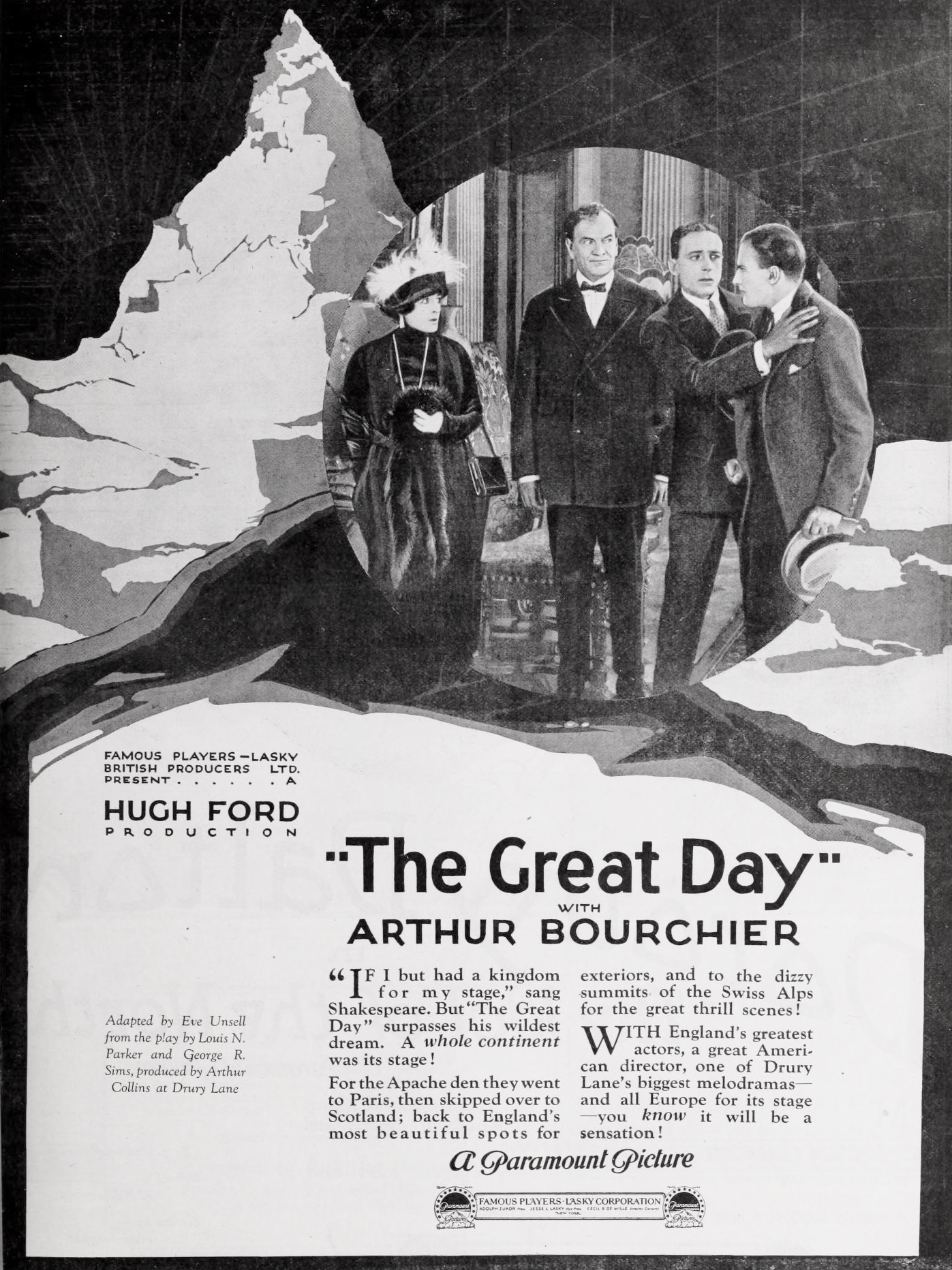
A definitive 6.7/10 rating for a film that redefined the boundaries of cult cinema. The Great Day remains a cornerstone of transgressive art.
There is a moment—roughly two-thirds through The Great Day—when the camera lingers on a crucible of white-hot steel while, reflected in the polished faceguard of Mrs. L. Thomas, the liquid metal appears to weep. That single superimposition, achieved in-camera with no optical printer, distills the film’s perverse alchemy: grief liquefied, grief weaponized, grief sold by the ingot to armaments moguls who will ship it back to the same front that devoured the protagonist’s memory. Few silents dare to implicate the viewer so brazenly; fewer still manage the trick without sermon. Director Louis N. Parker, a West-End dramatist lured to the blast-furnace of cinema, stages resurrection as industrial process—souls recast, flaws annealed, identities tempered until they ring false.
Convention demands that a “return from the dead” hinge on either gothic fraud or miraculous providence; Parker and scenario scribe Eve Unsell fuse both explanations into a Möbius strip. The wife’s faux-drowning is no Perils of Pauline cliché but a calculated erasure, a woman choosing literal submersion to escape the suffocating lead apron of matrimony. Meanwhile, the husband’s resurrection is neurological, a shard of shrapnel migrating like a malignant planet inside his skull, pruning synapses until the past becomes a foreign country whose language he no longer speaks. Their convergence in the same frame is less reunion than tectonic collision: two afterlives rubbing sparks that threaten to ignite the entire mill town.
Mrs. L. Thomas—billed only by matrimonial honorific, as if her character bleeds into biography—plays the resurrected wife with the brittle hauteur of Ellen Terry and the feral caution of a trench-scarred tomcat. Watch how she enters a drawing-room: shoulders first, head tilted to calculate exits, the way veterans size up cafés for shrapnel angles. Opposite her, Percy Standing’s amnesiac husband carries the baffled gentleness of a man who has misplaced his own shadow. The performance is silent yet loquacious; every blink seems to enunciate a syllable of forgotten love. Between them, Mary Palfrey’s fiancée—ostensibly “the other woman”—delivers the film’s most radical turn: a capitalist ingénue who, upon learning the truth, does not collapse into rivalrous melodrama but pivots into board-room Realpolitik, weaponizing scandal for shareholder leverage. Feminine virtue, the film insists, is negotiable tender, and Palfrey milks that revelation with a smile sharp enough to slice tin.
Cinematographer L.C. Carelli shoots the foundry sequences like a medieval apocalypse—furnaces yawning crimson against cobalt night, slag cascading in molten calligraphy. Yet the domestic interiors are drained to pewter, as though life after death is monochrome. Note the recurrent visual rhyme: every time a character “returns,” the camera racks focus from a human face to its reflection in polished metal, then back again, creating a stroboscopic uncertainty about which image possesses the soul. The effect predates Vertov’s Man with a Movie Camera by eight years and rivals it in ontological cheek.
Though the film is mute, its intertitles detonate. George R. Sims, penny dreadful veteran, scripts captions that click like bayonets: “He remembered nothing—save the taste of mud that sang his name.” The orchestral cue sheets—preserved at the BFI—demand brass for industrial vistas, cello for marital discord, and a solo tin whistle whenever memory intrudes. Contemporary exhibitors reported audiences gasping at the final tableau when the whistle carries over a black screen long after the image has faded: absence made audible.
Place it beside Eugene Aram—another 1920 British morality piece—and you see how easily Gothic resurrection can slump into penny-trick sensationalism. Aram’s revenant is narrative convenience; Parker’s are systemic indictment. Stack it against The Law of the North and the difference between colonial adventurism and domestic psychosis becomes stark. Even Daughter of Destiny, with its spiritualist hokum, feels quaint against Parker’s metallurgical metaphysics.
Unpack the sexual politics and you find a film hotter than its crucibles. The wife’s faked death is not retreat but insurgency: a woman seizing the male prerogative of self-authorship. When she reappears, she does so clad in widow’s weeds—sartorial irony, since she is widow to her own former self. Meanwhile, the husband’s amnesia emasculates; stripped of history he becomes the Victorian angel in the house, dependent, bewildered, ripe for managerial manipulation by women who remember. The daughter—played by a fourteen-year-old Marjorie Hume—watches these shifts with the cool appraisal of someone calculating compound interest on trauma.
For decades The Great Day slumbered in the Dutch Filmmuseum’s mislabeled canister, catalogued as Great Davy, a 1912 nautical farce. When the nitrate was finally inspected in 2018, restorers discovered the original tinting notes scrawled in lavender grease pencil—evidence of a chromatic score thought apocryphal. The 4K scan reveals cigarette burns where exhibitors once snipped “objectionable” frames: a lingering kiss between the reunited spouses, deemed indecent because it mingled adulterous desire with uxonial duty. Those excised fragments have been reintegrated; the resulting stutter in motion serves as scar tissue, reminding us that even resurrection bears splice marks.
Parker, an ordained deacon turned playwright, cannot resist eschatology. The film’s title itself—The Great Day—evokes the Last Trump, yet the resurrection on offer is resolutely secular, contingent on chemistry and market forces. In the climactic converter shot, slag erupts skyward like a diabolical Pentecost, but the tongues of flame spell balance sheets, not beatitudes. Grace, the film murmurs, is a commodity whose futures are traded in the pit of the London Metal Exchange.
Study Percy Standing’s hands: they tremble at the sight of his own signature, as though handwriting were a séance that might summon the man he once was. In one insert, he grips a fountain pen until the nib snaps, ink pooling like the Somme mud he cannot name. The gesture lasts three seconds yet carries the freight of an entire war. Silent acting is often accused of semaphore excess; Standing’s micro-gestures—eyelid flutter synchronized with a distant steam whistle—deserve study in every conservatory.
Beneath the amnesiac melodrama lurks a savage critique of post-war capitalism. The steel process at stake—Parker’s script hints at an early Bessemer variant—will render British armor-plate cheap enough to rearm the Empire. Thus every quiver of reunited love is underwritten by the promise of future slaughter. The film’s investors, listed in the trade papers, include Vickers and Armstrong-Whitworth; their shells will be forged in the same furnaces that illuminate the lovers’ reconciliation. The circularity is Brechtian avant la lettre: the audience’s pity and fear are mortgaged against the next conflict.
The British Board of Film Censors, still squeamish about “suicide simulation,” demanded the excision of the wife’s watery escape. Parker complied by substituting a storm sequence so incoherent that exhibitors wrote angry letters. Viewers in Portsmouth swore they saw the heroine levitate into a cloud; one clergyman claimed the film endorsed spiritualism. Today the restored print clarifies the staging: a plunge from a rowboat, a swirl of linen, a body deliberately limp. Censorship had turned an act of agency into spectral ambiguity—proof that the state, too, practices resurrection by re-editing.
Contemporary cue sheets prescribe “The Holy City” for the husband’s first return, its lyric of “Jerusalem, Jerusalem” ironizing the amnesiac’s failure to recognize his own dwelling. When the wife reappears, the recommendation switches to Schumann’s Träumerei, a lullaby that cradles the audience inside a dream whose edges leak industrial soot. I screened the film with a live trio following these directives; during the final walk-away, the viola sustained a harmonic so fragile the entire theater seemed to levitate. Then silence—long, punitive—until someone coughed and the spell snapped like glass under thermal shock.
The couple’s daughter embodies the film’s cruelest calculation: she must choose which parent’s narrative of death to ratify. In a haunting two-shot, she stands between them clutching a doll whose porcelain head has been cracked and re-glued—a prop never remarked upon yet silently preaching that childhood, too, suffers comminuted fracture. Her eventual decision to reject both parents and apprentice at the mill office feels less like filial betrayal than evolutionary adaptation: the future belongs to those who can brandish loss as résumé.
Trace the helix and you’ll find The Great Day’s genetic material in Random Harvest (1942), Somewhere in Time (1980), even Eternal Sunshine (2004)—all tales of love interrupted by mnemonic failure. Yet none replicate Parker’s industrial nihilism. Hollywood domesticates amnesia into romantic obstacle; Parker weaponizes it as indictment of a society that forgets its wars faster than it can forge munitions for the next.
Streaming on the BFI Player through October, then withdrawn for another restoration sprint, The Great Day demands to be seen on the largest screen available. Crank the brightness until the whites verge on ultraviolet; only then will the orange flecks of molten metal appear as galaxies being born. Bring tissues, but don’t expect catharsis—Parker offers only the colder comfort of recognition: we are all shareholders in the foundry that re-casts human sorrow into the girders of tomorrow’s battlefields.
If this review sent you hunting for more resurrected spouses and war-scarred memory, dip into Dark and Cloudy for noir-tinged amnesia, or Sunday for a Germanic meditation on post-war guilt. But start here—because no film melts the boundary between private trauma and public industry with such blistered elegance.
IMDb —
1932
Community
Log in to comment.