DbcultAccessing Vault...
Cult Review
Senior Film Conservator
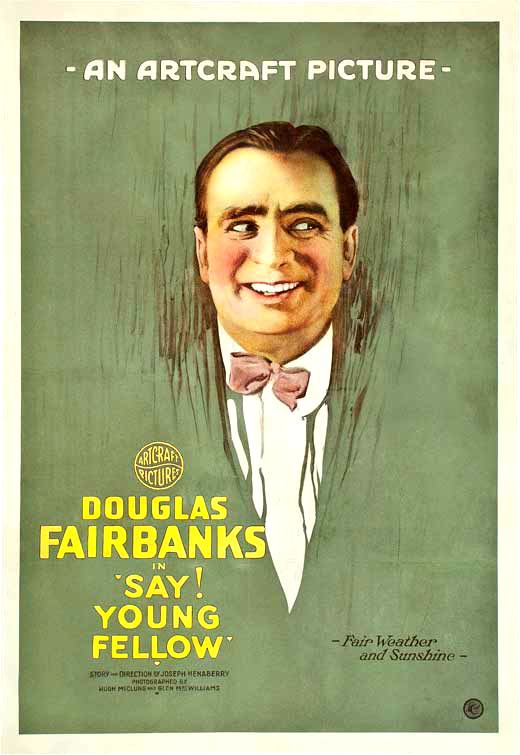
A century after its release, 'Say! Young Fellow' remains a dazzling testament to the silent film era’s ability to marry high-stakes drama with whimsical moralizing. This 1920s gem, starring the indomitable Douglas Fairbanks, is less a mere adventure story and more a philosophical parable wrapped in the garb of action-mystery. The film’s conceit—a miniature self (The Hunch) perched on the protagonist’s shoulder—serves as both a narrative device and a visual metaphor for the eternal tension between societal expectations and personal ethics.
What sets 'Say! Young Fellow' apart is its audacious structure. The Young Fellow, a cub reporter at The New York Herald, is thrust into a scenario that escalates from a farcical interview to a full-fledged corporate espionage thriller. Fairbanks, in a role tailor-made for his athleticism and charm, embodies the archetype of the self-made hero, his physicality echoing the silent film star’s signature acrobatics. Yet the film’s true innovation lies in the Hunch—a tiny, gruff-voiced version of the protagonist (voiced by Frank Campeau) who offers a running commentary of common-sense wisdom. This duality is not merely comedic; it’s a psychological exploration of self-doubt and conviction, rendered with a precision that modern cinema often overlooks.
The opening act is a masterclass in economy. The Young Fellow’s forced interview with a financier, staged with a gun pointed at the wealthy man’s chest, is a microcosm of the film’s thematic backbone: the collision of idealism and pragmatism. The editor’s subsequent assignment—uncovering a stock fraud scheme—transforms the protagonist from a brash novice into a reluctant crusader. The narrative’s pivot to Melford, a fictional town under the shadow of a corporate villain, is where the film’s visual language truly shines. The decaying mansions and fog-draped streets evoke a noir sensibility decades ahead of its time, while the Hunch’s interjections add a layer of absurdist levity.
The secondary characters, though briefly sketched, are instrumental in fleshing out the film’s moral universe. Marjorie Daw’s secretary, Edythe Chapman’s landlady, and James Neill’s villain all contribute to a tapestry of conflicting loyalties. The secretary’s subplot, in particular, is a nuanced counterpoint to the main narrative. Her attraction to The Young Fellow is not reduced to a mere reward for his heroism; rather, it emerges from his demonstrated integrity, a quiet affirmation that his quest is not self-serving. This is a rarity in films of the era, where romantic subplots often feel tacked on.
Technically, 'Say! Young Fellow' is a marvel. The use of shadow and light in the mansion scenes—where The Young Fellow retrieves the incriminating documents—is reminiscent of German Expressionism’s influence on Hollywood. The set pieces are meticulously constructed, each location a character in its own right: the financier’s opulent office, the bachelor’s dimly lit study, and the bustling Herald newsroom. The action sequences, though constrained by the era’s special effects, are staged with kinetic energy. A climactic escape from the financier’s mansion, involving a precarious rooftop chase and an escape via rope, is staged with a simplicity that belies its dynamism.
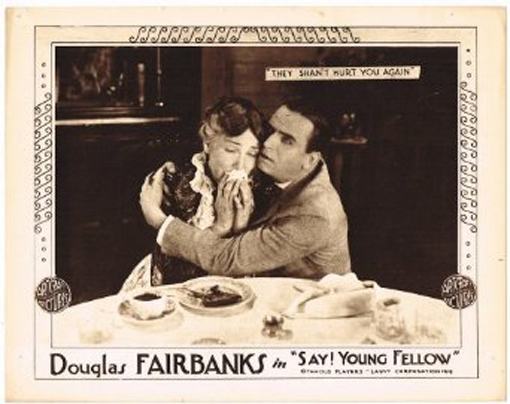
The film’s pacing is another triumph. It balances the episodic nature of a serialized adventure with the introspective musings of its protagonist. The Hunch’s presence ensures that even in moments of high tension—such as the confrontation with the financier’s thugs—there is a running thread of self-reflection. This device, while rooted in the silent film tradition of textual intertitles, is elevated here to a form of internal dialogue, a silent film’s equivalent of a voiceover. It’s a technique that modern audiences might find anachronistic, yet it feels wholly organic within the film’s framework.
Comparisons to other works of the period are inevitable. Like 'Mary Lawson’s Secret' (Mary Lawson's Secret), 'Say! Young Fellow' uses a dual narrative to explore themes of trust and ambition. However, where 'Mary Lawson’s Secret' leans into melodrama, this film opts for a more balanced tone, blending humor and pathos with finesse. The influence of 'The Eternal Law' (The Eternal Law) is also detectable in the moral framework, though 'Say! Young Fellow' is more concerned with individual ethics than divine justice.
Douglas Fairbanks’ performance is the linchpin of the film’s success. His physicality—leaping over desks, scaling walls, and dodging bullets—is matched by a subtle expressiveness in his eyes and gestures. He conveys The Young Fellow’s internal struggle without ever overplaying his hand, a feat that must have been even more challenging in the silent medium. Supporting actor James Neill, as the villainous financier, embodies the era’s archetypal antagonist: a man of cold intellect and ruthless ambition, his smugness a foil to Fairbanks’ moral fervor.
The film’s resolution is both satisfying and thematically cohesive. The retrieval of the documents, the unmasking of the financier, and the romantic closure all occur within a single, breathless sequence. Yet what lingers most is the quiet moment at the end, where The Young Fellow, now a seasoned reporter, glances at his Hunch with a knowing smile. This final shot—a silent acknowledgment of the journey’s end and the self’s enduring complexity—is the film’s truest triumph.
In the broader context of early 20th-century cinema, 'Say! Young Fellow' stands as a bridge between the slapstick comedies of the Keystone era and the more serialized adventures of the 1930s. Its influence can be seen in later works such as 'Lola Montez' (Lola Montez), which similarly blends historical intrigue with personal drama. Yet 'Say! Young Fellow' retains a uniqueness in its treatment of the self as both protagonist and antagonist—a duality that remains a rich vein for modern storytelling.
For contemporary viewers, 'Say! Young Fellow' offers more than just nostalgia. It is a masterclass in visual storytelling, a film that communicates volumes without a single line of dialogue. Its exploration of integrity, ambition, and self-awareness is as relevant today as it was in 1920. In an age where media integrity is under constant scrutiny, the film’s message—that truth is both a weapon and a responsibility—resonates with startling clarity.
IMDb —
1917
Community
Log in to comment.