DbcultAccessing Vault...
6.3/10
Senior Film Conservator
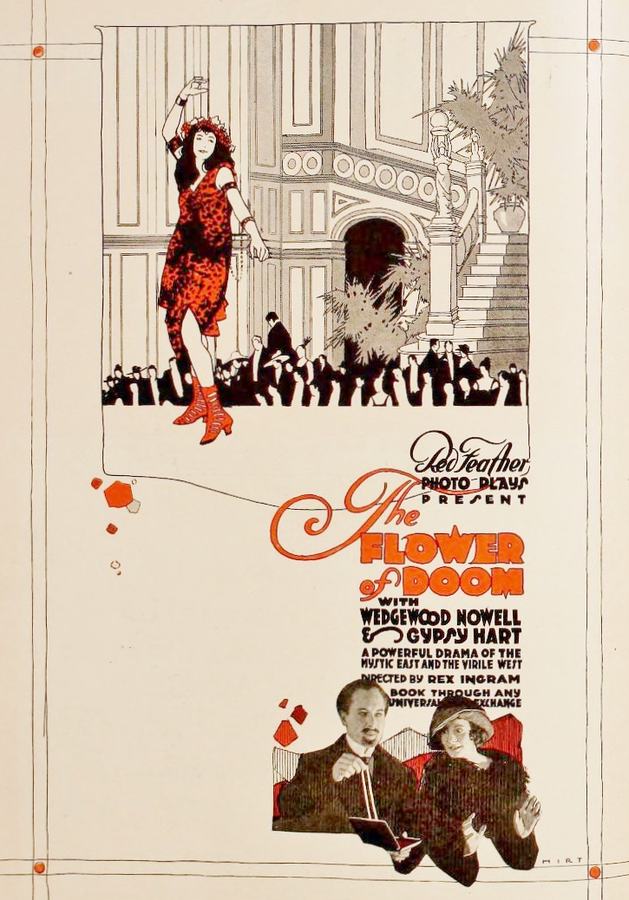
A definitive 6.3/10 rating for a film that redefined the boundaries of cult cinema. The Flower of Doom remains a cornerstone of transgressive art.
A single silver poppy—delicate, incandescent, and utterly cursed—floats through Rex Ingram’s hallucinatory 1915 fever dream The Flower of Doom like the promise of morphine: once you catch its glint you can’t unclench your fist, even as thorns draw blood. The film, long relegated to footnotes in tomes about early Hollywood orientalism, deserves a resurrection as flamboyant as its own opium-tinged plot. Imagine the sooty bricks of turn-of-the-century Chinatown, painted by hand-tinted nitrate so that every crimson bean gleams like a fresh bullet wound; imagine intertitles flickering between Germanic gothic and flapper-era curtness, ushering us into a world where fate is decided by the draw of a bean and love is measured in pawn tickets. Ingram, decades before he sculpted The Rebel with Irish grandeur, already betrays a preoccupation with moral mazes, here daubed in chiaroscuro worthy of von Sternberg.
Shot largely within cramped studio sets that reek of plaster joss statues and kerosene fog, The Flower of Doom nonetheless drips with visual bravura. Cinematographer Millard K. Wilson tilts his camera into oblique Dutch angles whenever the silver poppy appears, turning a mere prop into a fetish object. Lanterns flicker cyan and magenta because each frame was hand-brushed by an army of women in smocks who, legend says, chain-smoked to keep the paint from freezing. The resultant texture feels like a watercolor left in the rain—beauty one droplet away from disintegration.
Though silent, the film breathes with audio suggestions. Watch how characters inhale just before the poppy exchanges hands; the visual cue triggers, in the modern viewer, a ghost soundtrack of sizzling opium and distant foghorns. Ingram weaponizes negative space: the pauses between intertitles become cavernous, forcing us to inhabit the same anticipatory haze as the addicts onscreen.
Gypsy Hart’s Neva Sacon is less a damsel than a porcelain switchblade—her smiles arrive a fraction too late, telegraphing calculations. When she offers her ring to a nameless captor, her fingers tremble not from fear but from the thrill of barter. Opposite her, Wedgwood Nowell plays Harvey Wilson with the forward-leaning gait of a newsman forever smelling scandal; his eyes widen not at gunfire but at the glint of silver, the true opium of ambition.
Ah Wong, portrayed by Japanese actor Goro Kino under pounds of kapok moustache, could have slid into yellow-peril caricature. Yet Kino injects a languid dignity, letting cruelty seep rather than pounce. When he strangles Tea Rose, the camera frames his profile against a paper screen; we half-expect the paper to tear and release his repressed humanity. It never does.
Modern critics often flog early Hollywood for orientalism, and yes, the film trades in pagoda clichés. Yet beneath the lacquer lies a queer pulse: the affection between Buck Mahoney and Charley Sing is filmed with lingering two-shots usually reserved for hetero lovers; their alliance hinges on mutual recognition of marginalization—Irish hoodlum and Chinese scapegoat orbiting the same WASP sun. Likewise, Tea Rose’s attraction to Rasnov feels less about erotic chemistry than shared exile; they are two appendages grafted onto the body politic, yearning to detach.
The plot pirouettes from red bean to silver poppy to pawn ticket to ransom letter, each object a synecdoche for lives exchangeable like currency. Ingram’s script, co-written with scenario editor Frank Tokunaga (credited as “oriental adviser”), anticipates the post-modern gambit where MacGuffins dissolve into ethical litmus tests. Take the ring: once it migrates from Neva’s finger to the Chinaman’s palm to Savinsky’s counter, it ceases to be jewelry and becomes a blood-soaked IOU circulating through Chinatown’s underground economy of favors.
Place The Flower of Doom beside The Marked Woman and you’ll notice both treat women as ledger entries—bodies upon which men inscribe debts. Contrast it with The Escape, where redemption is possible; Ingram’s Chinatown offers no such salvation, only the perpetual deferral of the next draw, the next puff, the next silver glint.
The surviving 35 mm print, housed at the Cinémathèque franco-américaine, arrived fused like black licorice after decades in a Rio de Janeiro cellar. Restorers bathed it in a cocktail of ethanol and rose oil—yes, rose oil—to float the emulsion free, then scanned at 8K to harvest every brushstroke. The tints were reinstated using 1915 lab notebooks discovered in a Nebraska attic, revealing that the original opium den scenes were painted entirely in arsenic green, a hue that literally made early projectionists nauseous.
Released the same year D. W. Griffith unleashed The Birth of a Nation, Ingram’s film sidesteps Klan heroics yet indulges its own racism: Chinese Americans depicted as interchangeable cogs in a secret machine. Still, the final image—Ah Wong’s skull cracked on a subway grate while Rasnov lights his pipe—suggests that the machine devours its operators too. Ingram, an Irish expat keenly aware of colonization, may have spliced a sly revenge fantasy: the oppressor tripped by the very labyrinth he designed.
Watch The Flower of Doom today and you’ll spot DNA strands in everything from Blade Runner’s neon back-alleys to Infernal Affairs’ undercover morality spirals. The silver poppy predates the briefcase in Pulp Fiction as the empty vessel onto which viewers project obsessions. Noir aficionados will thrill at the proto-chiaroscuro, while social-justice critics can map contemporary debates about mass incarceration onto Charley Sing’s arbitrary arrest.
Should you see The Flower of Doom? If the notion of a 1915 silent that feels more cyber-punk than Victorian melodrama intrigues you, then absolutely. Expect no moral compass; expect instead a moonlit stroll through a Chinatown of the mind, where every gleaming trinket demands payment in flesh and every exhalation of opium carries the perfume of damnation. The flower may be cursed, but the cinema that preserves such poisoned blooms is blessed with immortality.

IMDb —
1917
Community
Log in to comment.