DbcultAccessing Vault...
9.1/10
Senior Film Conservator
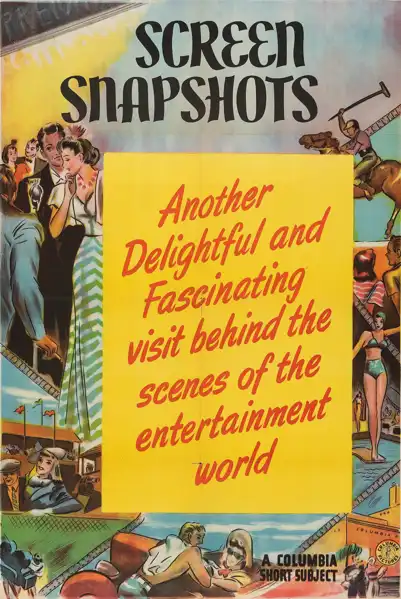
A definitive 9.1/10 rating for a film that redefined the boundaries of cult cinema. Screen Snapshots, Series 16, No. 1 remains a cornerstone of transgressive art.
So, Screen Snapshots, Series 16, No. 1. Is it worth tracking down today? Well, if you’re hoping for a movie in the modern sense, absolutely not. But if you’re a history buff, someone really into old Hollywood, or just curious about how celebrities were presented back in the late 1930s, then yeah, it’s a neat little time capsule. Anyone expecting a plot or even coherent transitions will probably find it a bit of a snoozer. 😴
This whole series of "Screen Snapshots" feels like a strange, flickering Instagram story from nearly a century ago. It's not a film so much as a collection of quick, disconnected clips. You jump from one star's staged moment to another without much rhyme or reason.
First up, we get a tour of Ken Maynard’s private circus. I mean, who just *has* a private circus? 🎪 It's such a peculiar, almost whimsical detail. He's there with his horses, and it all feels very... rustic? You see him interacting with them, and it’s clear he genuinely loves these animals.
The whole thing with his horses and the "Tarzan" horse, specifically, just makes you smile. It's so earnest, so unashamedly old-school charming. You can almost smell the hay. It felt longer than it probably was, just because it’s such an *odd* segment to lead with.
Then, suddenly, we're with Bette Davis. She’s posing for her portrait, looking very serious and dramatic, even off-screen. It's hard to tell if she's genuinely posing or if this is just *how* Bette Davis was all the time. The camera just kind of lingers, and you wonder what the painter thought of having a whole film crew watching.
It's a very formal, almost stiff moment, a stark contrast to Maynard's dusty animal show. She's got that intense gaze, even when she's just sitting there. You can feel the *gravitas* even in a few seconds of screen time.
Next, a quick, heartwarming (and very common for the era) clip of Frank McHugh playing with his children. It's clearly meant to show the star as "just like us," a family man. They’re running around, laughing. It's sweet, but also feels a little too perfectly set up, you know?
There's a moment where one of the kids nearly trips, and it felt like the only *unscripted* thing in the whole section. These bits were always a studio staple, showing that even big stars were just regular folks.
The final segment takes us to the West Side Tennis Club. This part is a bit of a "who's who" of the time. You see glimpses of a lot of famous faces, though sometimes it’s hard to tell who’s who without a narrator pointing them out. It’s like a silent movie gossip column.
I found myself trying to identify everyone in the background, which was a fun little game. The tennis itself is barely the point. It’s all about the social scene, the glamour. It felt like a precursor to modern red carpet coverage, just way more casual and, honestly, a bit more elegant.
This "snapshot" really highlights how different celebrity culture was. There's an innocence, almost. These aren't deep dives; they're literally snapshots. The whole thing barely clocks in, but it leaves you with a very distinct taste of 1930s Hollywood.
It's a bit choppy, sure, and some parts go on about ten seconds too long. But that’s part of the charm. It’s a genuine artifact, a window into a past that feels both familiar and incredibly foreign. Worth a quick watch if you're into that sort of thing. 👍
IMDb 5
1901
Community
Log in to comment.