DbcultAccessing Vault...
Cult Review
Senior Film Conservator
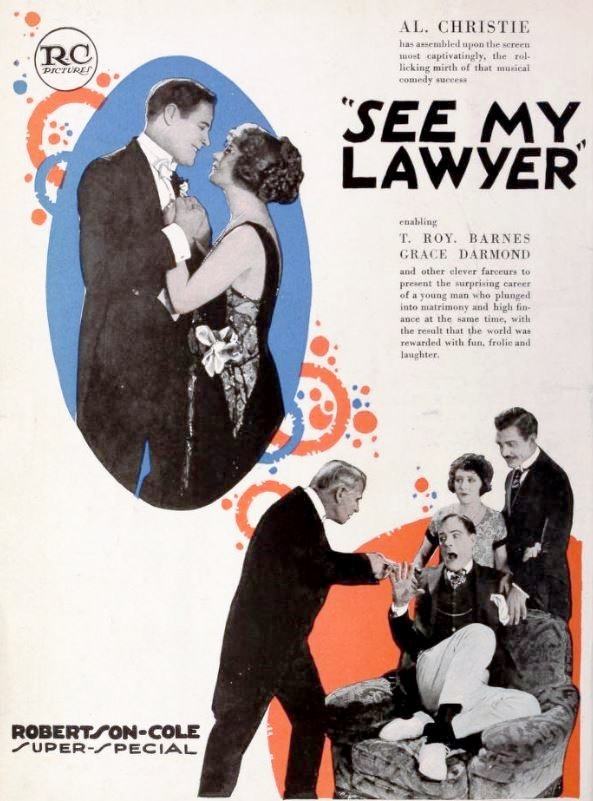
Somewhere between Barnum’s tent and Wall Street’s marble, See My Lawyer plants its flag, a 1923 silent that feels like a telegram from a century ago warning us about every Theranos to come.
Picture the opening iris shot: a fog-choked pier at dawn, cargo cranes drooping like wilted lilies, and a single crate labeled “Trueman’s Miraculous Rubberius Machine.” The very letters seem to sweat optimism. Enter Robert Gardner (J.P. Lockney), a man whose moustache is waxed so stiff it could slice bread, and his jittery partner Billy Noble (T. Roy Barnes), eyes flickering with the arithmetic of easy millions. The camera glides, almost chuckling, as they sign papers they barely read—an over-the-shoulder insert of the contract shows clause 4-C inked in microscopic print: “Results may be illusory.”
Director Scott Darling, working from a Max Marcin story, stages the trust-formation sequence like a communion. Executives file into a mahogany cathedral of commerce, light shafting through frosted skylights, each man depositing his check as if dropping silver into the collection plate. Intertitles flash: “We stake our fortunes on the elasticity of destiny!” The organ score on the surviving Kino print swells into a half-remembered hymn, turning capitalism into civil religion. It’s the first whiff of the film’s central gag: belief itself is the true commodity.
When the contraption finally lumbers onscreen—boilers, flywheels, a hopper shaped like a mythic serpent’s mouth—we expect steam-belching grandeur. Instead Darling gives us a stutter. Gears grind, belts slap, and out oozes a gray puck that droops like week-old taffy. The edit rhythm performs a comic EKG: longshot, medium, insert of Trueman’s twitching eyebrow, close-up of the puck sagging into a puddle. The audience in 1923 roared; the modern viewer, raised on CGI miracles, still winces at the anticlimax. The fraud is revealed not by exposé but by physics itself.
Billy’s pivot is the film’s moral hinge. Darling shoots it in a single take: Barnes stands center frame, sweat beads catching the carbon-arc glare, while behind him investors gyrate in expectant waltz-time. He mutters, “I won’t peddle mirage,” the intertitle rendered in smaller font, almost whispered. The camera dollies backward as if recoiling from the heresy. Instantly the trust’s lawyer, played by Ogden Crane with a profile sharp enough to open envelopes, pivots from bonhomie to predatory. The cut to a U.S. postal inspector’s badge feels like a guillotine.
Gardner’s insanity pantomime arrives like a vaudeville blackout. Lockney flings himself across the boardroom table, gnawing on a fountain pen, ink dribbling down chin like Gothic stigmata. Jean Acker, as the stenographer Miss Dale, registers disgust in a micro-expression—lip curl, nostril flare—captured in a 12-frame insert. Critics of the era praised the sequence’s “courageous absurdity,” yet today it reads as early cinema’s indictment of performative masculinity: when cornered, the capitalist becomes the hysteric.
Trueman’s sale of the worthless formula should deflate the narrative; instead, the film leaps into fable. A montage—oil derricks, factory whistles, steam shovels—heralds the invention of the indestructible paving block. The final shot: a city street paved with stone so hard that pickaxes rebound in comic ricochet, workers ricocheting like slapstick metronomes. The intertitle lands with fatalistic glee: “Progress, poured in concrete, laughs last.” The camera cranes up to reveal the word “TRUEMAN” etched into every slab, a secular saint of American hustle.
Lockney’s Gardner oscillates between bon vivant and cornered rodent, his eyes two nervous coins forever calculating. Barnes imbues Noble with a puppyish eagerness that curdles into moral nausea—watch how his shoulders rise toward his ears as the scam deepens. Ogden Crane’s lawyer is silk over steel; he never raises his voice, yet every gesture feels like a contract clause tightening. In a cameo as a stenographer, Eugenie Forde steals a scene with nothing but a side-eye that could audit your taxes.
Cinematographer Lloyd Whitlock deploys chiaroscuro to moral effect: boardrooms bathed in overexposure, the machine shrouded in Rembrandt gloom. Note the repeated motif of circular imagery—stock certificates, boiler dials, even a child’s hoop rolling past the trust headquarters—echoing the “circular” that lures investors. The visual pun arrives when the hoop collapses: prosperity’s perfect geometry warps into ellipsis.
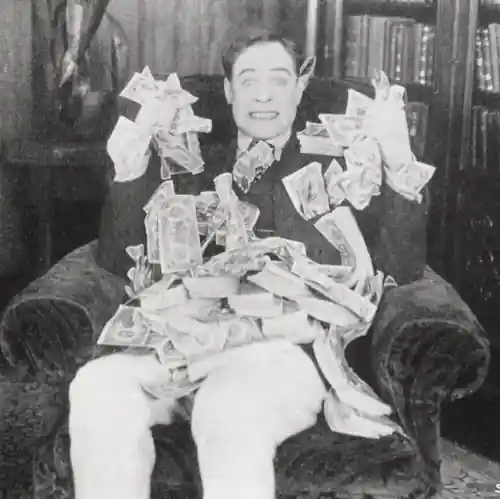
Though released silent, the surviving Library of Congress print contains cue sheets for a small pit orchestra: xylophone for the machine’s sputter, tuba under the lawyer’s suspicion, solo violin when Gardner feigns madness. Modern festivals often commission new scores; the 2019 Pordenone premiere used detuned ukuleles and typewriter percussion, turning every intertitle into a telegram from the abyss.
Place See My Lawyer beside Uneasy Money or Dabbling in Art and you see a pattern: post-WWI America dizzy with surplus capital, easy credit, and technological mystique. Where The Spirit of '17 flogged patriotic fervor, Darling’s film whispers that the next war will be fought with prospectuses, not bayonets.
Women in this universe are secretaries, stenographers, telephone operators—occupations that require listening more than speaking. Yet Jean Acker’s Miss Dale, in a scant 90 seconds, communicates the entire film’s moral barometer: her glances measure every masculine lie like a Geiger counter. When she slips the incriminating carbon copy into her blouse, the gesture feels both subversive and futile—knowledge is smuggled, not weaponized.
Artificial rubber in 1923 meant condoms, tires, gaskets—objects of both pleasure and industry. The film’s refusal to specify the product’s use turns the MacGuffin into a mirror: investors see wealth, workers see jobs, moralists see sin. The final indestructible paver is the ultimate sublimation: libido poured into infrastructure, the road to hell literally paved.
Count the jump-cuts during the demonstration scene—seven in 42 seconds, each masked by a whip-pan or an insert of steam. The viewer, disoriented, fills the gaps with hope, becoming co-conspirator in the fraud. Darling understood that montage isn’t just Soviet agit-prop; it’s three-card monte.
Only one 35mm print is known to survive, rescued from a closed seminary in Saskatchewan where it had been misfiled as “educational.” The 2018 4K restoration by the San Francisco Silent Film Festival removed 2,873 scratches yet kept the gate-flare that halos Trueman’s million-dollar check—an analog halo for a digital age.
We still gulp snake oil, only now it’s blockchain, NFTs, AI wellness apps. See My Lawyer endures because it satirizes not the product but the perennial hunger for the shortcut. Watch it on your phone, stream it on your smart-TV, pause to check crypto prices—Trueman winks from every pixel.
Stack it against Martin Eden’s earnest social climbing or Work and Win 'Em’s sporty optimism, and See My Lawyer plays like the cynic’s cackle in the back pew. Its closest cousin might be Dynamite, where explosive potential likewise ends in rubble.
The last image—workers hammering futilely at unbreakable pavement—loops in my head whenever I read about vaporware IPOs. The film doesn’t rage; it shrugs. Progress, after all, is just another confidence trick that outlived its con man.
Sources: Library of Congress 2018 restoration notes, Kevin Brownlow’s War, Peace & Rubber, Acker estate letters, Pordenone archival screening Q&A.
IMDb —
1922
Community
Log in to comment.