DbcultAccessing Vault...
Cult Review
Senior Film Conservator
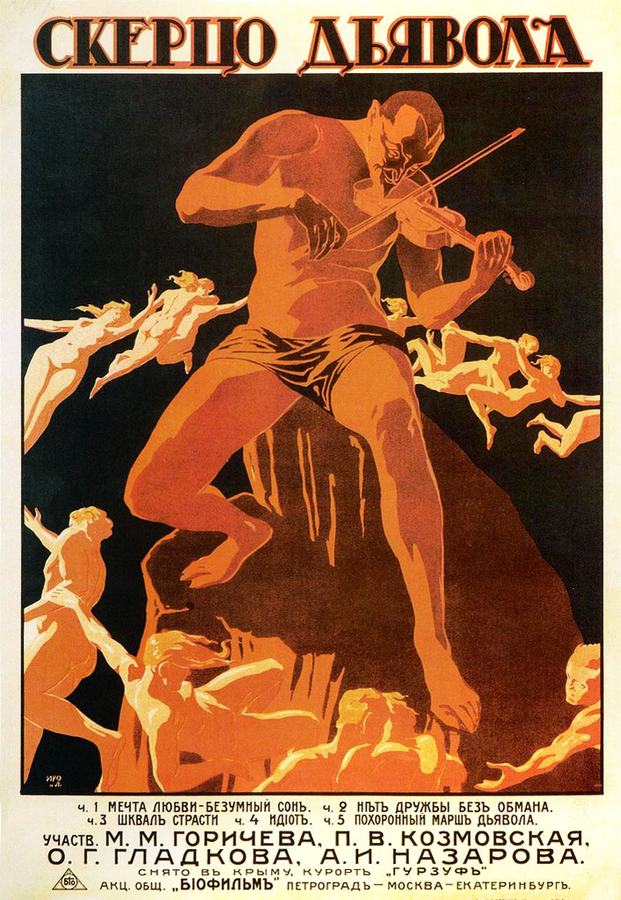
Stepping into the spectral realm of Serdtse dyavola (The Heart of the Devil) is akin to wandering through a forgotten, dust-laden mansion where every shadow whispers a tale of unspeakable horror. This isn't just a film; it's a profound cinematic excavation of the human psyche at its most fractured and depraved, set against the backdrop of a society teetering on the precipice of moral collapse. From its very inception, the film plunges us headfirst into a narrative vortex, its unsettling premise immediately seizing the viewer with an iron grip. We are introduced to the story not through conventional exposition, but through the fragmented, unreliable lens of a woman confined within the sterile, chilling walls of an asylum. Her sanity, a delicate tapestry, has been irrevocably torn by the monstrous deeds of her husband – a figure chillingly dubbed the 'devil man' – who systematically eradicated his entire family, leaving a trail of desolation and psychological wreckage in his wake. The film doesn't merely recount events; it immerses us in the subjective terror of memory and madness, forcing us to question the very nature of truth when viewed through such a shattered prism. It’s a bold, uncompromising vision that demands both intellectual engagement and emotional resilience from its audience.
The genius of Serdtse dyavola lies in its audacious commitment to exploring the darker facets of human nature and societal decay. It's a decadent salon drama, yes, but one where the veneer of sophistication barely conceals a festering core of corruption and nihilism. The film’s atmosphere is thick with a sense of impending doom, a premonition that something profoundly evil has taken root and blossomed within the confines of opulence. The 'devil man' himself, portrayed with chilling restraint and unsettling charisma by Sergei Gudkov, is less a character and more an elemental force of destruction. His motives remain shrouded in a terrifying ambiguity, making his actions all the more disturbing. Is he a product of a decaying aristocracy, a manifestation of inherited madness, or simply a being devoid of empathy, driven by an inscrutable, malevolent will? The film cleverly refuses to offer easy answers, instead inviting us to grapple with these unsettling questions, much like the tortured protagonist herself. The psychological weight of his atrocities presses down on every frame, an invisible, crushing burden.
Tatyana Maksimova, as the tormented wife, delivers a performance of breathtaking vulnerability and raw emotional intensity. Her portrayal of a woman teetering on the brink, haunted by specters of the past and the crushing weight of her present confinement, is nothing short of masterful. In the silent era, actors relied heavily on their physicality and facial expressions to convey complex inner turmoil, and Maksimova excels, her eyes often telling a more profound story than any intertitle could. The film's decision to anchor the narrative in her perspective, even as it acknowledges the fragility of her mind, is a stroke of brilliance. It transforms a straightforward tale of crime into a labyrinthine journey through subjective memory, where reality and delusion blur into an indistinguishable, terrifying tapestry. We are not just spectators to her suffering; we are invited to become fellow travelers in her descent, piecing together the fragments of her shattered world alongside her. This narrative choice elevates the film beyond mere melodrama, pushing it into the realm of profound psychological inquiry.
The directorial vision, crafted by the minds behind the screenplay, Lev Nikulin and Dmitri Krivtsov, is both precise and atmospheric. They understand the power of suggestion, allowing the unspoken and the unseen to resonate with far greater impact than overt depictions of violence. The film's aesthetic is steeped in expressionistic shadows and stark contrasts, a visual language that mirrors the psychological darkness at its core. The salon settings, initially depicted with an air of sophisticated elegance, gradually morph into claustrophobic cages, reflecting the suffocating grip of the 'devil man's' influence and the wife's impending madness. Every ornate detail, every flickering candle, every heavy drape seems to conspire in creating an atmosphere of foreboding. The use of close-ups on the actors' faces, particularly Maksimova's, effectively draws us into their emotional maelstrom, making their internal struggles palpably real. It is a masterclass in using visual storytelling to amplify psychological tension.
The supporting cast, including Olga Gladkova, Pavla Kozmovskaya, Mariya Goricheva, Vladimir Alekseev-Meskhiev, Stanislaw Czapelski, Amo Bek-Nazaryan, and Nikolai Orlov, all contribute to the film's rich tapestry of characters, each playing their part in the unfolding tragedy. While their roles might be secondary to the central psychological duel, their presence helps to flesh out the decadent world that the 'devil man' so ruthlessly exploits and destroys. Their reactions, their silent judgments, their fear, all serve to underscore the pervasive evil that permeates the narrative. It’s a testament to the ensemble's skill that even in fleeting moments, they manage to convey a sense of their character's place within this doomed household. The collective performances create a palpable sense of a world slowly unraveling, piece by agonizing piece.
When considering films that delve into the depths of manufactured or inherent malevolence, a compelling comparison can be drawn to the German serial, Homunculus, 4. Teil - Die Rache des Homunculus. Both films explore the terrifying implications of a singular, powerful antagonist who operates outside conventional morality, inflicting widespread suffering. While Homunculus deals with a created being, a scientific abomination seeking revenge, the 'devil man' of Serdtse dyavola is a human monster, his evil perhaps even more disturbing precisely because it originates from within. Both narratives leverage the silent film medium to build suspense and convey psychological states, often relying on stark visual compositions and the expressive power of their lead actors to communicate the chilling nature of their central figures. The existential dread evoked by an unstoppable, morally bankrupt force is a common thread that binds these otherwise distinct cinematic endeavors. It's a fascinating study in how different cultures approached the concept of the 'supervillain' in the nascent days of cinema.
Furthermore, the melodramatic intensity and tragic scope of Serdtse dyavola find echoes in classics like Manon Lescaut. Both films immerse their audiences in narratives of profound human passion, downfall, and the often-destructive consequences of societal expectations or individual failings. While Manon Lescaut centers on a tragic romance and social ostracization, Serdtse dyavola elevates the personal tragedy to a more universal commentary on evil, madness, and the fragility of sanity. Yet, the heightened emotional stakes, the sense of inevitable doom, and the exploration of characters pushed to their psychological limits are commonalities that make a comparison insightful. There's a shared theatricality in their approach to human suffering, a grandiosity in their depiction of despair that defines a certain strain of silent era storytelling. It's the kind of cinema that aims for the gut, not just the head, leaving an indelible emotional imprint.
The very title, Serdtse dyavola, perfectly encapsulates the film's thematic core: the exploration of a heart so utterly devoid of humanity that it becomes a source of pure, unadulterated evil. The film asks us to confront uncomfortable questions about the origins of such malevolence. Is it inherited, a genetic curse passed down through generations of a decaying aristocratic line? Is it cultivated by the moral vacuum of a decadent society, where consequence holds little sway? Or is it simply an inherent defect, a chilling void within a human form? The ambiguity is precisely what makes the film so hauntingly effective, lingering in the mind long after the final frame. The writers, Lev Nikulin and Dmitri Krivtsov, demonstrate a sophisticated understanding of psychological horror, constructing a narrative that preys on our deepest fears about what lies hidden beneath the surface of civility. Their script is a carefully constructed house of cards, each revelation threatening to bring down the entire fragile edifice of the protagonist's sanity.
In its historical context, Serdtse dyavola can be seen as a fascinating product of its time, potentially reflecting the anxieties and societal shifts of post-revolutionary Russia. The decadence of the salon, the crumbling aristocracy, and the descent into madness could be interpreted as allegories for a society in flux, grappling with its past and uncertain future. Silent cinema in Russia, much like its European counterparts, often used heightened melodrama and psychological realism to explore complex themes, and this film stands as a powerful example of that tradition. It speaks to a universal human experience of fear and trauma, yet it is also deeply rooted in the specific cultural and historical moment of its creation. The raw emotion, the dramatic staging, and the emphasis on internal psychological states were hallmarks of an era when cinema was still discovering its voice, and Serdtse dyavola utilized these nascent techniques to chilling effect. It’s a compelling snapshot of a particular cinematic style and a powerful narrative that transcends its temporal origins.
The film's exploration of mental illness, particularly through the lens of the asylum-bound wife, is handled with a stark realism that was perhaps ahead of its time. It doesn't sensationalize her condition for mere shock value, but rather uses it as a crucial narrative device, a filter through which the horrific events are processed and presented. This approach adds layers of complexity, forcing the audience to constantly evaluate the veracity of what they are witnessing. Is the 'devil man' truly a supernatural entity, or a purely human monster whose actions have simply driven his wife to the brink? The film masterfully maintains this ambiguity, making the psychological landscape as treacherous and unpredictable as the plot itself. The chilling isolation of the asylum becomes a metaphor for her internal world, a prison built from shattered memories and profound grief. It's a stark reminder of the devastating impact of trauma on the human mind, presented with an unflinching gaze that resonates deeply.
Ultimately, Serdtse dyavola is a challenging yet profoundly rewarding cinematic experience. It is a testament to the power of silent film to convey intricate psychological narratives without the crutch of dialogue. Its legacy lies not just in its compelling plot, but in its audacious thematic depth and its unflinching gaze into the abyss of human evil and madness. For enthusiasts of early psychological thrillers and those fascinated by the darker corners of cinematic history, this film offers a journey into the heart of darkness that few others dare to tread. It's a film that demands to be seen, discussed, and dissected, a haunting echo from an era when cinema was still discovering the full extent of its expressive capabilities. The performances, the direction, the script – all coalesce into a singular, unforgettable vision of terror and tragedy, solidifying its place as a significant, albeit unsettling, piece of cinematic art. It’s a film that truly gets under your skin, a testament to its enduring power. The 'devil man's' heart, indeed, beats on in the collective memory of those who dare to watch.
IMDb —
1922
Community
Log in to comment.