DbcultAccessing Vault...
Cult Review
Senior Film Conservator
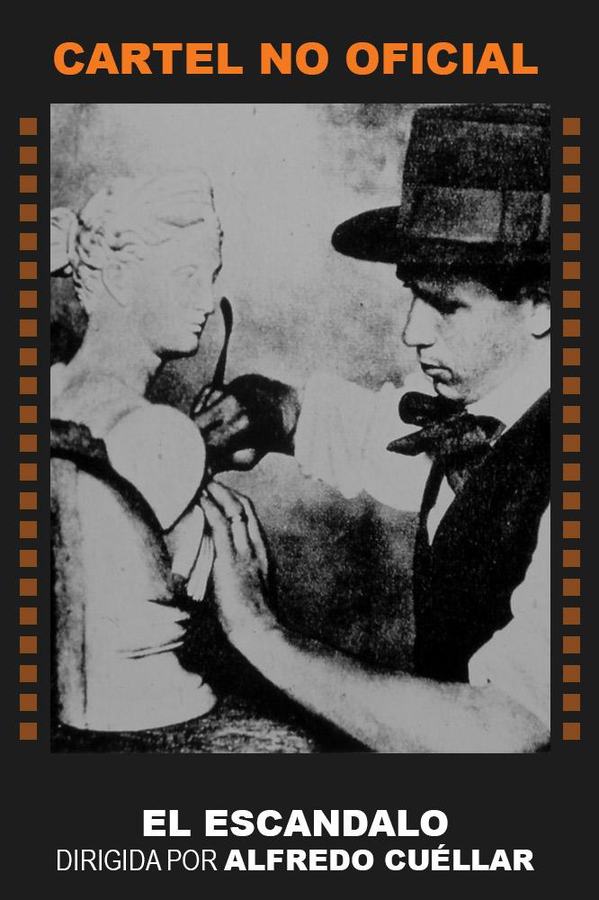
Velvet shadows, poisoned quills, and the soft rustle of taffeta: El escándalo is not merely watched—it is inhaled like opium smoke that refuses to leave the lungs.
There is a moment—roughly at reel four—when the camera glides past a mirror so old its silvering has turned bruise-blue. In that mirror, Emilia Otaza’s face fractures into three versions of itself: the woman she claims to be, the girl she once was, and the corpse she is racing to become. Most silent films ask you to read lips; this one demands you read the backlit terror in a pupil’s dilation. Director Vicente Blanco (a name scrubbed from too many anthologies) understood that the Spanish aristocracy circa 1850 was already a silent movie: everyone performing compliance while rehearsing betrayal in the same breath.
The plot, at first whiff, feels like a rosary of clichés—missing heirs, forged canvases, midnight duels—but Blanco’s alchemy transmutes each bead into mercury. Nothing stays solid; everything slips.
Take the scandal itself: a packet of love letters that may or may not have passed between the Duchess of Mairena and her Moorish guitar instructor. The letters surface not with a bang but with the discreet cough of a butler placing silver salvers too close to the edge of a table. From that cough erupts a chain reaction of bankruptcies, suicides, and one extraordinarily choreographed cathedral fire that rivals the burning of Atlanta for sheer baroque excess—yet done on what had to be the budget of a Valencia carpentry shop.
The cast operates like a string septet in which every instrument is strung with human hair.
Emilia Otaza, all clavicle and hauteur, plays Doña Lucrecia as if she were carved from chilled marble then suddenly injected with hot mercury; watch the tremor in her left pinkie when she pretends to bless a congregation—femininity weaponized into a stiletto. Opposite her, Emilia Ruiz del Castillo’s Beatriz has the eyes of a startled doe but the calculating spine of a chess clock; her fingers on the piano keys spell out a conspiratorial Morse code that only the camera—and we—can hear.
Enrique Tovar Ávalos, equal parts ravaged poet and ledger-book vulture, gives the Count of Alhama the gait of a man who has already sold his shadow and is now haggling over the echo of his footsteps. Meanwhile the Cozzi sisters—Ana and María—twirl through ballrooms like paired gyroscopes, their costumes shifting from virginal white to venom-green between blinks, a chromatic trick achieved by tinting alternate frames manually, creating a strobe of moral contagion that predates Salome’s technicolor debauchery by three full years.
Blanco’s visual lexicon borrows from Spanish costumbrismo but filters it through German Expressionism’s angular nightmare. Note the sequence where a confession is staged inside a bell tower: the bells themselves become negative space, their absence more deafening than any clang. Compare that to the carnival montage in O Que Foi O Carnaval de 1920!—both films turn revelry into a danse macabre, yet Blanco withholds the cathartic release; the confetti here is made of torn legal documents, and every dancer wears the mask of a creditor.
Soundtrack? There never was one. Yet the film hums.
Contemporary exhibitors reportedly commissioned local organists to improvise on 18th-century tonadillas, but surviving playbills advise: “Play con sordino—the silence must sweat.” That instruction nails the picture’s strategy: tension so taught you could pluck it with a tortoiseshell pick.
Where does El escándalo sit in the pantheon? Somewhere between the skeletal eroticism of Das Spiel vom Tode and the social-climbing heartbreak of The Cinderella Man, yet its DNA is more Iberian, more Catholic, more obsessed with the mortification of the flesh. Think of it as the missing link between Goya’s Caprichos and Buñuel’s Viridiana, with a pit stop at Thoughtless Women for lessons in gossip as blood-sport.
Restoration status: 35 mm negative lost in the 1936 Madrid bombings. What survives is a 9.5 mm Pathé-Baby abridgement (18 minutes) and a heavily water-damaged Spanish intertitle list. Even so, the film’s pulse beats—ferocious, feverish, unrepentant.
Scholars who revisited the footage in 2019 discovered that Blanco double-exposed certain frames with microscopic text—phrases from Saint John of the Cross floating like subliminal plankton. Projected at modern 4K, these whispers become legible: “Where there is no love, put love—and you shall draw love out.” A theological Easter egg or a sardonic taunt? The film refuses to arbitrate.
And therein lies its contemporary sting. In an era when every private message can be screen-captured and every JPEG metadata dissected, El escándalo feels prophetic: reputations reduced to calligraphy, shame commodified as currency. Swap the quill for an iPhone and the Duchess for an influencer and you have the same economy of scandal, minus the hoop skirts.
Final take: El escándalo is a cracked reliquary containing the still-beating heart of Spanish melodrama. Approach it not as antique curio but as operating manual for the machinery of disgrace. Watch it—if you can find it—then spend the rest of the night listening for footsteps that arrive half a beat too late. They are yours.
IMDb 4.7
1936
Community
Log in to comment.