DbcultAccessing Vault...
5.6/10
Senior Film Conservator
A definitive 5.6/10 rating for a film that redefined the boundaries of cult cinema. Roughest Africa remains a cornerstone of transgressive art.
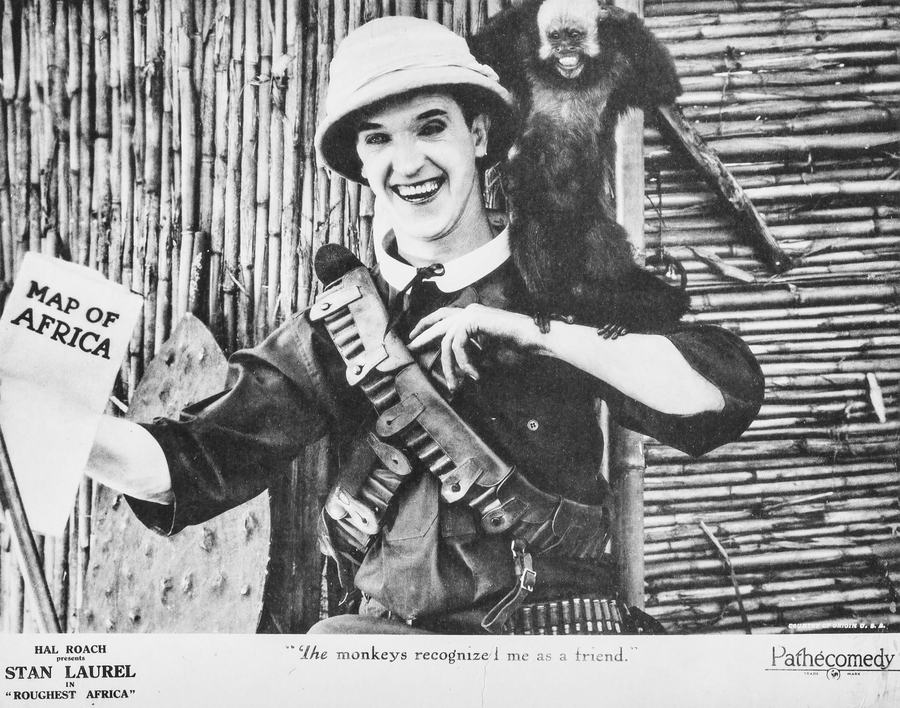
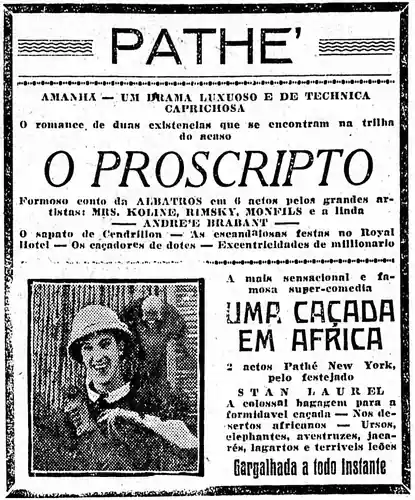
To witness Roughest Africa is to observe a pivotal moment in the metamorphic journey of Arthur Stanley Jefferson. Long before the legendary pairing with Oliver Hardy, Stan Laurel was a nomad of the comedic landscape, honing a persona that was simultaneously fragile and resilient. In this 1923 Hal Roach production, Laurel assumes the mantle of Professor Stanislaus Laurello, a caricature of the intrepid Victorian explorer whose hubris is eclipsed only by his spectacular incompetence. The film operates as a sharp-witted lampoon of the contemporary obsession with safari documentaries—a genre that, much like The Leopard Woman, sought to commodify the 'mysteries' of the African continent for Western consumption.
The aesthetic of the film is built upon a foundation of intentional incongruity. We are presented with an 'Africa' composed of dusty Los Angeles canyons and scrubland, a choice that serves the film’s parodic intent perfectly. By placing these high-strung characters in a landscape that barely conceals its domesticity, the film mocks the manufactured peril inherent in the travelogues of the time. Laurel's physical performance is a masterclass in eccentric motion; his gait is a syncopated shuffle, his reactions delayed by a half-second of bewildered contemplation. It is a proto-surrealist approach to comedy that feels remarkably modern in its self-awareness.
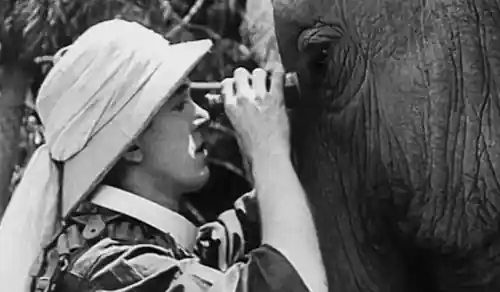
The structural integrity of Roughest Africa relies on the rhythmic interplay between Laurel and the formidable James Finlayson. Finlayson, with his iconic squint and explosive irritability, provides the necessary friction against which Laurel’s airy nonchalance can spark. The film’s sequences are meticulously choreographed vignettes of disaster. Take, for instance, the sequence involving the ostrich—a creature that becomes a feathered symbol of nature’s refusal to cooperate with the cinematic gaze. The chase is not merely a chase; it is a ballet of kinetic frustration, with Laurel’s limbs flailing in a desperate attempt to maintain dignity while being outmaneuvered by a flightless bird.
Contrast this with the more grounded, albeit fantastical, elements found in The Ghost Breaker. While that film uses atmosphere to build tension, Roughest Africa uses the vacuum of atmosphere—the sheer emptiness of the 'safari'—to highlight the absurdity of the characters' actions. The technical proficiency of the Hal Roach studio is evident in the crisp cinematography and the timing of the editing, which ensures that every pratfall and double-take lands with maximum impact. The film understands the primal satisfaction of the 'slow burn,' a technique Finlayson would eventually perfect and pass into the lexicon of comedy history.
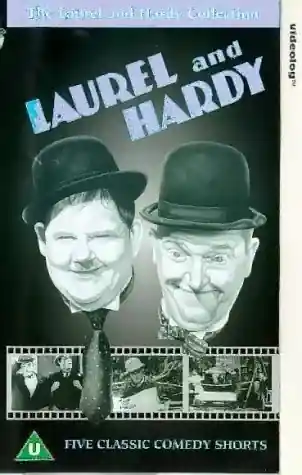
There is a sophisticated derision at play here regarding the 'Great White Hunter' archetype. By reducing the tools of the trade—the rifle, the pith helmet, the camera—to props of failure, the film subtly undermines the colonial narrative of mastery over the wild. Laurello’s camera is a weapon of misdirection; every time he attempts to capture a 'savage' beast, he instead captures his own inadequacy. This meta-cinematic layer adds a depth often missing from the broader slapstick of the era. It shares a spiritual kinship with The Three Must-Get-Theres, which similarly dismantled a high-adventure genre through the lens of the ridiculous.
The portrayal of the 'natives' in the film, while reflective of the unfortunate racial tropes of the 1920s, is framed within a context where the white explorers are the primary targets of ridicule. They are the outsiders, the intruders whose presence is an affront to the logic of the land. Katherine Grant and George Rowe contribute significantly to this ensemble of the inept, creating a group dynamic where no one is the voice of reason. Each character is an island of eccentricity, colliding in a sea of narrative entropy.
The climax of the film involves a lion encounter that serves as a precursor to the surrealist heights Laurel would reach later in his career. The creature, clearly a man in a suit in several shots, juxtaposed with actual stock footage of lions, creates a jarring, dream-like quality. This intentional artifice forces the viewer to engage with the film as a fabrication, a move that predates postmodernism by decades. When Laurel hides in a tree or attempts to pacify the predator with his idiosyncratic logic, we are seeing the birth of the 'Stan' character—the man-child who survives not through strength, but through a fundamental misunderstanding of danger.
In comparing this work to the dramatic weight of something like The Road to the Dawn, one appreciates the levity that Laurel brings to the screen. Comedy, in its purest form, is a rebellion against the gravity of existence. Roughest Africa is a manifesto of that rebellion. It suggests that if we cannot conquer the wild, we can at least make a fool of ourselves trying, and in that failure, find a more honest human connection than any staged documentary could ever provide.
One must not overlook the contribution of the uncredited writers and the direction of James Parrott. The pacing is relentless, yet it allows for moments of quiet, observational humor. The intertitles are punchy, serving as the dry, sarcastic narrator to the visual mayhem. Unlike the sprawling narratives of Don Quixote, which lean into the epic, Roughest Africa finds its power in the miniature—the flick of a finger, the adjustment of a hat, the trembling of a knee. These are the brushstrokes of a comedic artist who understood that the largest laughs often come from the smallest gestures.
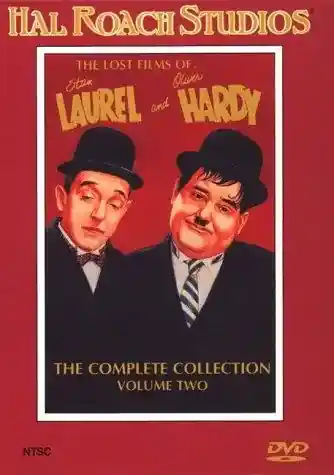
The film also benefits from the ensemble's collective history in the Roach 'lot.' There is a shorthand in the performances, a telepathic understanding of space and timing. James Finlayson’s role as the 'heavy' is crucial; his presence provides the gravitational pull that keeps Laurel’s more ethereal comedy from drifting off into pure abstraction. Their chemistry here is a fascinating blueprint for what would eventually become the most successful comedy duo in history. Even in this early stage, the seeds of the 'Laurel and Hardy' dynamic are visible in the way Laurel interacts with Finlayson’s authoritative bluster.
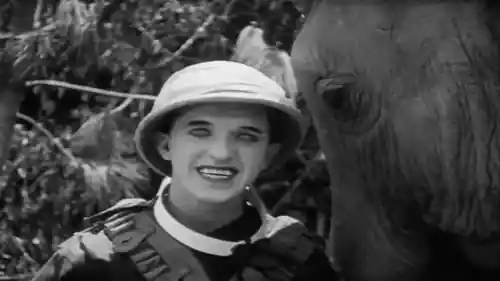
Looking back from a century’s distance, Roughest Africa remains a vital artifact of silent cinema. It captures a world in transition, where the myths of the 19th century were being dismantled by the irreverence of the 20th. It stands alongside other experimental comedies of the time, such as Amatörfilmen, in its willingness to play with the medium's limitations. The film doesn't just ask us to laugh at the explorers; it asks us to laugh at the very idea of the camera as a truth-telling device.
In the grand tapestry of Stan Laurel’s filmography, this short is a vibrant, chaotic thread. It lacks the sentimentality that would sometimes creep into his later work, opting instead for a raw, anarchic energy. It is a reminder that comedy is often most effective when it is most derisive—not out of malice, but out of a desire to see the world as it truly is: a place where ostriches are faster than professors, where lions are men in suits, and where the bravest thing one can do is admit they have no idea what they are doing. For the cinephile, Roughest Africa is an essential expedition into the origins of a genius, a journey well worth taking, even if the destination is nothing more than a dusty backlot in Hollywood.
IMDb 5.3
1925
Community
Log in to comment.