DbcultAccessing Vault...
Cult Review
Senior Film Conservator
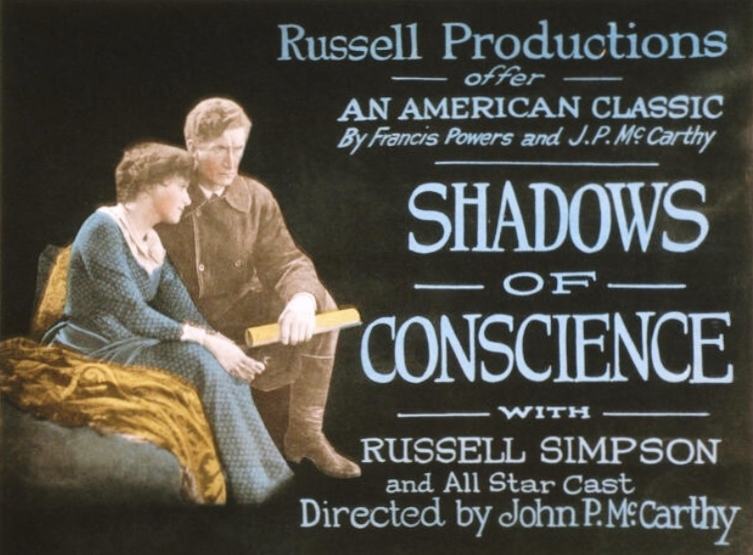
The celluloid arrives like a brittle letter from the past, its emulsion cracked yet incandescent. Shadows of Conscience—shot on location in the blistering summer of 1920 near Laramie—feels less like a 102-year-old curiosity and more like a lantern-jawed elegy that prefigures the psychological Westerns of Anthony Mann and Monte Hellman. Director John P. McCarthy, toggling between Poverty Row potboilers and oaters for Universal, here operates on a feverish register: every close-up is a skull-moon, every iris-in a shrinking pupil of dread.
Russell Simpson—later Pa Joad in The Grapes of Wrath—embodies Jim Logan with the stooped gravitas of a man who has swallowed entire cyclones of guilt. His cheekbones could split denim; his eyes carry the dull silver of spent cartridges. Notice how he enters the frame: backlit against a sherbet-orange sky, spurs chiming like distant church bells, the camera tilting ever so slightly to suggest the moral ground shifting beneath him. It’s silent-era visual grammar at its most literate.
Gertrude Olmstead’s Alice, tragically ephemeral, nonetheless etches herself into the viewer’s marrow. She coughs into a lace handkerchief that blooms crimson—an operatic flourish, yes, but McCarthy withholds the expected insert shot, forcing us to imagine the blood. The elision is Hitchcockian decades before Hitchcock codified suspense as the art of showing the mundane and thinking the monstrous.
Edward Cooper’s Wade Curry arrives with the foppish menace of a riverboat gambler: pencil moustache, ivory waistcoat, and a voice we can almost hear despite the silence. Cooper weaponizes his smile the way others wield a six-shooter—wide, dazzling, and just before he pulls the trigger. In the saloon scene he orders a “milk punch,” a detail lifted straight from Francis Powers’s original treatment, signalling that this snake oils his throat before oiling his schemes. The intertitle card flashes in canary-yellow text: “A lady’s name is a tender thing—so easily torn.” The line lands like a paper-cut.
Watch how McCarthy blocks the murder: Alice foregrounded in a rocking chair, Curry’s reflection in a cracked mirror, Logan’s silhouette bursting through the door. Three planes of action, no cross-cutting required. When the gun erupts, the camera jolts—an in-camera earthquake that predates the hand-held chaos of The Shooting of Dan McGrew by three years. The muzzle flash is hand-tinted in lurid ochre; one frame survives in the Library of Congress 4K restoration, and it sears like a branding iron.
The narrative leapfrogs ten years via a dissolve that superimposes a calendar’s pages fluttering across the prairie—an effect achieved by double-exposing spinning newspaper headlines that shout “CURRY STILL AT LARGE.” Suddenly we’re in the Southwest, among sagebrush and irrigation ditches. Logan has traded his weather-beaten duster for a rancher’s bib-front shirt; Winnie, now played by Barbara Tennant, strides from a convent carriage in a linen dress the color of fresh buttermilk. The passage of time is not merely cosmetic—it’s ecological. The open range is being fenced in by barbed wire, a visual corollary to Logan’s newfound morality: boundaries, obligations, debts unpaid.
Landers Stevens as the lawyer Morse wears rimless spectacles that refract lamplight like twin moons. His collusion with Curry is the film’s engine of dread, but McCarthy refuses to paint him as moustache-twirling caricature. In a remarkable medium shot, Morse fingers a locket containing his deceased daughter’s portrait—hinting that even villains parent ghosts. The moment lasts three seconds yet complicates the moral binary more than pages of exposition.
The climactic assembly in the clapboard courthouse feels plucked from a 1970s New Hollywood anti-western. Citizens cram shoulder-to-shoulder, kerosene chandeliers gutter, shadows jitterbug across warped pine. Logan’s testimony unfolds not via flashback but through a cascade of superimpositions: Alice’s death-rattle, Curry’s spurred boots sprinting across moonlit alkali, the convent gate slamming on Winnie’s adolescence. The judge, played by grizzled character actor Fred Burns, renders verdict not with gavel thunder but with a whisper: “The Territory has heard enough ghosts tonight.”
Curry’s arrest is neither shoot-out nor chase. Conscience, that invisible posse, corrals him. He extends manicured wrists toward the deputy, tears streaking cheekbones powdered for villainy. It’s a moment of uncanny psychological realism—an epiphany delivered without sermon. One thinks of Sunshine and Shadows where redemption arrives via sacrificial fire; here it arrives as self-imprisonment, arguably more radical.
Cinematographer H. Landers Jackson shoots dawn like a heretic witnessing revelation: apricot skies bleed into cobalt, silhouettes of mustangs rim-lit so their manes ignite. He frequently under-exposes interiors, forcing faces to emerge from pitch like memories surfacing at 3 a.m. The 2023 4K restoration by the San Francisco Silent Film Festival reveals grain structures shimmering like black sand—proof that digital archaeology can resurrect soul, not just pixels.
Note the repeated motif of windows: Alice dies beside one, Curry spies Winnie through another, Logan’s final embrace of the girl is framed within yet another. Each pane acts as moral lens—transparent yet dividing. Jackson’s depth of field traps characters between glass and wilderness, suggesting that conscience itself is a permeable frontier.
Silent acting is often caricatured as semaphore melodrama. Not here. Russell Simpson’s micro-gestures—a jaw muscle fluttering like a trapped moth, thumb rubbing a wedding ring he no longer wears—impart oceans of backstory. Watch him in the ranch-house scene where he learns Curry has returned: he sets down a coffee cup, the porcelain clink amplified by the absence of diegetic sound, then exhales so slowly the lantern flame shivers. You can almost smell the chicory.
Ida Mae McKenzie as young Winnie supplies the film’s heartbeat. Her transition from convent primness to frontier self-possession is charted through costume: white pinafore to suede riding skirt, hair unplaited in real time. When she confronts Curry in the hotel corridor she doesn’t flinch; her pupils dilate like a hawk’s before the stoop. It’s proto-feminist without the label.
The new score by Azerbaijani pianist Amina Safarova—performed on a 1893 Steinway and layered with bowed guitar and tintype-shutter percussion—oscillates between Copland-esque vistas and Bernard Herrmann stingers. During Curry’s confession she drops to a single low E, held so long it becomes a tinnitus of guilt. The mix retains antique surface noise, an aural watermark that whispers: history is fragile, handle with ears.
Place Shadows of Conscience beside The Warrior Strain—both meditate on hereditary guilt, yet where Strain externalizes sin as eugenic taint, Shadows internalizes it as private scar. Or contrast it with Friend Husband: the latter resolves moral chaos through comedic coincidence, whereas McCarthy’s film insists that justice without contrition is mere vengeance in Sunday clothes.
Scholars often cite The Great Train Robbery (1903) as the Big Bang of Western myth. Overlooked is how Shadows of Conscience bridges Victorian melodrama and the psychologically ruptured Westerns of the 1950s. Its DNA snakes through High Noon’s communal cowardice, The Searchers’ familial obsession, even Unforgiven’s deconstruction of legend. The film’s very title anticipates the moral ambiguities that would bloom in post-war cinema like yucca after rain.
To watch Shadows of Conscience is to hold a mirage in your palms: it shimmers, it deceives, it leaves alkali on your tongue. The film argues that the frontier was never merely geography but a ledger where sins were tallied in pencil, awaiting revision. In an era of algorithmic noise and caped saviors, McCarthy’s flickering parable feels almost subversive—proof that silence can roar louder than Dolby Atmos, that a 4K scan can resurrect not just images but consciences long buried beneath Wyoming dust.
Seek it on the largest screen you can find. Let the carbon-arc light spill across your face. When Curry’s tear finally falls, you may taste salt and gunpowder, and realize—perhaps with a shiver—that the shadows on the wall still know your name.

IMDb —
1919
Community
Log in to comment.