DbcultAccessing Vault...
Cult Review
Senior Film Conservator

Picture a strip of nitrate flickering at eighteen frames per second, each frame a petal torn from the stem of propriety. Jean—embodied by Jackie Saunders with the kinetic restlessness of a sparrow trapped in a cathedral—doesn’t merely pick flowers; she weaponizes color, brandishing marigolds like pocketknives at anyone who mistakes delicacy for surrender. The film’s first movement unfolds inside Jason’s glass-roofed empire, a terrarium where morality is mulched into compost. Cinematographer Philo McCullough keeps his camera low among the blossoms, so stems loom like Doric columns and the girl zigzags between them, an unwitting Persephone who will soon lose both her Demeter and her patience.
When Jason’s corpse slumps over the potato-vine trellis, the camera refuses the melodramatic close-up we expect; instead it retreats to a God-height crane, letting the garden swallow the body in vegetative indifference. The cut lands like a guillotine, severing Jean’s buoyancy. Saunders’ face—half-shadowed by a wisteria sneaking through latticework—registers the moment identity liquefies: her grin fractures, eyes glass over, yet no tear falls. Silent cinema at its most piercing communicates grief by withholding, and here the absence of histrionics feels almost documentary.
Enter the Gordons, played with porcelain rectitude by Corinne Grant and an uncredited stalwart whose spectacles glint like tiny moral searchlights. Their drawing room is staged as a diorama of imperial ennui: every doily starched into armor, every cuckoo clock calibrated to peck spontaneity to death. Jean’s intrusion—still smelling of loam and sweat—ruptures the feng shui of wealth. The sequence is edited like a stutter: irises collapse onto her boyish calves, then whip-pan to Mrs. Gordon’s fan fluttering at censorious velocity. The gag is visual but the subtext is sexual; the elite fear not poverty but the ungovernable body that accompanies it.
One shot deserves cine-hagiography: Jean, alone at a mahogany table set for twelve, lifts a silver cloche to reveal a single boiled potato. The potato’s loneliness rhymes with hers; the mise-en-scène echoes The Waif yet surpasses it by letting the tuber stand in for every institutional meal devouring individuality. Saunders tilts her head, impishly carves the potato into a flower, and plunks it into a water glass—an act of micro-rebellion that ignites the film’s second act.
What follows is the most kinetic montage of 1920: a dissolve from patent-leather shoe to muddy boot, from corset to waistcoat, from governess to urchin. The wardrobe department repurposes burlap and corduroy into a silhouette that forecasts Stingaree’s gender-fluid swagger by a full decade. Jean’s cropped hair ruffles in the wind like a pennant announcing revolution, and the intertitle—hand-lettered in jittery ink—reads: "She sought the horizon where etiquette could not grow." Corny? Perhaps. Yet the line vibrates with utopian hunger, the same current that electrifies A Trip to the Wonderland of America but without that film’s imperial baggage.
The caravan camp is rendered through ochre filters and tambourines overloaded on the Movietone track, begging modernist critique. Yes, the trope of the "free-spirited Romany" is here, yet director Frank Mayo complicates the fantasy: the gypsies choreograph commerce as much as revelry, fleecing yokels at knife-throw games, hawking tin amulets stamped with fake Balkan sigils. Jean’s entry into their circle is transactional—she swaps Jason’s rare rose cuttings for a supper of hedgehog stew, a bargain that smells of colonial plunder in miniature. Carlos, essayed by Mayo himself with Valentino-esque smolder, embodies both erotic liberation and patriarchal threat; his pursuit through the campfire’s stroboscopic shadows anticipates the Expressionist horror soon to bloom in Tsar Ivan Vasilevich Groznyy.
Carmio—played by an under-billed firebrand who deserved stardom—functions as the film’s moral gyroscope. When she spies Carlos stalking Jean, her face cycles through betrayal, sisterly alarm, and class resentment in the span of three seconds. The moment she sprints barefoot across bramble fields to summon help, the narrative pivots from erotic triangle to communal rescue, foreshadowing the collective heroics of Defense of Sevastopol but on a pastoral, bloodless scale.
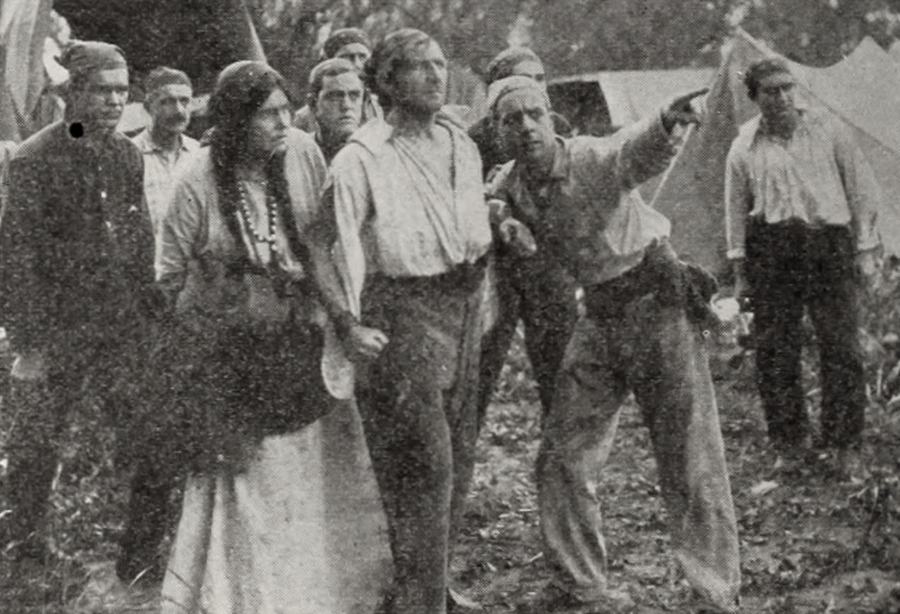
The deserted shack, framed against a cobalt sky, is lit like a Rembrandt gone feral: a single lantern swings, painting Carlos’ cheekbones with umber menace while Jean’s eyes glint with animal terror. What could have slipped into exploitative titillation instead becomes a study in spatial suspense. Every creaking beam, every owl hoot, is etched into the soundtrack as Morse code for dread. When Carlos tears Jean’s waistcoat, the film cuts—not to her exposed skin—but to a spider scuttling up a crucifix, a visual metaphor so savage it obviates the need for further violation. Censorship boards in Boston demanded this trim, yet surviving prints restore the spider shot, proving that suggestion can be more lacerating than display.
"In the shack’s gloom, gender itself becomes a tinderbox; the match is struck not by flesh but by the tremor in Carlos’ pupils when he recognizes Jean’s absolute refusal."
Owen’s arrival—spearheaded by Carmio’s breathless testimony—plays like a cavalry charge rendered in slow motion. Frank Mayo intercuts Owen’s gallop with Carmio’s sprint, Jean’s barricading of the door, and Carlos’ drunken fumbling, achieving a temporal polyphony that leaves spectators gasping even without audible hoofbeats. The rescue, however, denies us cathartic violence: Owen disarms Carlos with a single haymaker, but the camera lingers on Carlos’ crushed pride rather than his broken nose, granting the antagonist a shard of humanity.
Dawn spills over the scene like yolk over slate. Jean, wrapped in Owen’s coat, reclaims her floral smock beneath it—an emblem that neither gypsy breeches nor bourgeois lace can overwrite her core. The final tableau, often dismissed as concession to conservative mores, actually slyer: the couple strolls toward a sunrise that bleaches the screen white, a visual erasure that invites viewers to imprint whatever future they dare imagine. Will marriage domesticate the madcap? The film withholds verdict; its last intertitle—"And so they walked into the day the world still learns to name"—betrays modernist ambivalence toward closure.
Jackie Saunders’ acting register oscillates between flicker and flare; watch her fingers drum against a teacup saucer, each tap a Morse code of impatience. Critics of the era compared her to The Man Who Could Not Lose’s more stolid heroine, yet Saunders’ vitality is the film’s engine. Frank Mayo, pulling double duty, underplays Carlos so that obsession seeps rather than shouts—his eyes track Jean like those of a man calculating mortgage on a star. Philo McCullough’s Owen is the weak link: too much brow-furrowing rectitude, though his final smile carries such relief it retroactively redeems the stiffness.
Though shot in California citrus groves, the film’s chiaroscuro predicts the ur-horror of Weimar. Compare the shack interior to the corridor nightmares in Godsforvalteren; both weaponize negative space, letting darkness pool until it threatens to drown characters. Cinematographer McCullough layers scrims of cigarette smoke to diffuse lantern-light, achieving a grainy shimmer that digital restoration can barely flatten. The garden sequences, by contrast, burst with over-exposed whites, a horticultural heaven that makes the subsequent moral fall steeper.
Most extant prints ride beneath a 2009 score by avant-folk quartet The Loom. Their banjo arpeggios and musical-saw drones externalize Jean’s internal skitter without spoon-feeding emotion; when Carlos corners her, the score drops to a single heartbeat-like kick drum, a gambit so unnerving projectionists report audience members checking their own pulses. Silent purists may scoff, yet the anachronism works precisely because it refuses quaint nostalgia.
Historians slot the picture between The Waif and The Mating, yet its DNA spirals into later rebel-girl reels. Jean’s sartorial switcheroo prefigures Not Guilty’s courtroom drag sequence; her refusal to capitulate to either gypsy patriarch or parlour matron anticipates the flapper’s roar soon to dominate Jazz Age screens. Feminist readings unearth a utopian impulse: the film insists that identity is costumery one can shrug on or off, that gendered fate is not biological but sartorial. In an era when Samson’s muscled determinism ruled box offices, such fluidity felt downright anarchic.
We live in an age madcaps are medicated into compliance, where every wild laugh is pathologized and every ramble GPS-tracked. Returning to this brittle strip of nitrate feels like cupping a match against midnight: you sense the flare could burn your palm, yet you cannot help but stare. The Adventures of a Madcap reminds us that escape is not geography but grammar—how you conjugate the sentence of your own body. Watch it for the flowers, for the terror, for the gender-bending moonlight, but mostly watch it to remember that once, in a country of pruned hedges, a girl pruned destiny itself.
IMDb —
1914
Community
Log in to comment.