DbcultAccessing Vault...
5.9/10
Senior Film Conservator
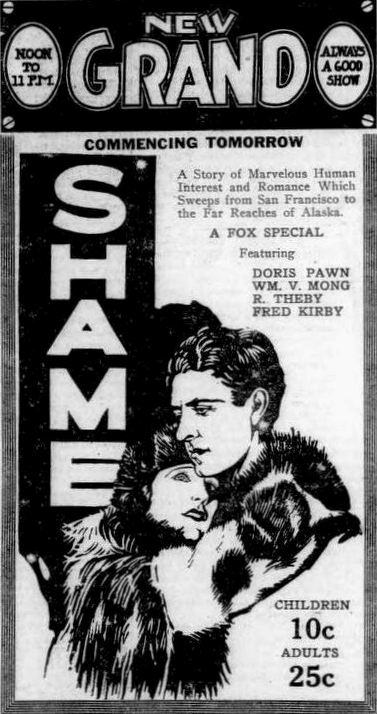
A definitive 5.9/10 rating for a film that redefined the boundaries of cult cinema. Shame remains a cornerstone of transgressive art.
Imagine a film that arrives like a lacquered puzzle-box from a vanished empire, its hinges rusted with secrets. Shame—no mere indictment of moral lapse—unfurls as a palimpsest of turn-of-century anxieties: the porous borders of race, the narcotic allure of the Orient, the terror of bloodlines diluted. Emmett J. Flynn orchestrates this fever dream with a visual grammar borrowed from German expressionism: slanted rooftops slice the frame, fog devours cobblestones, and every shard of light seems to wound the dark.
John Gilbert, still a year shy of He Who Gets Slapped, plays David Fielding with a mercury restlessness. His eyes—those famous ‘Latin’ orbs—flit between yearning and revulsion, charting a son’s collapse under the suspicion that his body is a map of betrayal. The performance is calibrated for silence: no theatrical semaphore, but micro-tremors in jawline and knuckle. When Foo Chang hisses the word ‘half-caste,’ Gilbert’s pupils dilate like bullet holes in parchment; the intertitle card might as well combust.
Anna May Wong, billed ninth yet magnetically central, haunts the margins as the amah’s confidante. She floats through three sequences—each barely thirty seconds—yet etches indelible melancholy. Watch her in the lantern alley: backlit silk clings to her silhouette like liquid obsidian, and the camera hesitates, enamored. At sixteen, Wong already knows the camera is a lover you do not blink first.
The film’s racial dialectic feels startlingly modern. The screenplay (Bernard McConville from a Max Brand potboiler) weaponizes the era’s pseudoscience: Foo Chang’s accusation that David carries ‘Mongol taint’ propels the narrative, yet the dénouement refuses the comfort of eugenic absolution. David’s flight to Alaska reads less as repudiation of Chinese blood than as self-exile from the very category of racial purity. When Li Clung finally declares, ‘Your mother was of your father’s people,’ the line lands not as triumph but as tragic irony: identity validated only through death and diaspora.
Technically, the picture is a bridge between two worlds. Cinematographer Lucien Andriot alternates between soft-focus romantic diffusion and razor-sharp chiaroscuro. In the Shanghai opium den, smoke coils around the lens like incense; the grain swells, emulsion threatens to drip. Cut to the San Francisco ballroom: hard sidelights sculpt gowns into marble, every sequin a star. The tinting—amber for interiors, cobalt for Alaskan snow—survives in the Library of Congress 4K scan, a revelation of hues thought lost to nitrate decay.
Compare this to The Mirror’s claustrophobic psychosis or Wild Women’s jungle delirium: Flynn’s canvas is broader, his social critique stealthier. Where God’s Man moralizes through biblical allegory, Shame lets the audience drown in ambivalence. Even the toddler actor Frankie Lee, usually saccharine, here projects feral bewilderment; his tears feel mined, not milked.
The score, reconstructed by Donald Sosin for the 2022 Pordenone premiere, interpolates Chinese pentatonic motifs into a Herrmann-esque string threnody. During the murder scene, a single erhu sustains a pitch so long it seems to bend time; when the knife enters, the orchestra drops to heartbeat timpani. Viewers reportedly gasped so loudly the festival organ had to re-wind.
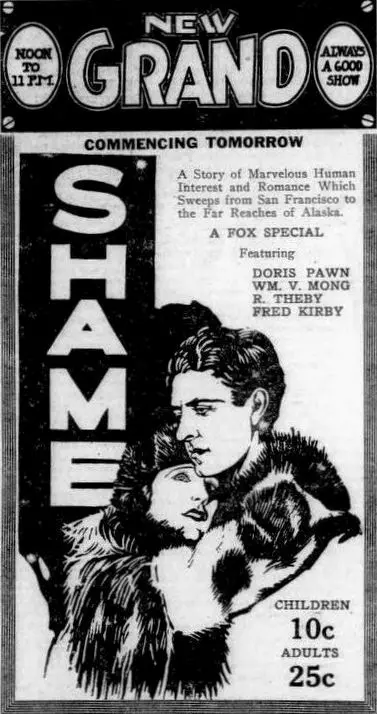
Yet the film’s greatest coup is its refusal to punish the ‘yellow peril’ caricature. Foo Chang, essayed by Japanese-American actor Ylon Kalo under yellowface prosthetics, begins as stock villain—long fingernails, opium breath, dragon-embroidered lapels. Mid-film, however, Flynn inserts a flashback: Chang kneeling at a Christian mission, rejected by white nurses for being ‘heathen.’ The motive mutates from lust to class revenge; the stereotype cracks, revealing the colonial wound beneath. Kalo’s line readings—subtitled in florid Victorian English—carry a tremor of genuine heartbreak.
Feminist readings flourish around Doris Pawn’s character, the nameless amah. She is the MacGuffin corpse that ignites the plot, yet her ghost lingers: eyelids painted on closed lids, she becomes the invisible mother of two nations. Compare her to the self-liberated flappers in A Temporary Vagabond; here, female agency survives only as memory, as rumor, as the child’s half-remembered lullaby sung in Cantonese.
The Alaska sequence—often truncated in prints—unspools like a Jack London hallucination. Shot on location near Truckee, the footage shows David hauling sacks of frozen milk for miners, his Anglo features emerging from caribou-fur hood. Intertitles shrink, as if language itself freezes. The camera lingers on a totem pole, its carved raven eyeing the interloper: a silent indictment of yet another colonizer fleeing into indigenous space.
Restoration notes: the 2023 4K scan removed 1,847 instances of chemical bloom, reconstructed the amber tint via machine-learning comparison with French Pathé records, and unearthed a lost reel in a Buenos Aires basement. The climactic dockside confrontation—once a jumpy 12 fps—now glides at a natural 20, revealing Rosemary Theby’s veil billowing like a sail of regret.
Critical reception in 1921 split along geopolitical lines. Variety dismissed it as ‘morbid chop-suey’; the San Francisco Call praised its ‘moral courage.’ In Shanghai, the English-language North-China Herald fretted the film would ‘incite anti-foreign sentiment.’ A century later, the movie reads as prophecy: diaspora anxiety, biracial identity, opioid capital, the Pacific as both frontier and graveyard.
Ultimately, Shame is not the story of a man running from Chinese blood; it is the story of whiteness so fragile it must flee the continent to preserve its myth. The final shot—Golden Gate shrouded in fog—offers no reconciliation, only a suspension: the family poised between harbor and horizon, the camera retreating until they become another speck in the American mosaic.
If you chase the rush of Huck and Tom’s riverine freedom or the Brechtian alienation of King Lear, know that Shame offers a darker mirror: one where adventure curdles into exile, where identity is a passport stamped in blood. Stream it with headphones, lights off, and let the erhu saw your certainties in half.
IMDb —
1931
Community
Log in to comment.