DbcultAccessing Vault...
Cult Review
Senior Film Conservator
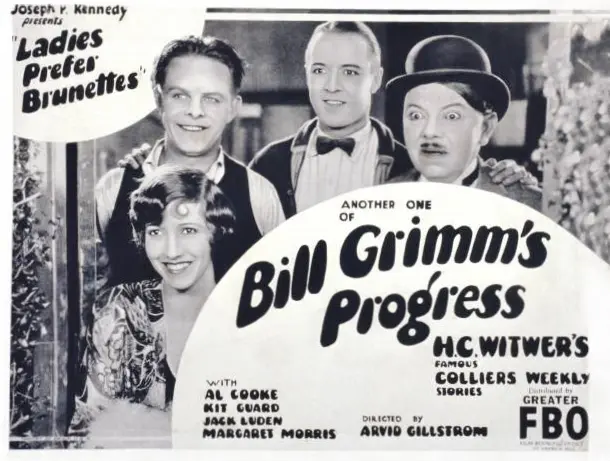
Is 1926’s Ladies Prefer Brunettes worth your time in the modern era? Short answer: only if you are a dedicated historian of the silent gag or a glutton for unrefined slapstick. This isn't a lost masterpiece of high cinema; it is a loud, visual shout from a duo trying to carve out a niche in a world dominated by giants like Keaton and Lloyd. It is for the archival completionist, not the casual viewer seeking a narrative hook.
This film works because of the sheer, unbridled energy of Al Cooke and Kit Guard, whose chemistry feels less like a choreographed dance and more like a controlled car crash. This film fails because it lacks a cohesive internal logic, often abandoning its titular premise to chase the nearest available pratfall. You should watch it if you want to see the 'Wisecrackers' at their most frantic, or if you're interested in how the 1920s parodied its own pop-culture obsessions.
In the mid-1920s, the 'Wisecrackers' series was the bread and butter of independent cinema. Al Cooke and Kit Guard didn't have the budget of the major studios, and it shows in every frame of Ladies Prefer Brunettes. But there is a certain charm in that poverty. While a film like The Speeding Venus might lean into a more polished production value, this short stays in the gutter—and it’s better for it. The gags are fast, dirty, and occasionally repetitive, but they possess a blue-collar grit that is often missing from the more 'prestige' comedies of the era.
Take, for instance, the sequence where Cooke attempts to navigate a crowded social gathering. His movements are jagged and unpredictable. Unlike the fluid, balletic grace of Charlie Chaplin, Cooke moves like a man who has had one too many cups of coffee and is late for a train. It’s stressful to watch, but it’s undeniably human. This isn't 'cinematic journey' material; it’s a snapshot of a working actor throwing his entire body at the screen to get a laugh from a nickelodeon audience.
The title is a clear riff on Anita Loos’ 1925 novel Gentlemen Prefer Blondes. By the time this film hit the screens in 1926, the cultural conversation around hair color and 'female types' was at a fever pitch. However, Ladies Prefer Brunettes doesn't actually have much to say about brunettes. Or blondes. Or women in general. It uses the title as a marketing hook, a way to signal to the audience that they are in for a modern, 'hip' comedy. In reality, it’s the same brand of chaos you’d find in A Looney Honeymoon.
There is a cynical brilliance in this. The filmmakers knew that the audience was hungry for anything that touched on the 'flapper' zeitgeist. By casting Margaret Morris, they secured a leading lady who could actually act, even if the script only required her to look bemused or offended. Morris is the straight woman to a duo of idiots, and her performance is the only thing that keeps the film from spinning off its axis. She brings a level of dignity that the film arguably doesn't deserve.
Technically, the film is a product of its constraints. The cinematography is functional, rarely venturing beyond the standard medium shots of the time. However, there are moments where the camera seems to get caught up in the frenzy. Much like the tension found in Trapped by the Camera, there is a sense that the performers are almost too big for the frame. They spill out of the edges, their limbs flailing into the negative space.
The pacing is where the film truly struggles. It is relentless. In modern cinema, we talk about 'breathing room,' but Ladies Prefer Brunettes doesn't believe in oxygen. It’s a barrage of stimuli. While this works for a ten-minute short, by the end of the film’s runtime, the viewer feels a bit like they’ve been worked over in a boxing ring. It lacks the rhythmic precision of Jazz Monkey, opting instead for a blunt-force approach to humor.
Short answer: Only for silent film enthusiasts. If you are looking for a deep narrative or emotional resonance, look elsewhere. This film is a historical curiosity that captures the manic energy of 1920s independent comedy. It is a fascinating look at how second-tier comedy teams operated during the height of the silent era.
When you compare Ladies Prefer Brunettes to contemporary shorts like Happy Go Luckies, you start to see the 'Wisecrackers' formula more clearly. They were the masters of the 'misunderstanding.' Most of their plots revolve around one character thinking the other is doing something they aren't. It’s a trope as old as time, but Cooke and Guard lean into it with such sincerity that it almost feels fresh. Almost.
The film lacks the surrealist edge of something like The Miracle, but it makes up for it with sheer volume. There is a scene involving a mistaken identity at a front door that is played with such high-pitched intensity that you can almost hear the actors screaming through the silent frames. It’s clunky. It’s loud. It’s effective in a very primitive way.
Pros:
- High energy that never flags.
- Margaret Morris provides a necessary touch of class.
- A fascinating time capsule of 1920s social tropes.
- Short runtime makes it an easy watch for historians.
Cons:
- The humor is dated and often repetitive.
- Low production values compared to major studio releases like The Branded Woman.
- The 'Wisecrackers' dynamic can be grating after fifteen minutes.
Ladies Prefer Brunettes is a messy, frantic, and occasionally exhausting piece of silent cinema. It doesn't have the heart of The Dawn of a Tomorrow or the visual ambition of The Foolish Virgin. It is a commercial product, designed to fill seats and provide a few quick laughs before the main feature started. But there is a honesty in its desperation.
It works. But it’s flawed. If you go in expecting a comedic revelation, you will be disappointed. If you go in expecting to see two men fall over things for twenty minutes while a brunette looks on in horror, you will get exactly what you paid for. It’s a minor footnote in film history, but even footnotes have their place in the grand narrative of the silver screen. It is a loud reminder that even in 1926, cinema was already learning how to clickbait its audience with a catchy title and a promise of scandal that it never intended to deliver.
IMDb —
1926
Community
Log in to comment.