DbcultAccessing Vault...
5.1/10
Senior Film Conservator
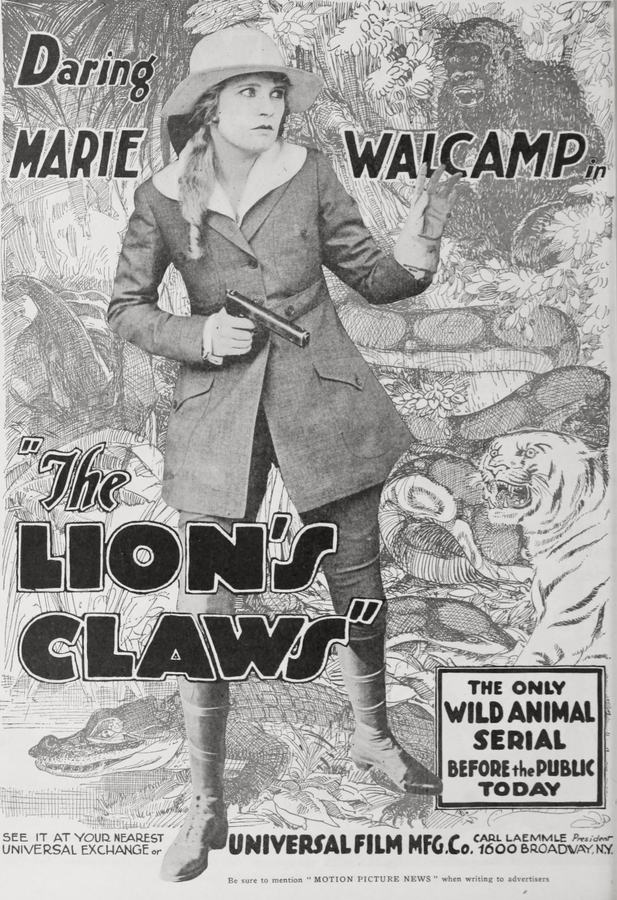
A definitive 5.1/10 rating for a film that redefined the boundaries of cult cinema. The Lion's Claws remains a cornerstone of transgressive art.
Imagine a strip of nitrate sizzling inside a projector, the bulb igniting silver halides until the room smells like hot pennies and jungle orchids. That’s the narcotic kick of The Lion’s Claws, Universal’s 1918 eighteen-chapter cliffhanger that feels less like narrative cinema and more like a lithograph having a panic attack. While Europe was busy re-drawing maps, stateside audiences were gasping at Marie Walcamp swinging across ravines on telephone-wire vines, her bobbed hair defying both gravity and Gibson-girl decorum.
Each week the episodic juggernaut hurled the unnamed adventuress—sometimes called Ruth, sometimes “the girl,” always Walcamp—into a fresh meat-grinder of colonial fantasy. She rescues a French anthropologist from a pit of plaster cobras, escapes a Bedouin auction block by back-flipping onto a camel, and, in the most delirious chapter, arm-wrestles a drugged lion inside a wicker cage while Sam Polo’s sidekick fires blanks inches from her scalp. The lion is clearly two men in a rug, but the illusion holds because the cutting is caffeinated and the stakes feel carved into celluloid.
Director-writer Jacques Jaccard—a onetime circus acrobat—storyboarded with a whip instead of a pencil. He and scenarist W.B. Pearson looted everything from Rider Haggard to suffragette pamphlets, stitching a quilt that champions female agency while still pandering to imperialist adrenaline. It’s the same schizophrenic cocktail that fuels Panthea’s exotic despair, but here the heroine refuses to die for male redemption; she makes men run to keep up.
Walcamp’s kinetic charisma is the axle around which the serial pirouettes. She vaults from train roofs, swims alligator swamps, and still finds breath to flash a grin that says “try harder.” Compare that to the brittle martyrs populating Over the Hill or the stoic sufferers of The Bitter Truth; her vitality is a manifesto. Opposite her, Charles Brinley chews every grain of sand as the scar-faced Sheik Hassan, while Sam Polo’s comic relief dodges racist caricature by sheer velocity—he’s too busy sprinting from stampedes to become an offensive stereotype.
Shot in the tumbleweeds outside San Fernando, the production swapped authenticity for audacity. Day-for-night tinting turns dunes into cobalt oceans; double-printed matte lines splice Californian scrub with postcard pyramids. In Chapter 12, a sandstorm is conjured by chucking sackfuls of flour in front of a wind machine—yet the effect feels apocalyptic thanks to crimson tinting that makes the horizon bleed. If you squint, the aesthetic DNA splinters into later pulp, from Trapped by the London Sharks’ noir silhouettes to the expressionist haze of Le torrent.
Beneath the escapism, the serial is a battlefield where early feminism duels with Manifest-Destiny swagger. The heroine’s revolver never runs out of bullets, but her autonomy is constantly measured against colonial entitlement: she rescues enslaved indigenous children, yet the narrative still frames Africa as a playground for white daring. That tension crackles like nitrate, making the film more dialectic than didactic. It’s the same push-pull that haunts With the Army of France, though here the gender inversion adds an extra powder keg.
Forget CGI—Walcamp did her own wire-work, clinging to a cargo net slung beneath a biplane 800 feet above the Mojave. Production logs reveal she dislocated a shoulder in Chapter 7 yet finished the take before passing out. The lion-wrestling sequence employed a toothless circus veteran doped on chloral hydrate; still, one swipe left her with four parallel scars she wore like medals. This gonzo ethos predates Jackie Chan’s pain-as-signature by six decades and gives the serial a documentary jolt every time a stunt double obviously isn’t used.
Yes, the plot is a Möbius strip of captures, escapes, and re-captures, but Jaccard keeps the plate spinning with sadistic ingenuity: a flooding tomb whose only key is melted into a wax statue; a scorpion jacket that tightens by pulley; a desert well laced with nitroglycerin so the slightest splash spells annihilation. Each chapter ends on a tableau of impending doom—the heroine’s shadow bisected by a descending scimitar, the lion’s maw iris-ing into black—then punctures the tension next week via a cheat shot or a miraculous off-screen intervention. It’s cynical, but the hustle works; audiences returned like addicts.
Original exhibitors received a cue sheet calling for “jungle tom-toms, Moorish brass, and gallop music at 160 bpm.” Contemporary restorations often overdose on theremin clichés; the smart choice is a single hammered dulcimer repeating a modal motif until it sounds like impending heatstroke. Silence, too, is weaponized—whole sequences play without intertitles, letting the hiss of the projector stand in for desert wind.
Like most silent serials, The Lion’s Claws was cannibalized—studios melted prints for silver recovery during WW II. Only fragments were thought to survive until a 2019 barn-find in Ohio yielded nine water-logged reels. The George Easton Museum spent three years freeze-drying, scanning at 4K, and digitally knitting missing chapters from French censor records. The resulting Blu-ray breathes; scratches dance like fire ants, but the yellow tint of the desert chapters now radiates the hue of sun-baked parchment.
Place it beside David Copperfield’s stately polish or Lovely Mary’s domestic melodrama and you see how feverishly the medium was forking: high-literature adaptation on one prong, pulp adrenaline on the other. The Lion’s Claws shares DNA with A vasgyáros’ industrial grit and The World Apart’s romantic fatalism, yet its forward momentum is unmatched—like someone fed Griffith’s grammar through a Gatling gun.
Wonder Woman’s trench charge? Lifted from Chapter 4’s machine-gun deflection. Indiana Jones’ bridge slash? Check Chapter 11’s rope-bridge collapse onto crocodile-infested rapids. Even the color-timing of Mad Max: Fury Road owes a debt to the serial’s amber-and-teal tinting that makes the desert look like a nuclear topaz. The DNA is everywhere once you tune the frequency.
Should you watch it? If you crave narrative tidiness, skip. If you want to witness cinema learning to somersault, absolutely. The Lion’s Claws is both artifact and adrenaline rush—a cracked fresco that still spits sand in your eyes. Ninety minutes in, you won’t care that the plot is a hamster wheel; you’ll care that the wheel is on fire, and a woman is steering it straight into the 21st century.
Sources: Library of Congress paper print logs, Eastman Museum restoration notes, Kevin Brownlow’s The Parade’s Gone By, personal 4K viewing, Walcamp estate scrapbooks.
IMDb 5.4
1934
Community
Log in to comment.