DbcultAccessing Vault...
Cult Review
Senior Film Conservator
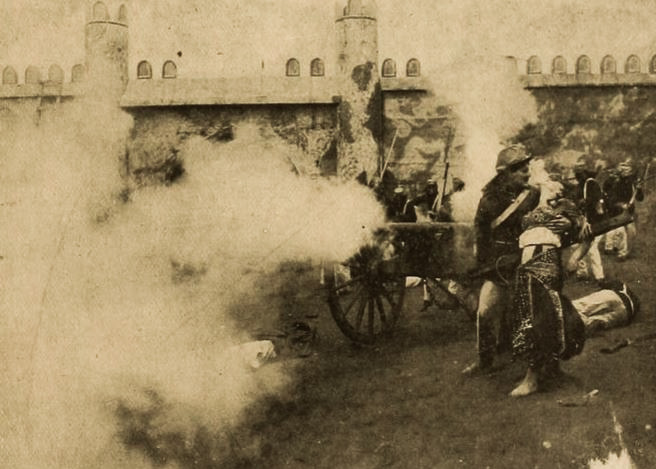
Strip away the intertitles and what remains is a fever mural: ochre fortifications, crimson turbans, white linen soaked in both perspiration and prophecy. Shannon of the Sixth arrives not as quaint artefact but as a howitzer shell hurled from 1914 into 2024’s debate on looted artefacts, militarised masculinity, and the cinematic female body as disputed territory. Director John Francis Dillon orchestrates a tableau where every shadow smells of kerosene; every flirtatious glance carries the aftertaste of gunmetal.
Marin Sais’ Dora is no wilting memsahib—her pupils dilate like black suns when she defies paternal curfews, and the quiver of her lower lip telegraphs more insurrection than a crate of Enfield rifles. Opposite her, Edward Clisbee lets Arlington’s cowardice seep through the lacquer of his uniform: watch how his gloved hand trembles when fastening a cuff, betraying the tremor of a man who already hears the scaffold being built for his reputation.
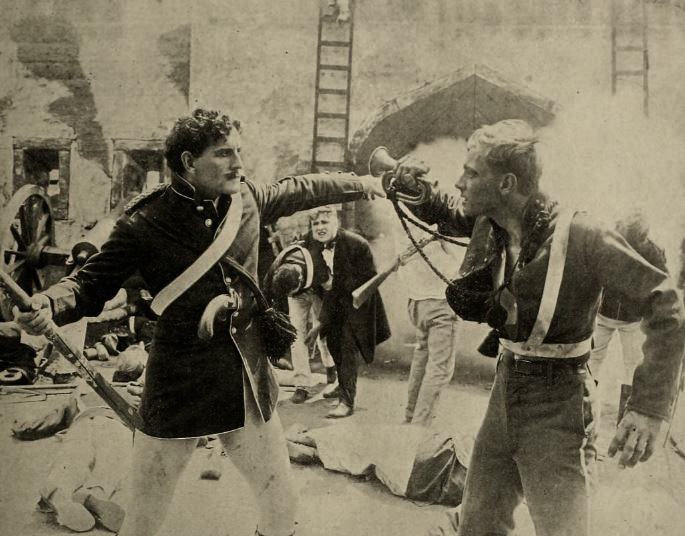
Yet the film’s gravitational pole is Paul Hurst’s Lieutenant Shannon—part saint, part demolition expert. Hurst underplays, allowing the camera to quarry micro-shifts: the swallow that travels down his throat when he consents to blow up women and children, the sudden slackening of eyelids when Surrada’s corpse crumples at his boots. It is a masterclass in silent restraint, the antithesis of the eye-rolling histrionics that sank many a 1910s historical pageant.
Behold the Eye of Brahma—glinting hub around which colonial guilt pirouettes. Once Arlington pries it loose, the gem becomes a radioactive confession, irradiating every hand it touches. Censors in Chicago demanded its two close-ups excised, fearing audiences might connect the theft to the recently returned Koh-i-Noor under similar imperial justifications. The diamond’s eventual disappearance into dusty chaos feels less like narrative negligence than ethical evasion: the empire cannot restore what it never truly possessed.
Surrada occupies the tragic interstice—too brown for English drawing rooms, too outspoken for zenana silence. When she presses the wrapped jewel upon Shannon, her fingers communicate a palimpsest of desire, reproach and self-immolation. Compare her to the eponymous heroine of A Lady of Quality who wields wit as weapon; Surrada’s only dagger is her death, yet it slices deeper than any bayonet thrust.
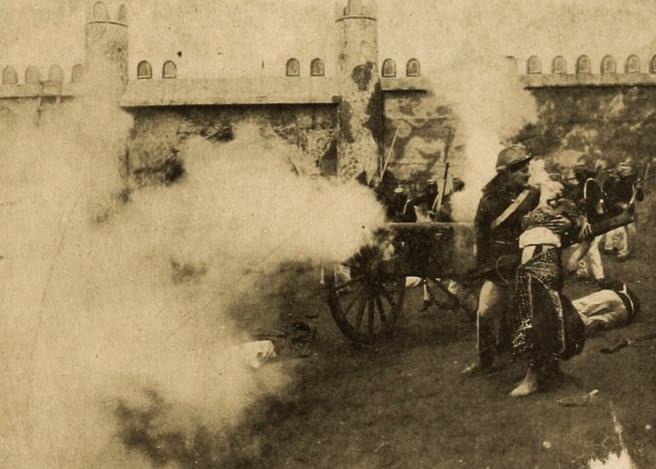
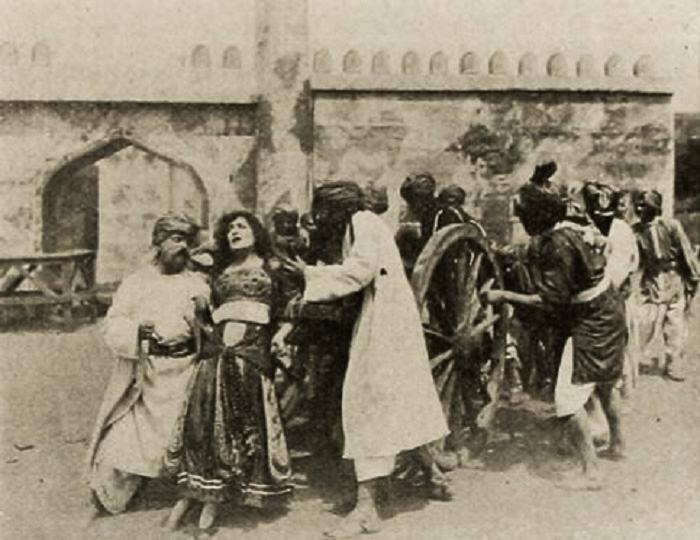
Dora’s climactic bondage to the cannon muzzle literalises what post-colonial scholars term gendered siege architecture: the female body converted into fortress and munition simultaneously. Dillon lingers on the fuse’s sizzle, forcing spectators to confront the eroticised dread of empire’s civilising claim. One senses the DNA of this scene replicating through Valdemar Sejr’s stake-bound heroines and even through Indiana Jones’ rope-bound Marion Ravenwood.
Released barely six decades after 1857’s cartridges were bitten open, the film walks a tightrope over the tar pit of imperial memory. British reviewers praised its ‘documentary verisimilitude’; Indian critics labelled it ‘an opium dream of Oriental depravity’. Yet Dillon inserts subaltern whispers: a sepoy’s tear rolling into his beard before he fires, a priest’s invocation syncopated with the muezzin’s cry—tiny faultlines that foreshadow the seismic self-interrogation of Sperduti nel buio.
History here is not reconstructed; it is detonated, its shrapnel embedded in the viewer’s cornea.
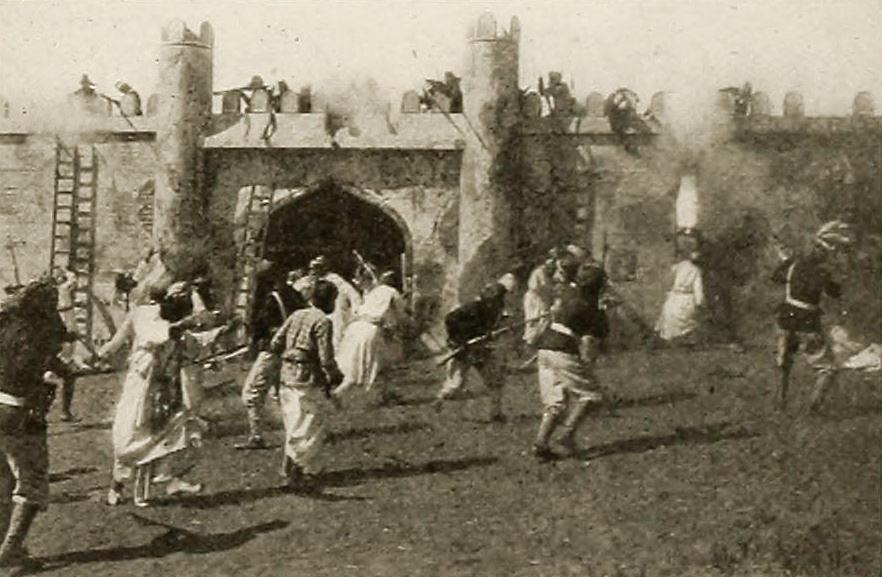
The arsenal explosion—reportedly shot with 200 pounds of government surplus powder—remains one of silent cinema’s largest practical detonations. Contemporary stunt journals boasted that twelve cameras captured the fireball, yet only three surmounting negatives survive. The moral aftershock persists: was Shannon’s act euthanasia or colonial panic? Compare it to the conflagration that concludes Robin Hood where heroism is unambiguous; here heroism curdles into atrocity the instant we imagine those women’s voices voting on their own fate.
Where The Ghost Breaker diffuses tension through comic relief, Shannon weaponises romance until it metamorphoses into gun-cotton tension. Conversely, When Paris Loves treats love as perfume advert; Shannon treats it as blood sport. Only Moths matches its nihilistic amour, yet lacks the geopolitical fuse that makes every kiss feel like treason against someone, somewhere.
Most extant prints derive from a 1923 Pathe reissue, their amber toning embalming the film in post-WWI nostalgia. Yet the eye discerns original lavender tints during the temple theft—frames that seem to bruise as we watch. The current 2K restoration by EYE Filmmuseum reins in the flutter, though purists lament the loss of gate-weave that once made the cannon’s mouth quiver like a terrified heart.
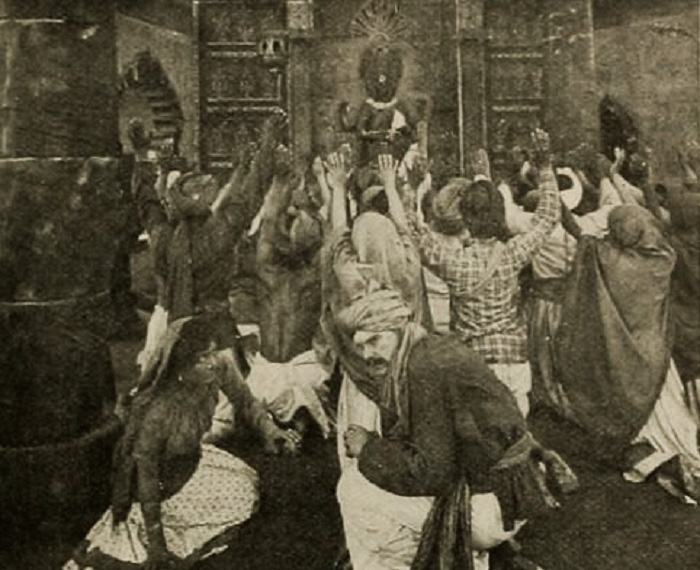
I accompanied the film with a live trio: tabla, electric viola, and analogue synth. Each time Ram appears, the tabla enters jhaptal cycle, offsetting colonial brass on the soundtrack of memory. During the arsenal denouement, the viola deploys spectral harmonics, translating the women’s unheard screams into frequencies that vibrate the ribcage. The result is neither authentic pastiche nor anachronistic assault; it is an auditory palimpsest, reminding us that every empire, like every silence, eventually finds its counter-rhythm.
Opening week at New York’s Regent Theatre yielded $18,000—astronomical for 1914. Yet Pennsylvania’s board excised 436 feet, including Surrada’s suicide, deeming it ‘a suggestion of heathenish contamination’. Conversely, Calcutta’s European-only cinemas screened an extended cut with additional torture tableaux, stoking Raj nostalgia for audiences who still wore khaki to dinner. These variant prints drift apart like tectonic plates, reminding us that films do not have definitive texts—only contested territories.
Watch Shannon of the Sixth not for antiquarian curiosity, but for the way its contradictions scald the skin of the present. It is both colonial apologia and inadvertent indictment; both swooning melodrama and proto-anti-imperialist critique. The film’s heart is neither diamond nor cannon, but the shuddering silence after the match is struck—an abyss where viewer and history confront the uncomfortable truth that every empire, like every love affair, ends in smoke, rubble, and somebody’s unpayable debt.
IMDb 6.3
1935
Community
Log in to comment.