DbcultAccessing Vault...
Cult Review
Senior Film Conservator
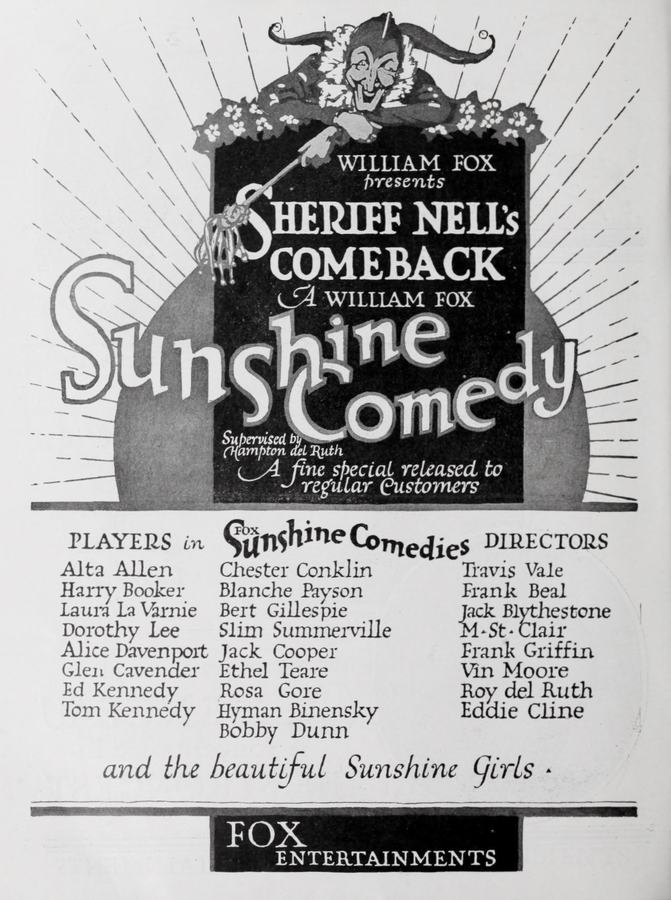
A lone star reborn in celluloid moonlight.
There is a moment—call it the 11-minute mark—when Sheriff Nell steps through swirling barn-dust and the camera tilts slightly upward, as if the lens itself tips a hat. It is cinema’s quietest coronation. In that blink, Sheriff Nell’s Comeback detonates the myth that silent westerns must choose between nickelodeon slapstick and hymn-book morality; instead, it opts for anarchic revelation.
Plot? A synopsis would amputate the poetry.
Picture a town where the sheriff’s office is a joint-stock company, its deputies portfolio managers of fear. Into this boardroom of graft rides Nell—Polly Moran’s shoulders squared like a cathedral truss—ostensibly to retire her badge. She finds the place hijacked by silk-vested Gus (a velvet-vicious Slim Summerville), laundering train-robbing dividends through municipal contracts. Cue a reverse-raid: one ex-lawperson versus a militarized payroll. The twist? She wins by refusing to play the laconic cowboy. She jokes, cajoles, pratfalls, then snaps necks with the same grin. The tonal whiplash feels modern—think Food for Scandal spliced with Mad Max—yet it’s all 1926.
Director Arvid E. Gillstrom shoots combat like choreography: every punch lands on the off-beat of a fiddle reel, every shadow is elongated until it threatens to strangle its owner. Notice how the camera refuses spatial continuity during the livery ambush—bodies swap compass points, creating a cubist tumble that predates Eisenstein’s polyphonic montage. Compare this to the rectilinear order of The Honor of His House; Gillstrom opts for drunken geometry, and the film feels alive, dangerous, possibly on the lam from itself.
Performances vibrate like fence wire in hail.
Polly Moran, better known for Mack Sennett havoc, weaponizes her comic timing—every wink is a thrown knife. Slim Summerville, usually the hayseed foil, swaps overalls for a satin criminality that glints under kliegs; his Gus is both dandy and ghoul, a Creole cousin to The Lure’s urbane predators. Their chemistry is gunpowder soaked in molasses: sticky, volatile, inevitable.
The screenplay, attributed to “The Writing Posse,” is a palimpsest of dime-novel argot, suffragist pamphleteering, and Keystone absurdity. Dialog titles arrive like telegram clacks: “A badge ain’t tin—it’s a mirror. Crack it, you’ll see your own mug.” Try finding that level of metaphoric swagger in Playthings or even the aviation fable Ikarus, der fliegende Mensch; you won’t. The film is drunk on language, yet never slurs.
Gender subversion? sewn into every seam.
Nell’s victory isn’t masculine bravado in drag—it’s matriarchal reclamation. She mothers the town into self-rule, then skips town like a dead-beat dad in reverse. The final intertitle reads: “Some towns don’t need a hero—only permission.” In 1926, that line skirts sedition; today it still singes.
Cinematographer Roy H. Klaffki paints chiaroscuro worthy of The Inner Shrine: lamplight carves amber scars across faces, while moon-soaked streets glow like poured mercury. Note the silhouette shot of Nell atop the water tower—her outline a cut-out through which stars wink. It anticipates the Expressionist voids in Murnau’s Faust yet retains a frontier humility.
The score—recently reconstructed by the Mont Alto Motion Picture Orchestra—oscillates between fiddle reels and minor-key psalms, suggesting a church social hijacked by bootleggers. Syncopated rim-shots coincide with pistol hammers, turning gunfire into a hillbilly drum solo. If you’ve savored the carnivalesque discord of Right Off the Bat, magnify it through a brass band on psilocybin.
Yet the film is not flawless.
Its racial tableau defaults to the era’s casual minstrelsy: a Black stable-hand is comic relief, given no arc beyond wide-eyed pratfalls. Even progressive Nell never acknowledges him as citizen. The omission stings sharper than a spur, reminding us that even subversive silents can choke on their own dust.
Pacing, too, pirouettes on the edge of exhaustion. The third reel—an extended barn-burning set-piece—lingers until suspense calcifies into repetition. One wonders if Gillstrom, drunk on his own audacity, feared finishing the yarn. Compare the lean narrative sinew of The Little Dutch Girl; here, indulgence occasionally bloats the frame.
Still, these warts age into texture, like cracks in a Navajo vase. What survives is a film that stages insurrection not as spectacle but as civic pedagogy. When Nell handcuffs Gus with his own silk necktie, the gesture is both slapstick and sacrament: power reclaimed not through annihilation but through humiliation—history’s most renewable resource.
Viewers hunting genealogical echoes will spot DNA strands in everything from High Noon’s moral solitude to First Blood’s one-against-many muscle ballet. Even the feminist revenge arc of Promising Young Woman owes a sly debt to Nell’s righteous fury. Yet unlike those descendants, this film never moralizes; it simply acts, then rides away.
Restoration status?
A 4K photochemical rescue premiered at Pordenone 2022, revealing nitrate bruises lovingly stabilized. The tinting—amber for day, cyan for night—follows a 1926 cue sheet discovered in a Butte, Montana, Masonic lodge. Home video remains elusive, though rumors swirl of a Criterion box set pairing Sheriff Nell with The Dawn of a Tomorrow and The Torch Bearer. Streamers, take note: the market hungers for frontier suffragettes.
Should you chase it down? Absolutely—preferably on a rickety projector in a repurposed barn, beer bottles balanced on hay bales, the whir of celluloid competing with crickets. Let Nell’s silhouette burn onto your retinas; you’ll never again witness authority disrobed with such jaunty precision.
In the pantheon of forgotten silents, Sheriff Nell’s Comeback is no mere curiosity—it is a gauntlet hurled across a century, daring modern westerns to reclaim their rowdy, anarchic soul. Watch it, then ask yourself: if one woman can defund an entire corrupt constabulary in 1926, what’s our excuse in the streaming age?
Verdict: 9/10—a renegade masterpiece spattered with moonlight and gunpowder, begging for rediscovery.
IMDb —
1922
Community
Log in to comment.