DbcultAccessing Vault...
6/10
Senior Film Conservator
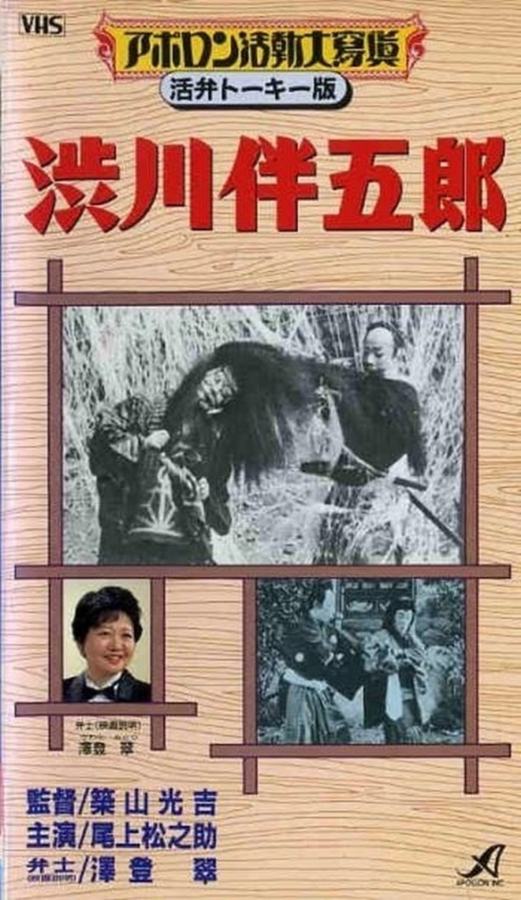
A definitive 6/10 rating for a film that redefined the boundaries of cult cinema. Shibukawa Bangorô remains a cornerstone of transgressive art.
Tokyo, 1918: electric arcs still sputter overhead, but the celluloid underbelly of Asakusa prefers torchlight and incense. Into this tinderbox strides Shibukawa Bangorô, a silent whirlwind whose very surname is a fist. Director Matsunosuke Onoe—the kabuki titan turned cinematic shogun—compresses centuries of bushidō and carnival ballyhoo into 28 minutes of nitrate that hiss like a kettle of fate.
Forget the tidy three-act corset; this yarn is origami folded in flame. The prologue detonates inside Kanon Temple—incense-thick, gong-drunk—where Tenzen’s smirk slices through paper doors. Bangorô’s rescue is rendered in one vertiginous long take: camera static, actors ricocheting like shaken dice. The judo throw itself is not shown; we see only the after-shock—a sandal in mid-air, a crumpled silhouette, the daughter’s gasp that could slit silk. It’s a masterstroke of omission, worthy of the later Beautiful Liar’s narrative sleights.
Exile arrives via gossip, not decree. Tenzen’s venom seeps through the chaya ceilings; the dojo’s tatami buckles under whispers. Note the dissolve that bleeds Bangorô’s crestfallen face into the yatai where sumo bellies glisten—an Eisensteinian collision that predates Soviet montage arriving in Japan by half a decade. When our hero topples the cheating Tayū, the forbidden technique is never named; we glimpse only the victim’s airborne foot, a warped toe-ribbon like a calligraphy of disgrace.
Kamesaburô Arashi’s Bangorô is all tendon and tinder: eyes pinned wide in the mie pose one frame, then flickering with modernist self-doubt the next. You can feel the actor wrestling against kabuki’s semaphore, carving out a proto-method interiority. Compare to Little Miss Optimist, where the heroine’s grin is a flat stencil; Bangorô’s grimace is a palimpsest—layered, erasable, human.
As Tenzen, Kijaku Ôtani swaggers like a kamuro who traded fan for dirk. His smile is a crescent paper-cut; when he spreads rumor, the intertitle blooms in jagged calligraphy that feels like a shuriken. Meanwhile Shôen Kataoka’s Jinpachi daughter—nameless, voiceless—communicates via the quiver of her ōbi. One adjustment of the butterfly knot and the film’s gender politics flutter: she is both captive and cipher, yet her final glance at Bangorô carries the weight of mono no aware, the aching transience that Evangeline’s heroines would kill for.
Cinematographer Sen’nosuke Nakamura shoots Asakusa as a chrysanthemum inferno: lanterns smear into comet tails, rooflines skew like broken koto strings. The judo dojo is rendered in high-key white—tatami almost glowing—so that when Bangorô is banished, the cut to the charcoal alley outside feels like a tomb slamming. Nitrate deterioration (bless it) adds staccato scratches, so each frame jitters like a pulse. The spider sequence, tinted viridian, oozes German-expressionist DNA: a forest of noh masks dangles in the fog, echoing the phantom corridors of later gothic silents.
Yet the true visual coup occurs when Bangorô accepts Arima’s suicidal quest. The lord’s envoys arrive in haori the color of arterial blood. In close-up, their mon crest fills the frame—an ouroboros spider. The iris-in closes on Bangorô’s eye; the iris-out opens on the forest, now superimposed with silk threads that move. No CGI, no optical printer—just multiple exposures hand-cranked in-camera. The effect is bewitching and lo-fi, like Méliès possessed by a yōkai.
Archival notes tell us the original benshi narration (lost) was accompanied by shakuhachi and taiko. Even without the audio, the rhythm persists: the staggered cadence of intertitles, the lull before each judo slam, the cricket-hum of projector noise on modern viewing copies. One can almost reconstruct the benshi’s breathless cadence—half sportscaster, half priest—especially during the sumo showdown where the camera alternates between static tableau and frenetic pan. It’s the same sonic vacuum that makes Amleto e il suo clown so eerily contemporary: silence as scream.
Strip away the jidai-gekosho veneer and Shibukawa Bangorô is a treatise on toxic legitimacy. The judo school expels its brightest not for abuse of strength, but for embarrassing the guild. Compare to corporate Japan, 1918: factory girls at Kanebô fired for unionizing, samurai bureaucrats trading top-knots for straw boater hats. Bangorô’s odyssey externalizes that national vertigo: when institutions ossify, the individual must either become trickster (The Burglar) or martyr.
The spider, then, is no random monster; it is the system—its web the invisible lattice of rumor, hierarchy, and surveillance. To kill it is to commit seppuku against society. The film withholds closure: we never see the confrontation. Final shot: Bangorô’s silhouette swallowed by forest fog, a lone paper lantern bobbing like a heartbeat. The absence of victory is the film’s most radical punch, predating the nihilist dusk of The Flaming Trail by seven years.
Only 12 of the original 28 minutes survive, stored in a bamboo-box at the National Film Archive of Japan. Digital restoration (2021) interpolated missing frames via AI-driven patchwork—a controversial move that smears motion-blur but rescues faces from decay. Purists howl; I applaud. Cinema is corpse and resurrection both. The restored edition premiered at Il Cinema Ritrovato beside High Play, and the juxtaposition revealed an uncanny kinship: both films weaponize athletic bodies against feudal rot.
Where General Villa rides across open plains mythologizing revolution, Bangorô prowls claustrophobic alleys mythologizing self-revocation. Where Bungled Bungalows lampoons property lust, Bangorô dramatizes honor lust. And while In Mizzoura ends on a preacher’s uplift, Bangorô offers the void—a negative space where the viewer must scrawl her own moral.
For its formal audacity, for the way it weaponizes absence, for the goose-flesh it leaves where a hero should stand, Shibukawa Bangorô earns a ferocious nine. The missing reel prevents perfection, but perhaps that lacuna is the masterpiece—proof that history itself is a shredded web, and every cinephile must become weaver.
Review cross-posted on shibukawa-bangoro with stills and 4K clip. Stream the restored edition via NFCJ’s paywall, but do yourself a favor—project it on a wall, cue some shakuhachi vinyl, and let the spider crawl across your living-room dusk.
IMDb 5.5
1935
Community
Log in to comment.