DbcultAccessing Vault...
Cult Review
Senior Film Conservator
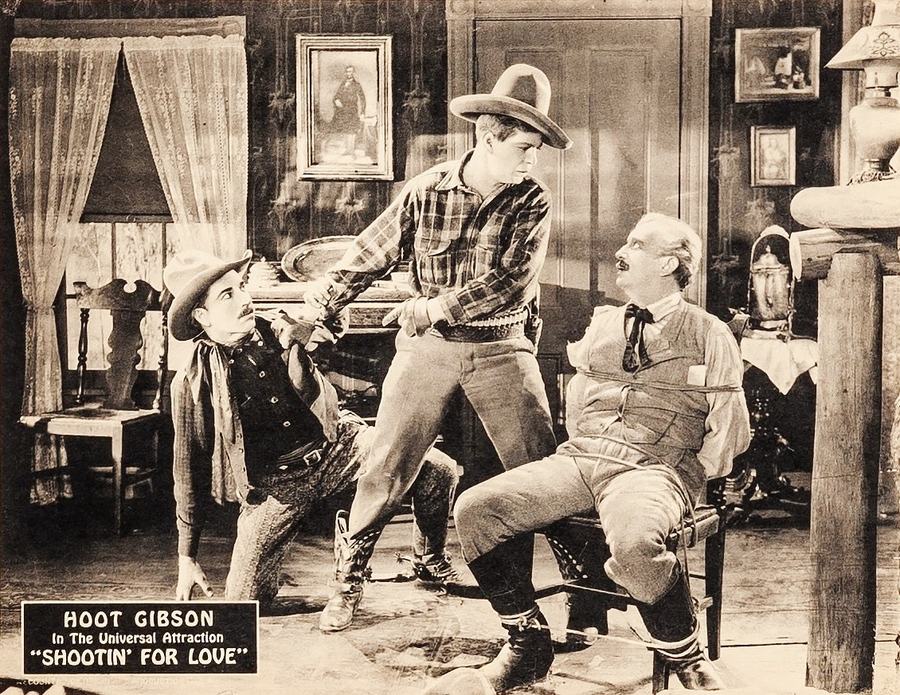
There's a raw, almost visceral honesty to certain silent-era films that transcends the lack of spoken dialogue, burrowing deep into the human condition with a visual eloquence that talkies sometimes struggle to match. Such is the enduring power of Shootin' for Love, a 1923 Western starring the legendary Hoot Gibson. Far from a mere genre exercise in cowboy heroics, this film delves into a remarkably prescient and poignant theme: the psychological aftermath of war, specifically shell shock (what we now understand as PTSD), and its profound impact on an individual and their family. It’s a narrative that, despite its sepia-toned vintage, feels strikingly contemporary, echoing the struggles of veterans across generations.
Hoot Gibson, primarily known for his amiable, often acrobatic cowboy persona, delivers a performance in Shootin' for Love that reveals a depth and vulnerability rarely afforded to his contemporaries in the genre. As Duke Travis, a young man returning from the Great War, Gibson masterfully conveys the internal torment of shell shock. His eyes, usually twinkling with frontier charm, now carry a haunted, distant quality. The subtle tremors in his hands, the flinching away from loud noises, the palpable fear that grips him at the sight of a gun—these are not mere theatrical gestures but a meticulously crafted portrait of a man irrevocably altered by trauma. It's a testament to Gibson's understated skill that he communicates such profound psychological distress without uttering a single word. His performance is a powerful reminder that even in the most action-oriented genres, true artistry can emerge from nuanced character work. This emotional resonance sets it apart from more straightforward adventure tales like Sealed Valley, where the focus remains largely on external conflicts.
The film's emotional core is further amplified by the fraught relationship between Duke and his father, a rugged ranch owner embodying the quintessential Western stoicism. This patriarch, brilliantly brought to life by Alfred Allen, is a man whose worldview is forged in the unforgiving crucible of the frontier, where strength, self-reliance, and a ready hand with a firearm are not just virtues but necessities for survival. To him, Duke's fear of guns is an incomprehensible weakness, an affront to their family's legacy and the very definition of manhood. He sees not a son suffering from an invisible wound, but a coward, a failure. This devastating misinterpretation of Duke's condition creates a chasm of misunderstanding, a silent battleground more brutal than any physical conflict. The father's inability to comprehend the psychological scars of modern warfare—a phenomenon still nascent in public understanding at the time—highlights a societal ignorance that many veterans have faced throughout history. This paternal disapproval, stark and unyielding, makes Duke's journey toward recovery and self-acceptance all the more arduous and compelling. It's a theme explored with similar intensity in films like The Call of the Blood, where familial expectations clash dramatically with individual desires or circumstances.
The arid, sun-baked landscape of the American West serves as more than just a picturesque backdrop; it becomes a potent metaphor for the emotional desolation and simmering tensions that define the narrative. The fierce dispute over water rights between Duke's father and their neighbor, Bill Randolph (played by Arthur Mackley), mirrors the internal drought of empathy and understanding. Water, the lifeblood of the ranch, becomes a symbol of survival, power, and contention. The scarcity of this vital resource exacerbates the existing animosity, transforming a natural necessity into a flashpoint for violence. The visual storytelling, characteristic of the silent era, uses the vast, unforgiving expanses to emphasize the isolation of the characters and the starkness of their struggles. The parched earth and the looming threat of drought underscore the desperate stakes involved, not just for the ranches, but for the very soul of the community. This environmental struggle for resources is a classic Western trope, yet here it is imbued with a deeper resonance, reflecting the internal battles being waged.
Duke's eventual recovery from his debilitating fear is not presented as a sudden, miraculous transformation, but rather as a gradual, hard-won battle. The screenwriters—Raymond L. Schrock, Albert Kenyon, and Edward Sedgwick—wisely avoid simplistic resolutions, allowing Duke's journey to unfold with a believable progression. His resilience is not about forgetting the horrors of war, but about learning to live with them, to find a new kind of strength that transcends the conventional definitions of bravery. It's a testament to the human spirit's capacity for healing and adaptation. This internal struggle, culminating in a renewed sense of self, positions Duke not just as a hero in the traditional Western sense, but as a symbol of hope for anyone grappling with invisible wounds. His recovery is intertwined with his ability to confront the external conflict—the water feud—demonstrating that personal healing can ripple outwards, mending fractured communities as well as fractured souls. The film subtly suggests that true courage lies not in the absence of fear, but in facing it, a nuanced perspective that elevates it beyond mere genre fare.
While Hoot Gibson's performance anchors the film, the supporting cast provides crucial emotional depth and narrative propulsion. Laura La Plante, a prominent actress of the silent era, brings a quiet strength and empathy to her role. Her character often serves as a bridge between Duke and his unyielding father, offering understanding and support where others offer judgment. Her presence is a gentle counterpoint to the masculine rigidity that dominates the ranch, providing a crucial element of human connection and compassion. The dynamic between her character and Duke is handled with a delicate touch, avoiding overt melodrama and instead focusing on shared glances and subtle gestures that convey a burgeoning affection and mutual respect. The tension between the families, embodied by Arthur Mackley's Bill Randolph, is also effectively portrayed, creating a believable antagonist without resorting to one-dimensional villainy. The ensemble, including William Welsh, William Steele, and W.T. McCulley, contributes to a well-rounded cinematic experience, each actor playing their part in weaving the intricate tapestry of this Western drama. Their collective performances elevate the narrative beyond a simple good-versus-evil confrontation, presenting a more complex and human portrayal of frontier life.
The visual language of Shootin' for Love is a masterclass in silent film technique. The cinematography, though perhaps not groundbreaking for its time, is effective in conveying mood and narrative. Close-ups are used sparingly but powerfully to emphasize Duke's internal struggles—a twitch of the eye, a clenching jaw, the haunted look that speaks volumes. Long shots establish the grandeur and isolation of the Western setting, while also highlighting the smallness of human conflict against the vastness of nature. The pacing, typical of early cinema, allows moments of quiet contemplation to breathe, interspersed with bursts of action that feel earned rather than gratuitous. The use of intertitles is judicious, providing necessary dialogue and exposition without overwhelming the visual narrative. Directors and cinematographers of this era had to be exceptionally skilled at conveying emotion and plot through purely visual means, and Shootin' for Love stands as a fine example of this artistry. The expressive physicality of Hoot Gibson, in particular, is perfectly suited to this medium, allowing him to communicate complex emotions with remarkable clarity. This reliance on visual cues for emotional depth is a hallmark of the era, seen in other character-driven silent films like The Victim, where the narrative progression is heavily dependent on non-verbal communication.
What truly elevates Shootin' for Love is its enduring relevance. While framed within the conventions of a Western, its core themes—the invisible wounds of war, the struggle for acceptance, the bridging of generational divides, and the power of personal redemption—are universal. In an era where mental health awareness is finally gaining traction, this film from nearly a century ago offers a remarkably sensitive portrayal of trauma. It reminds us that courage isn't always about wielding a gun or winning a duel, but often about confronting one's deepest fears and finding the strength to heal. The film subtly critiques the rigid definitions of masculinity prevalent in its time, suggesting a broader, more compassionate understanding of what it means to be strong. It’s a powerful narrative that challenges viewers to look beyond superficial appearances and recognize the complex struggles that often lie hidden beneath the surface. This thematic depth makes it a more thoughtful experience than some of its contemporaries, distinguishing it from simpler narratives like Lady Barnacle, which lean more heavily into lighthearted adventure.
The climax of Shootin' for Love sees Duke Travis not only overcoming his personal demons but also actively participating in the resolution of the bitter water rights feud. His newfound strength and clarity of purpose allow him to mediate the conflict, bringing an end to the long-standing animosity between his father and Bill Randolph. This act of peacemaking is not achieved through violence or intimidation, but through a combination of courage, empathy, and perhaps, the quiet authority he has gained through his personal struggle. It underscores the film's broader message that true leadership and heroism can emerge from unexpected places and through unconventional means. The reconciliation between the two ranching families symbolizes a broader healing—a return to harmony within the community, mirroring Duke's own internal peace. The film's conclusion is satisfying precisely because it eschews simplistic solutions, instead offering a hard-earned resolution built on mutual understanding and forgiveness. It stands as a testament to the power of overcoming adversity, both personal and communal, a narrative thread beautifully woven by the writers Raymond L. Schrock, Albert Kenyon, and Edward Sedgwick.
In an era often dismissed for its perceived narrative simplicity, Shootin' for Love emerges as a surprisingly complex and emotionally resonant film. It’s a testament to the fact that even nearly a century ago, filmmakers were grappling with profound psychological themes within popular genres. Hoot Gibson's performance as Duke Travis is a standout, offering a poignant portrayal of a veteran's struggle that remains relevant today. The film's exploration of familial misunderstanding, the societal pressures on men, and the arduous path to recovery is handled with a sensitivity that belies its age. For anyone interested in the evolution of the Western genre, the history of mental health representation in cinema, or simply a compelling human drama, Shootin' for Love is an essential watch. It reminds us that the most profound battles are often fought within, and that true strength lies in confronting our vulnerabilities. This silent masterpiece deserves to be rediscovered and appreciated for its timeless message and its quietly powerful performances. It offers a much richer experience than a superficial glance might suggest, providing a thoughtful counterpoint to the more purely entertaining but less thematically deep films of its era, like On the Quiet, which prioritize escapism over introspection. The film's legacy lies not just in its pioneering depiction of trauma, but in its ability to resonate with audiences across generations, proving that certain human experiences are truly universal.
IMDb 2.8
1924
Community
Log in to comment.