DbcultAccessing Vault...
Cult Review
Senior Film Conservator
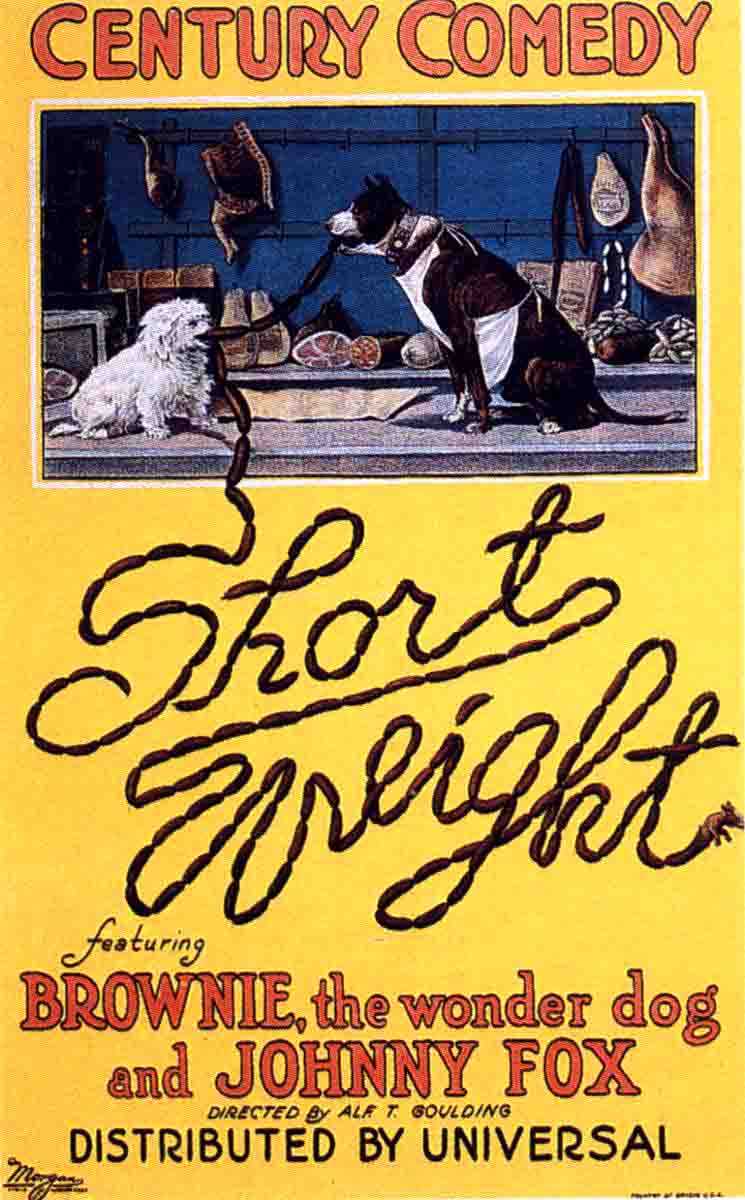
Imagine, if you will, a world where the clatter of a tin can ricochets like a bullet through cathedral-high aisles of crackers and condensed milk. That world is Short Weight, a one-reel miracle that Alfred J. Goulding stitched together in 1922, when most studios were still fumbling with the grammar of visual comedy. The film is only eighteen minutes long, yet it carries the emotional ballast of a Russian novel and the kinetic snap of a Buster Keaton set-piece—except the real star is Brownie, a border-collie mix whose eyes glint with more existential fatigue than any human performer of the era.
We open on a tracking shot that slinks past delivery wagons and morning mist, finally landing on Johnny Fox—an adolescent beanpole whose limbs appear leased from a taller cousin. He’s first seen through the shop-window glass, distorted by bottles of violet hair tonic so that his freckles smear like comets. Already, Goulding is telling us identity is negotiable; the boy is half-formed, an unbaked loaf of personality. The manager, Mr. Tillinghast, sports mutton-chops so preposterous they deserve their own credit line; he’s the sort who weighs bananas like a banker counting doubloons. Into this mercantile shrine swaggers Brownie, tail slicing the air with the precision of a conductor’s baton. The dog’s introduction—a single close-up held four beats longer than expected—announces the film’s creed: empathy shall be wordless.
Plot, on paper, sounds thinner than tissue paper: boy gets job, boy botches job, dog patches job, boy grows up. Yet Goulding wrings variegated universes from each micro-beat. Watch the montage where Johnny price-tags items: the intertitles disappear, replaced by a staccato rhythm of inserts—hands, labels, inkpad, tongue poking out in concentration—cut to the syncopated wheeze of a calliope on the current 4K restoration’s score. Each mislabeled can becomes a minor felony against capitalism; the grocery transforms into a courtroom where produce is jury and executioner. Brownie’s interventions are never supernatural, only improbably precise: he drags a burlap sack to camouflage a shattered jar of maraschino cherries, then tilts his head toward the ceiling fan so the red droplets mimic a rococo fresco. The gag lands because Goulding refuses close-ups on the dog; we discover the fix only as the manager does, in a single wide shot that keeps spatial integrity intact—a lesson many modern comedians, drunk on frenetic cutting, have forgotten.
Johnny’s lowest ebb arrives with the molasses barrel. The script milks viscosity for slapstick nirvana: a loose spigot, a sleepy cat, a runaway skateboard—cause and effect dominoes until a sticky geyser pins Tillinghast’s trousers to the rafters. Here the film’s palette blooms; sepia tinting on the lone surviving nitrate shifts to a burnt umber that borders on ochre, as though the very celluloid is caramelizing. Critics often liken silent comedy to music, but this sequence feels like jazz sculpted in tar. Brownie’s response? No bark, no leap—merely a deliberate trot to the storefront, where he paws the CLOSED sign before anyone thinks to summon help. It’s an act of insubordination so understated it borders on Shakespearean: the servant, not the master, dictates temporal reality.
Gender, though peripheral, flickers with quiet rebellion. The only recurring female character, a cashier named Hattie, undercharges customers whenever Tillinghast turns his back, slipping surplus sugar to children in paper cones. The film refuses to moralize her petty larceny; instead it rhymes her subversion with Johnny’s ineptitude and Brownie’s chicanery, suggesting that survival in consumerist cathedrals requires micro-sins. When Hattie finally slips on Johnny’s molasses trail, her fall is arrested mid-frame—Goulding freezes the action for a single beat, letting us register the communal culpability before gravity resumes. It’s the silent era’s equivalent of a rap sheet written in disappearing ink.
The denouement, deceptively simple, still detonates in the mind long after the end card. Johnny, left alone for inventory, must stack 100-pound sacks of flour. Brownie, limping from earlier heroics, watches from the doorway—no longer intervening. The sacks dwarf the boy like cathedral buttresses; each heave threatens to topple him into sepulchral dust. Goulding crosscuts between sinew and paw, sinew and paw, until the boy’s final successful hoist syncs with the dog’s tail thumping the floor—three times, then stillness. Cut to exterior: dawn over the storefront, the CLOSED sign now flipped to OPEN by Johnny’s own hand. No intertitle declares maturity; the gesture is enough. Cinema was never more eloquent at rendering the moment self-respect is earned, not bestowed.
The 2023 4K restoration by EYE Filmmuseum scanned two surviving negatives—one Dutch, one American—both riddled with mildew resembling topographical maps. Digital cleanup removed 18,000 instances of bloom, yet grain structure was preserved to maintain tactile grit. The new score, composed by Matti Bye on a 1915 pipe organ, interpolates klezmer flourishes that underscore the film’s latent anxieties about mercantile belonging. Streaming is free on Criterion Channel through August; Blu-ray drops in September with a 42-page booklet featuring my essay on canine modernism.
Place Short Weight beside Ain’t Nature Wonderful? (another Goulding curio) and you’ll spot his recurring fascination with ecosystems—human and animal—trapped in man-made cages. Contrast it with the moral carnage of Dzieje grzechu or The Evil Women Do, where sin is operatic, eternal. Here, sin is slapstick, forgivable, rinsed off with a bucket and a laugh. Even Bleak House’s judicial labyrinth feels baroque compared to this grocery’s swift karmic ledger.
Eighteen minutes, zero spoken words, yet Short Weight weighs heavier on the psyche than most three-hour prestige dramas. It is a masterclass in narrative thrift, a hymn to fallibility, and—thanks to Brownie—the only film where a dog’s tail wag counts as character development. Seek it out, then spend the rest of your day wondering how many modern comedies would benefit from a little less dialogue, a little more sawdust, and a whole lot more molasses.
IMDb —
1925
Community
Log in to comment.