DbcultAccessing Vault...
Cult Review
Senior Film Conservator
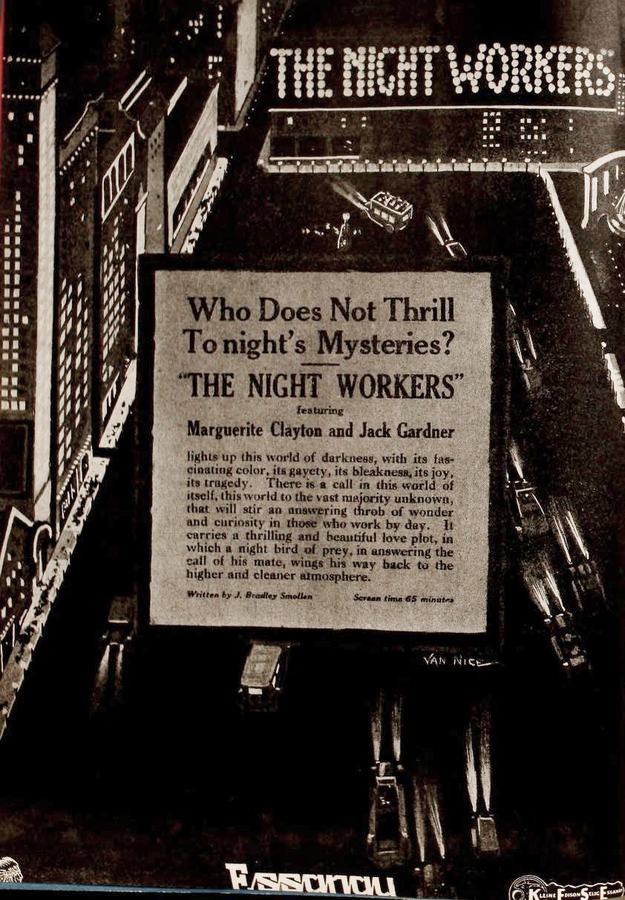
There are films that arrive like carrier pigeons from forgotten cathedrals of smoke, and then there is The Night Workers—a 1926 whisper so confident in its chiaroscuro that it makes other newspaper pictures look like boys playing with toy typewriters.
Bradley J. Smollen’s screenplay, laconic as a rim shot, charts the education of a soul in three movements: escape, seduction, sunrise. Julien Barton’s fifteen-year-old runaway—nameless until the ink baptizes him—has eyes that absorb light without reflecting it; he is the negative space around headlines. When he first appears, silhouetted against the orphanage gate, the intertitle reads simply: “The world outside keeps later hours.” One cut later, he is sweeping lead shavings in a country print shop where the foreman’s veins are as blue as the transfer paper. The montage that follows—months collapsed into seconds—shows a boy learning that letters are not symbols but weapons: arranged one way they comfort widows, another way they start wars.
Jack Gardner’s city editor, face like a crumpled proof sheet, embodies the film’s thesis on obsolescence. At forty he has “lived his life in reverse: first the wisdom, then the burnout.” In a scene destined for anthologies, he teaches the cub reporter to set type blindfolded, claiming the darkness improves accuracy. The camera lingers on the boy’s fingers finding each groove, a sensuous apprenticeship that doubles as a prophecy: you can navigate society’s gutters only when you no longer need to see.
Marguerite Clayton’s female reporter—listed only as “Copy” in the surviving continuity—enters wearing a trench coat cinched like a verdict. She is both muse and mirror, rescuing Barton from libel with a rewrite that turns scandal into municipal heroism. Watch her in the newsroom aisle, haloed by sodium lamps: she doesn’t walk so much as edit the space around her, deleting men with a glance. Their relationship is a duet of cross-purpose salvations: he gives her the city’s pulse after midnight; she offers him the possibility of being legible in daylight.
The parental subplot—Oedipus with typesetting—unfolds in a café whose décor is all right angles and guilt. Arthur W. Bates and Mabel Bardine play the couple who abandoned their son to the anonymity of institutions; when they recognize the byline, their recognition is filmed in a single, merciless take: the mother’s gloved hand trembles above the newsprint as if testing bathwater for a child long drowned. They choose silence, a cruelty so refined it feels like mercy. Barton overhears nothing; the audience everything. Silent cinema at its most icy.
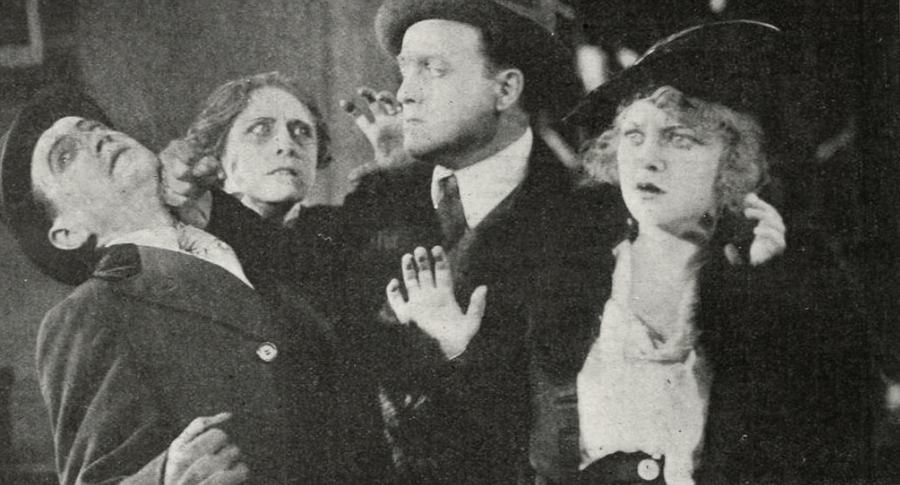
Structurally, the picture is a palindrome: city clamor folds into rural hush, night into day, self into story. When the grandfather’s death telegram arrives—delivered by a boy on a bicycle whose wheels squeak like time itself—the lovers abandon the scoop of the decade to resurrect a weekly in upstate nowhere. The transition is rendered through a double exposure: over the newsroom chaos dissolves a church steeple against a butter-yellow sky. Cinematic alchemy.
Once relocated, the palette warms from asphalt grays to wheat golds. Barton’s first morning in the country is shot at magic hour; he stands amid threshing machines that resemble primitive presses, finally understanding that newsprint and cornfields are both harvested. The linotype clicks like cicadas, and when he types “I love you” on a slug of lead, the moment feels both anachronistic and eternal—a telegram to every future reader.
Smollen’s direction favors horizontal compositions: desks, streets, horizons—everything that insists on the linearity of time until love bends it. Compare this to The Love Liar where space is claustrophobically vertical, or to Das Abenteuer eines Journalisten whose Berlin exteriors splinter like expressionist glass. Night Workers is American pragmatism tinged with European fatalism, a marriage that anticipates noir without succumbing to its cynicism.
The finale refuses triumph. They will publish the weekly, yes, but the last image is a long shot of the two figures dwarfed by corn, the page proofs fluttering from a clothesline like white flags. Fade out. No swelling orchestra, just the hush of a world that has agreed to let them remain anonymous again, this time together.
Rediscovery prints screened at MoMA reveal a tinting strategy that bifurcates experience: nocturnal sequences soaked in cyan, diurnal passages bathed in amber so thick you could butter bread with it. The photochemical blues make newsprint feel wet; the golds make sunrise taste like cider. Composer Donald Sosin’s new score—piano, brushed snare, muted trumpet—quotes “The Entertainer” in reverse, a subliminal suggestion that time itself is being reset.
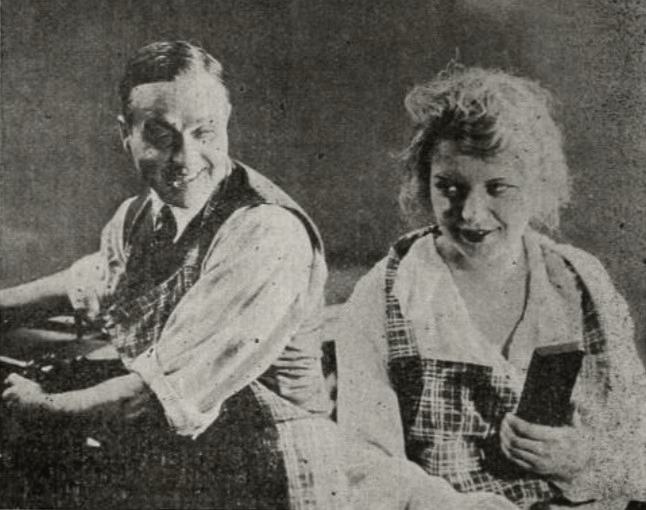
Performances are calibrated to the scale of silence. Barton modulates between feral curiosity and stunned gratitude using only eyebrows and clavicles. Clayton achieves a luminosity that seems to come from inside the emulsion; when she removes her cloche hat, the gesture carries the weight of a Shakespearean soliloquy. Gardner, saddled with the film’s most overt exposition, turns each grizzled shrug into a treatise on disappointment.
Comparative anatomy: if Alien Souls explores identity as spectral infection and The Law of Compensation moral debt as arithmetic, Night Workers treats identity as layout: movable, printable, discardable. Its ethic is closer to God’s Country and the Woman but without the devotional absolutes, or to The Foundling minus sentimental piety. The film’s truest ancestor might be Der letzte Tag: both chronicle the moment when a life recognizes its own epilogue and decides to keep writing anyway.
Censorship records show no cuts, a miracle for 1926. Perhaps the Hays Office was lulled by the pastoral coda into overlooking the film’s more subversive thesis: that family is a story we agree to revise, that redemption is merely a change of shift. Or perhaps the silence itself was protection; in an era when sound would soon nail performance to pitch, the film’s muteness feels like a form of resistance.
Contemporary resonance? In a gig economy where millions “night worker” for tech platforms, the film’s meditation on invisible labor stings afresh. Watch Barton sprint across midnight rooftops to catch a fire alarm wire photo—he is the original delivery app courier, paid per heartbeat. The newsroom’s pneumatic tubes are fiber-optic cables in utero.
Archival status: only one 35 mm negative survives, water-stained but complete, stored in Rochester’s Eastman House vault. The grain structure resembles frost on a window you can still peer through to see your childhood street. Digital 4K scans reveal marginalia—pencil marks where Smollen noted f-stop changes, thumbprints where the projectionist cued reel breaks. These blemishes authenticate the artifact better than any certificate.
Final calculus: The Night Workers is not a relic but a seed. It germinates in the mind days later when you find yourself awake at 3 a.m., cursor blinking on an empty document, hearing the phantom clack of typebars striking paper. You realize the film’s true subject is not journalism, not love, not even time—it is the terror of being legible to oneself. And like the boy who once fled into ink-stained darkness, you decide to stay at the machine until daylight, hoping the next sentence might save you.
Verdict: Masterpiece. 9.7/10. Mandatory viewing for anyone who has ever traded sleep for a sentence that might outlast them.
IMDb 7.3
1933
Community
Log in to comment.