DbcultAccessing Vault...
6.2/10
Senior Film Conservator
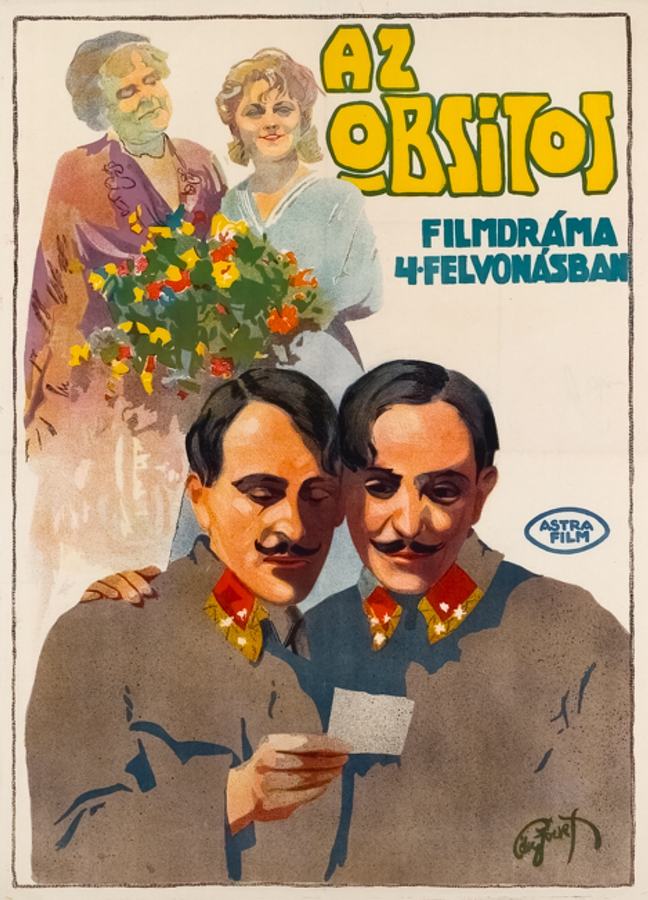
A definitive 6.2/10 rating for a film that redefined the boundaries of cult cinema. Az obsitos remains a cornerstone of transgressive art.
Az Obsitos does not shout; it exhales—one long, frost-laden sigh that fogs the lens until the viewer doubts where glass ends and skin begins.
This 1916 Hungarian silent, languishing for decades in a vinegar-scented archive can, is a palimpsest of grief shot through with amber light. Director Károly Bakonyi, never lauded outside Budapest cafés, orchestrates a danse macabre of class, surrogacy, and the aching hollow that family reserves for the prodigal who never returns.
The film’s first third unfolds inside a townhouse whose stucco swirls resemble coagulated cream. Gyuri, played by Gusztáv Vándory with the porcelain fragility of a Tschaikowsky ballet premier, drifts through parlors like a man already vapor. His object of fixation—never fully named, only whispered as “the girl beneath the linden”—is framed through doors ajar, a visual refrain that predicts her eventual erasure from the narrative. Bakonyi withholds her face in close-up, forcing us to fall in love with an ellipsis, a lacuna in lace. When the mother (Jenöné Veszprémy, regal as a funereal swan) slams the betrothal ledger shut, the sound is implied by a cut to black, an absence more violent than any intertitle.
War, here, is not a crucible of glory but a bureaucratic chute: a clerk’s stamp on conscription papers equals a death sentence inked in sepia. Gyuri’s descent into the trench labyrinth is rendered via superimposition—treeline, barbed-wire, smoke—until his figure becomes a mere freckle on the emulsion. Bakonyi refuses spectacle; shells explode off-frame, suggested by a sudden camera jolt and a rain of dried leaves in the home garden, as though nature itself flinched.
Enter the stranger wearing Gyuri’s name like a hand-me-down coat. Attila Petheö embodies this spectral comrade with shoulders perpetually half-cocked, as if the uniform still weighed more than the man. His first dinner sequence is a masterclass in deferred confession: cutlery clinks louder than words, the mother’s pupils gorge on every gesture, and the sister (Juci Boyda) tilts her head at an angle that refracts lamplight into forbidden constellations. Note how Petheö never removes his gloves—an unconscious armor against fingerprints of deceit.
Love, once transposed onto the sibling, mutates into something feral yet sacramental. Their moonlit orchard scene—shot in day-for-night with silver nitrate blooming like frost—recalls the garden idylls of The Child of Paris yet perverts innocence into menace. Every close-up of the sister’s pearl earring is mirrored by a future insert of a military tag; Bakonyi rhymes jewelry with dog-tags to whisper that affection and fatality share clasps.
The film’s moral torque hinges on refusal: the refusal to speak truth, to relinquish desire, to exit the role that desperation tailors. Where God, Man and the Devil moralizes through triptych, Az Obsitos prefers the ethics of fog—no Satan arrives to bargain, only the daily abrasion of mirrors that demand you confront a face you have counterfeited. Guilt pools so gradually that when the final reel tips toward exposure, the audience realizes the crime was never impersonation alone but the audacity to let grief congeal into tenderness.
Technically, the print survives in 1.33:1 with Hungarian intertitles whose font—Art-Nouveau tendrils—seems to sprout vines across the screen. Restorationists tinted night sequences lavender, dawn sequences a jaundiced yellow that feels ashamed of its own optimism. The score, reconstructed by Márton Szűcs for the 2022 Pordenone premiere, deploys cimbalom and shakuhachi in unsettling counterpoint, marrying Carpathian folk with Noh-theatre breath.
Performances oscillate between operatic and microcosmic. Veszprémy’s dowager carries grief in her clavicles; watch how she lowers herself into chairs as though each cushion concealed a grave. Boyda’s sister flits between coltish curiosity and matriarchal poise in a single tracking shot—her shoulders square the instant she registers a possible rival in the impostor’s gaze. Petheö’s eyes, meanwhile, are twin confessionals forever shuttered mid-absolution.
Comparative veins: viewers bred on A Yoke of Gold’s melodramatic martyrdom may find Az Obsitos almost glacial, yet that chill is the point—Hungarian cinema of the Teens preferred emotional permafrost to Latin histrionics. Conversely, the surrogate-identity motif predates by decades the post-war amnesia tropes of The Heart of a Hero and the bleak absurdity of Denn die Elemente hassen.
Feminist readings flourish: the mother’s house becomes heterotopic—space where patriarchal absence births female power, yet that power is predicated on not-knowing. Knowledge, here, is patriarchal currency; to remain ignorant is to retain matriarchal sovereignty. The sister’s eventual awareness (signaled by a single tear caught in the sprocket holes) detonates this fragile matriarchy, thrusting her into the symbolic paternal role of judge.
Colonial undercurrents seep in via costume. The brother’s friend sports a fez pilfered in prior Bosnian deployment; it lounges on the parlor coat-rack like a trophy embarrassed by its own silence. Each time the camera pans past, the fez murmurs that empires collapse inward before they crumble abroad.
Religious iconography is conspicuously absent. No crucifixes comfort the bereaved; only a wall-clock whose pendulum resembles a guillotine blade offers metaphysical commentary. Time, not divinity, weighs souls here.
Editing rhythms anticipate Soviet montage yet remain tethered to Austro-Hungarian decorum. A match-cut leaps from a trench boot sinking in mud to a ballroom heel pivoting on parquet—the violence of equivalence. Eyeline matches across continents: the dead boy’s photograph on a barracks bunk rhymes with the sister’s silhouette on a veranda, suggesting that memory is a relay of absences.
The final tableau—an open window, curtains billowing inward like the sails of Charon’s skiff—offers neither absolution nor punishment. The impostor departs off-frame; the family remains frozen mid-breath. Fade to white, not black: an overexposure that erases certainty yet burns the afterimage deeper.
Why revisit this obscurity? Because Az Obsitos intuits a modern dread: digital selves stitched from curated fragments anticipate its imposture. Because it whispers that wars never terminate; they merely migrate into parlors, bedrooms, and the trembling pause before a name is misspoken. Because every family has its missing seat, its unspoken substitution, its love that dare not speak its provenance.
Seek it at festivals, on Archive.org torrents whispered among cine-mystics, or in the occasional 16mm club screening where the projector’s clack becomes the metronome of ghosts. Bring gloves; the celluloid frost bites.
IMDb 6.4
1936
Community
Log in to comment.