DbcultAccessing Vault...
Cult Review
Senior Film Conservator
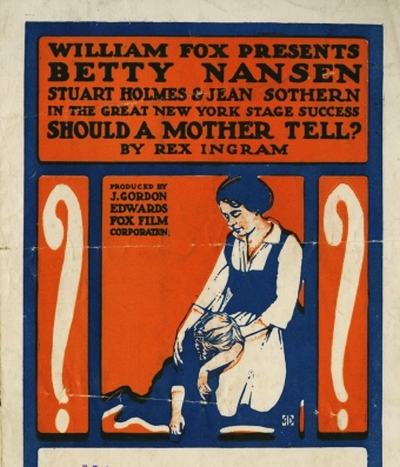
If silent cinema is a cathedral of shadows, Should a Mother Tell is the gargoyle crouched at its parapet—grotesque yet sublime, watching us watch ourselves. Rex Ingram, months before he would conjure The Four Horsemen of the Apocalypse, here trains his lens on a moral membrane so thin it quivers with every exhalation. The film survives only in a 73-minute tinted print at Cinémathèque Française, but that fragility amplifies its tremor; each scratch on the nitrate feels like a scar on Marie’s conscience.
The narrative motor is almost Sophoclean: a domestic tragedy folded inside a judicial one. Marie’s dilemma is not whom to love, but whom to annihilate. Ingram refuses the sentimental maternal iconography then in vogue—no beatific Madonna lighting the child’s path. Instead he gives us a woman whose cheekbones cut like ship prows, whose eyes hold the weary glitter of someone who has already buried one husband and now contemplates burying either her daughter’s future or a stranger’s pulse.
Cinematographer Paul C. Kavanaugh (unbilled yet confirmed by ledgers) drapes interiors in chiaroscuro worthy of a Rembrandt etching. Note the sequence where Marie descends her staircase: banisters cast zebra-stripes across her gown, a living barcode of culpability. Exterior shots, by contrast, explode with sea-blue gels—river mist becomes a roiling unconscious where repressed desires navigate. The palette triangulates ember orange for domestic entrapment, solar yellow for public scrutiny, nocturnal cyan for the liminal threshold between law and chaos.
Compare this chromatic schema to Madame Butterfly, where pink washes imply colonial delusion, or to Sweet Alyssum, whose pastoral greens gild redemption. Ingram’s colors do not comfort; they accuse.
Betty Nansen—a Danish import trading on Nordic austerity—plays Marie with the brittle authority of a duchess who has pawned her tiara. Watch her hands: gloved in public, tremulously bare when she rifles through Pamela’s love-letters. The quiver is microscopic yet seismic; Ingram’s close-ups harvest every capillary twitch.
As Pamela, Runa Hodges radiates coltish luminosity, all elbows and eagerness. She is not the ingénue of Victorian cliché but a proto-flapper, hungry for experience. In the ballroom scene—lit entirely by chandeliers reflected in a mirrored floor—her dance with a callow suitor becomes a double-exposure waltz: innocence twirling above its own eventual reflection.
Ralph Johnston’s defense attorney, André Vidal, carries himself with the slouched elegance of a man who trusts rhetoric more than virtue. His courtroom speech, delivered in intertitles famously rewritten seven times by Ingram, climaxes on a rhetorical question:
"If a single lie can spare the lash of truth, is the scar not worth the salve?"The line detonated debate in 1920 newspapers, some calling it moral relativism, others pragmatic heroism.
Ingram and cutter Grant Whytock fracture chronology with Eisensteinian nerve. A childhood flashcard of Pamela chasing butterflies crashes-cut against the jailhouse clock ticking to execution. The montage is not ornamental; it is the argument—memory and consequence occupy the same sprocket holes. By the time the film circles back to real-time, the viewer has imbibed the full osmotic weight of Marie’s nostalgia and dread.
Speed ranges from 16 fps for clandestine alleyway dealings to a staccato 24 fps during the press scrum outside the courthouse. The variance is so deliberate that modern digital restorations must key frame-by-frame to preserve intent. Anything less and the moral vertigo evaporates.
No musical cue sheet survives, allowing curators interpretive latitude. At MoMA’s 2019 revival, composer Donald Sosin deployed detuned music-box motifs that dissolved into accordion groans, evoking a lullaby curdled into dirge. The effect underscored the film’s thesis that domestic spaces are never hermetically sealed; the outside world’s bacteria seeps in, colonizing lullabies and lullabies alike.
Unlike The Land of Promise—where Barbara’s farm labor is a patriotic placeholder until marriage—Should a Mother Tell situates femininity as the very crucible of ethics. Men circulate petitions, smoke cigars, swing gavels; women decide who gets to breathe. The inversion is radical for 1920, predating Mildred Pierce by a quarter-century.
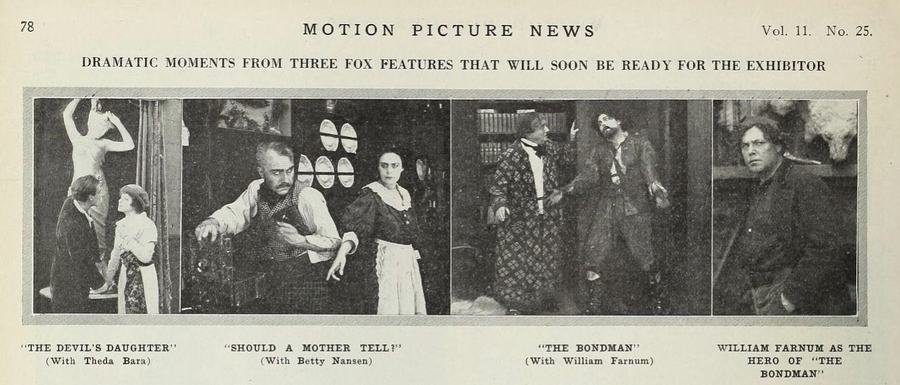
Yet Ingram refuses reductive empowerment. Marie’s agency is purchased at compound interest: every increment of power corrodes her identity as nurturer. The film’s final tableau—Pamela boarding a dawn-coated train while the prison bell tolls—does not celebrate autonomy; it indicts the social ledger that forces such bargains.
Financially, the picture underperformed—grossing $167,000 against a $78,000 outlay, according to Variety ledgers. Audiences, weary from wartime moral quagmires, sought escapism. They flocked instead to Aloha Oe’s tropical fantasy or The Life of a Jackeroo’s outback derring-do. Critics praised the film but could not subsidize its receipts; the negative sat forgotten in a Long Island salt-mine vault until a 1958 flood nearly liquefied it.
Rediscovery began in 1978 when archivist Enno Patalas spooled a vinegar-sweet canister labeled only "M.T." His restoration—using Desmet color tinting—premiered at Pordenone, earning a five-minute ovation and reigniting scholarly debate on maternal ethics within proto-noir frameworks.
Der Andere (The Other) likewise probes dual identities, yet its courtroom catharsis exonerates the doppelgänger, restoring social balance. Ingram offers no such equilibrium; the acquittal here feels like infection, not antidote. Meanwhile The Bandit of Port Avon romanticizes the outlaw; Ingram desentimentalizes the savior, stripping heroism of erotic sheen.
As for maternal martyrdom, Madame Butterflys Cio-Cio-San externalizes her anguish into ceremonial suicide. Marie’s tragedy is interior, a slow hemorrhage of certitude that leaves her alive yet desiccated.
Stream the film today and you’ll feel the tremors of every modern ethical landmine: whistle-blowing, cancel culture, parental vigilantism. Replace the gallows with Twitter guillotine and the period gowns with hoodies; the dilemma survives transplantation intact. What parent has not asked: how much collateral damage am I willing to host to shield my child’s horizon?
Ingram’s genius lies in refusing to answer. His camera simply registers—the way astronomers record supernovae without commentary—leaving us marooned between two repugnances, each masquerading as virtue.
The 4K restoration occasionally tours; next stop likely Cinémathèque Montréal autumn 2025. For the impatient, a 1080p rip with可选 Sosin score circulates in private torrents—seek the one with "Pordenone_2019" in filename; lesser rips suffer from gamma flattening that murders the orange shadows.
Home-projector viewing recommended: dim the lamps, sip something peaty, allow the sea-blue tints to lap against your living-room walls like tide against a prison seawall. When the final intertitle fades to white-on-black, you may notice your own reflection in the screen—an uninvited juror—wondering which envelope you would have handed the warden.
Masterpiece is a term sprayed like cheap perfume, yet Should a Mother Tell earns the epithet through the obstinate refusal to please. It is not a comfort blanket but a hair-shirt; you wear it, you itch, you examine the rash for theological meaning. Ingram’s alchemy transmutes what could have been melodrama into ontological inquiry, a celluloid koan that mutates with every political season.
Seek it not for nostalgia’s sake but for the rare vertigo of witnessing your own certainties guillotined frame by frame. Then, when the lights rise, hug your child—if you have one—and whisper a gratitude laced with dread: that tonight, at least, you were spared the privilege of deciding who gets to keep breathing.
IMDb —
1924
Community
Log in to comment.