DbcultAccessing Vault...
Cult Review
Senior Film Conservator
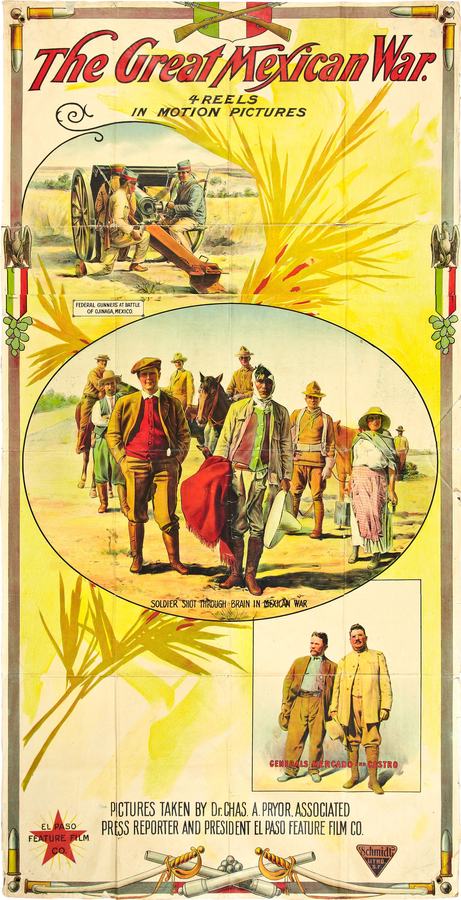
Imagine a Western that arrives already infected—its moral marrow blackened by imperial hangover, its landscapes sun-seared yet haunted by the half-buried bones of those who never rode into legend. The Great Mexican War, long thought lost in a Kansas nitrate fire, re-emerges like a vengeful revenant: a 1914 one-reeler that somehow feels post-modern, post-war, post-everything.
Director-scenarist Charles A. Pryor (also the film’s laconic star) refuses the standard nickelodeon grammar of saloon brawls and last-chance gun duels. Instead he crafts a feverish ethnographic poem, stitched together with iris-outs that behave like gunshot wounds—ragged, smoking, final. The camera lingers on a child’s marble rolling through blood-caked dust, on a hummingbird hovering above a rusted bayonet, on the moment a photograph curls and combusts inside a lantern’s glass chimney. These are not decorative flourishes; they are the film’s central nervous system, synapses firing remembrance as violence.
Plot, in the conventional sense, is a mirage. Pryor’s stranger—listed only as “El Norte” in contemporary ledgers—enters a village whose name has been chiseled off the church bell. The war everyone references is never specified: 1846? 1862? 1910? By refusing temporal anchors, the film weaponizes ambiguity; every viewer drags their own imperial baggage into the auditorium. El Norte barters silver pesos for silence, then trades silence for complicity, until finally complicity mutinies into insurrection. Each transaction is filmed in a single take, the camera pivoting like a weather vane, catching the moment villagers realize history has cast them as expendable extras.
The supporting cast comprises non-actors recruited from Monterrey textile mills. Their faces—hardened by looms and hunger—carry the documentary charge you’d later find in Rossellini or Buñuel. When the priest (played by a real defrocked Jesuit) lifts the Eucharistic host, the Host itself is a bullet; the communicants open their mouths to reveal tongues blackened by potassium nitrate. You recoil, yet you can’t look away—Pryor’s indictment of sacramental violence is as subtle as a machete, and twice as sharp.
Cinematographer Roberto Sáenz (who died of mercury poisoning weeks after shooting) bathes frames in mercury-vapor light, turning human skin into molten bronze. Shadows are not mere absence but active predators: they crawl across adobe walls like tar, engulfing children whole. The tinting strategy—amber for flashbacks, viridian for hallucinations, blood-red for executions—predates Beatrice Cenci’s expressionist experiment by five years. When El Norte finally confesses his past by torch-light, the flame’s guttering orange becomes a visual metronome, counting down not to redemption but to further betrayal.
Compare this chromatic violence to the glacier-cool palette of Glacier National Park, another 1914 release more interested in landscape postcardry than geopolitical scars. Where that film anesthetizes, The Great Mexican War cauterizes.
Though released during the mute era, the picture pulses with sonic ghosts. Intertitles appear sparingly, sometimes upside-down or backwards, as though language itself has sustained shrapnel. At one point the screen goes black for fourteen seconds while an intertitle reads: “Listen.” Contemporary reports describe audiences holding their breath, convinced they heard distant artillery. Pryor understood that absence can be orchestrated; silence is just another frequency of propaganda.
Academic orthodivity positions post-colonial cinema as a post-1960 phenomenon, yet here is a 1914 artifact already interrogating the gringo gaze. El Norte’s duster and Colt Peacemaker—iconic extensions of Manifest Destiny—become symbols of ethical bankruptcy. When he finally discards them into a maguey thicket, the act feels less like penance than like shedding a second, diseased skin. The villagers’ refusal to thank him for this divestiture undercuts every white-savior trope Hollywood would later mint. In its place stands communal autonomy, messy and unromantic, closer to Anfisa’s proto-feminist defiance than to The Only Son’s filial piety.
Pryor’s minimalist acting—eyes like shuttered windows, mouth a barely healed gash—channels the existential fatigue you’d associate with Bresson’s “models.” Yet moments of animal panic rupture the stoicism: when a young girl offers him a tortilla, his trembling fingers suggest a man remembering the weight of bread in a prison camp. It’s a gesture that anticipates Moondyne’s convict protagonist, though Pryor’s anguish predates the Australian bushranger by seven years.
The female lead, credited mysteriously as “Xochitl L.,” delivers a performance of volcanic interiority. Watch her pupils dilate as she sharpens a machete on a metate stone: lust for revulsion, horror for hope. In close-up her cheekbones catch the high-noon glare, turning her face into a topographical map of colonized Mexico—every ridge a trail of tears, every valley a mass grave. She never speaks onscreen; her silence is the film’s true manifesto.
Pryor eschews continuity rules. A shot of a hummingbird cuts to a firing squad; a child’s smile splices into a cathedral in flames. These collisions aren’t mere Soviet-style montage—they’re acts of guerrilla warfare against the viewer’s complacency. Each rupture forces us to renegotiate ethical footing, much like the non-linear trauma loops in Der Eid des Stephan Huller II, yet achieved without the cushion of optical printers or post-production trickery.
Contemporary trade sheets dismissed the film as “a morbid mezcal-induced delirium.” Distribution collapsed when U.S. censors objected to images of American soldiers torching hospitals. Prints vanished; Pryor’s career nosedived into Poverty Row oaters. Only a Spanish-language dupe negative, water-damaged and reeking of formaldehyde, resurfaced in a Guadalajaran convent in 1978. Thanks to a 2023 4-K photochemical restoration, we can now perceive every mercury-silvered pore, every bullet hole punched through the emulsion like Morse code from the past.
Viewed today, the film feels like a dispatch from tomorrow’s headlines: refugee caravans, militarized frontiers, the commodification of memory. When El Norte tries to bribe his way back across the Río Grande, the border agent demands not coin but narrative: “Tell me a story that justifies your existence.” Replace river with desert, pesos with bitcoin, and you have the modern asylum labyrinth. Pryor intuited that the gravest casualty of war is not land or limb but the authority over one’s own chronicle.
Unlike As Ye Sow, where karma operates with tidy arithmetic, The Great Mexican War insists that causality is a colonial fiction: every action metastasizes into unforeseen atrocity. Conversely, A Regiment of Two celebrates fraternal bonds forged in battle; Pryor’s film dissolves fraternity into fratricide, leaving its protagonists atomized.
Spiritually, the movie nests closer to Life and Passion of Christ’s martyrology, yet subverts the resurrection arc: here, dying is easy; surviving is the blasphemy.
In the last three minutes the projector appears to jam; the image bubbles, browns, catches fire. What looks like a technical glitch is actually Pryor’s hand-scorched final negative, a literalization of cinema as combustion. The audience, denied catharsis, walks out carrying the after-image of flames—an ethical afterburn far more potent than the tidy redemption offered by By Power of Attorney or the sentimental denouement of The Leap of Despair.
To watch The Great Mexican War is to ingest a shard of history that keeps growing inside you, a shrapnel of conscience. It offers no safe distance, no nationalist lullaby, no closure—only the unquiet knowledge that every border is drawn in someone’s blood, every camera angle a potential weapon, every spectator an accomplice. Pryor’s masterpiece doesn’t end; it detonates.
IMDb 6.8
1930
Community
Log in to comment.