DbcultAccessing Vault...
6.3/10
Senior Film Conservator
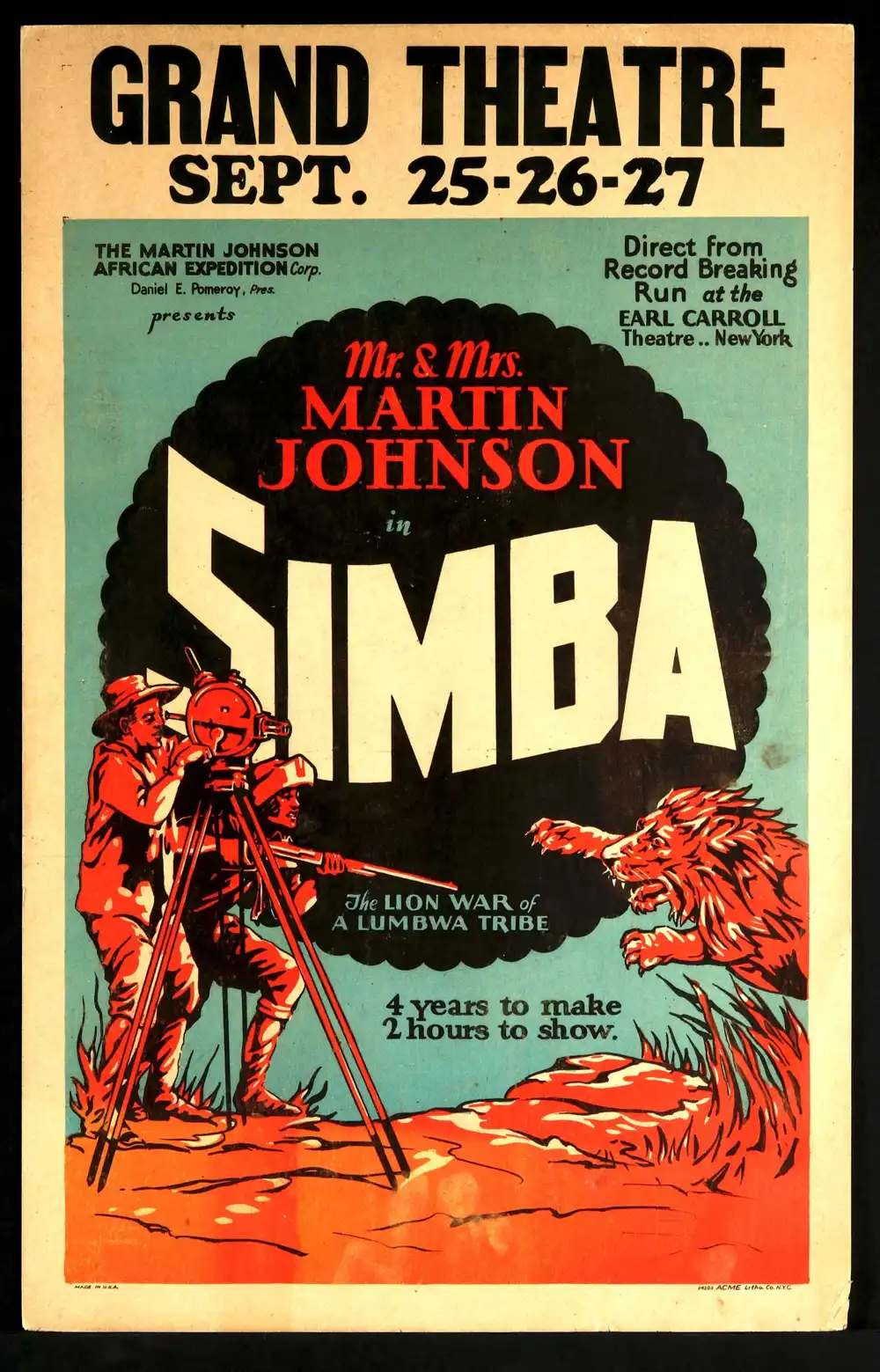
A definitive 6.3/10 rating for a film that redefined the boundaries of cult cinema. Simba: The King of the Beasts remains a cornerstone of transgressive art.
If you have a high tolerance for 1920s pacing and a curiosity about how people used to view the world before National Geographic became a TV channel, Simba: The King of the Beasts is worth a look. It’s not for everyone. If you’re the type who gets annoyed by the colonial gaze or the slow, chugging rhythm of silent film titles, you’ll probably turn it off after twenty minutes. But for those who like seeing the literal mechanics of early filmmaking—how they dragged these massive cameras through the mud—it’s kind of a marvel.
The first thing that hits you isn't the animals, it’s the Johnsons themselves. Martin and Osa. They look like they stepped out of a costume shop. Osa, in particular, has this incredible ability to look perfectly coiffed while sitting in a thorn bush. There’s a scene early on where they’re setting up camp, and it feels staged in that very specific "acting for the camera" way that people did back then. They aren't just exploring; they are performing the idea of exploring. It lacks the grit of modern survival shows, yet you know for a fact they were actually there, in the heat, with no backup.
The animals are, obviously, the draw. There is a shot of a lion—the titular Simba—emerging from the tall grass that actually made me lean back a little. It’s not the zoom-lens intimacy we get now. It’s wide, grainy, and feels dangerous because you can sense the physical distance between the lens and the predator. There’s no safety net. When the lions look at the camera, they aren’t looking at a drone or a hidden GoPro; they are looking at Martin Johnson, who is probably sweating through his shirt while hand-cranking a wooden box.
The pacing is... well, it’s 1928. Some of the sequences with the giraffes go on for what feels like an eternity. You see one giraffe. Then another. Then a group of them. The film seems to think we’ve never seen a giraffe before, which, for the 1928 audience, was probably true. For a modern viewer, it’s a test of patience. I found myself looking at the background more than the animals—the way the light hits the acacia trees, or the weirdly empty vastness of the plains before they were carved up by tourism.
There’s a strange tonal shift when the film moves from the animals to the indigenous people. It’s uncomfortable. The Johnsons treat the locals like another species to be cataloged. The titles are patronizing, and the way the camera lingers on people’s faces feels intrusive in a way that the animal shots don't. It’s a reminder that this film is a product of its time, for better and mostly for worse. It’s much less of a "groundbreaking travelogue" and more of a historical artifact that caught a lot of things it didn't mean to, like the sheer arrogance of the expedition itself.
I kept thinking about The Glorious Adventure while watching this, mostly because of how much Simba tries to inject drama into every frame. Everything is a "peril" or a "conquest." Even when nothing is happening, the intertitles are screaming about the ferocity of the wild. It’s that same theatricality you see in early features, where the reality isn't enough; it has to be sold as a spectacle. It lacks the quiet, almost meditative quality of something like Weaving, opting instead for a constant, low-level sense of manufactured dread.
One thing I noticed: the way the grass moves. In these old restorations, the wind in the savannah grass has this flickering, ghostly quality. It’s more atmospheric than the animals themselves. There’s also a shot of an elephant stampede where the camera shakes violently. It’s probably the most honest moment in the film. For a second, the "brave explorer" persona slips, and you realize they were almost stepped on.
The editing is choppy. You’ll be looking at a rhino, and then suddenly there’s a hard cut to Osa pointing a rifle, and then a cut back to the rhino running away. You can tell they were trying to piece together a narrative of "The Hunt" out of footage where the animal probably just got bored and walked off. It’s a bit like the staged action in High Power, where you can see the strings if you look closely enough.
Is it a good movie? Not in the traditional sense. It’s long, the music (if you’re watching a version with a score) is often repetitive, and the ethics are a mess. But there’s a shot near the end—a group of lions feeding at night—that is genuinely haunting. The way their eyes catch the light of the flares is something you don't forget easily. It’s raw in a way that modern 4K nature docs, with their perfect color grading and Hans Zimmer scores, often miss. It’s just a man, a woman, a heavy camera, and a lot of things that want to eat them.
If you’re looking for a tight narrative, go watch The Talk of the Town. If you want to see what Africa looked like through the eyes of two people who were half-scientists and half-showmen, Simba is a weird, dusty trip worth taking once.
IMDb —
1920
Community
Log in to comment.