DbcultAccessing Vault...
Cult Review
Senior Film Conservator
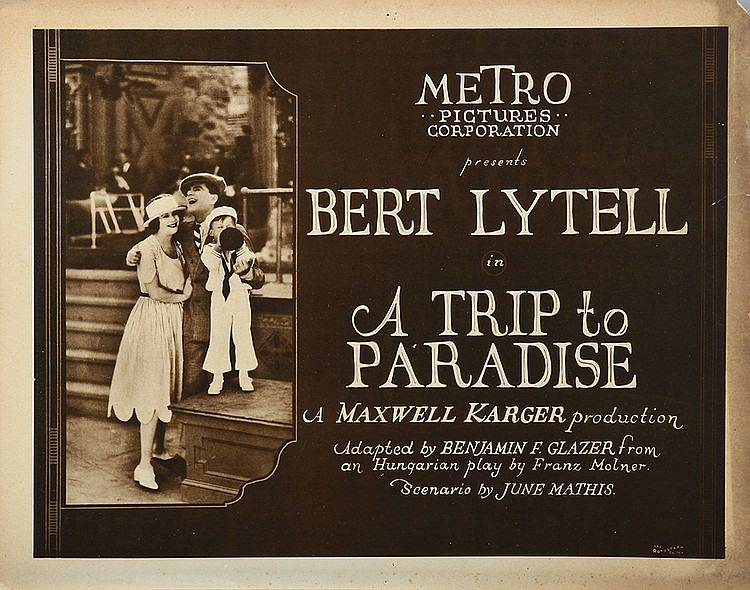
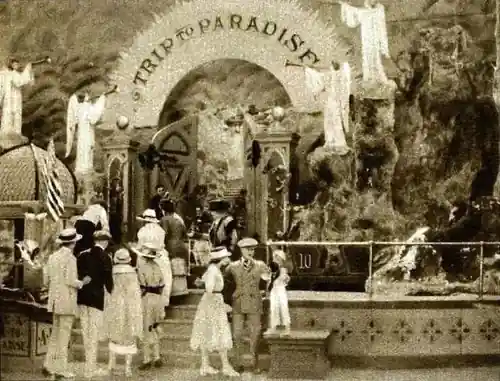
The first thing that strikes you is the shimmer of the celluloid itself—those silver halide ghosts flickering like magnesium flares against a velvet void. A Trip to Paradise arrives as a clandestine sibling to Molnár’s Liliom, birthed in the same annum the Hungarian bard’s play detonated Broadway, yet this silent doppelgänger chooses phosphorescent melancholy over footlight bravura. The camera, hungry and prowling, stalks a carnival midway where tinny calliope music drips like molasses into the viewer’s ear. Bert Lytell’s barker—part snake-oil showman, part wounded faun—leans against a carousel horse whose painted rump has blistered under a thousand cheap suns. His grin is currency; his eyes, however, are overdrawn accounts.
Director Benjamin Glazer, tethered to June Mathis’s metaphysically caffeinated adaptation, refuses the proscenium politesse of stagebound predecessors. Instead he fractures chronology, letting flashbacks bleed through iris shutters like acid leaks. When the barker’s switchblade flashes—an eruption of nickel and resentment—the editing cadence swaps waltz for staccato, hurling us into a chiaroscuro Manhattan where elevated trains scream like banshees. Compare this urban panic to the more sedate The Midnight Girl or the pastoral whimsy of The Gingham Girl: here the city is an abattoir of neon, each bulb a dangling Judas coin.
Eunice Murdock Moore’s Julie—renamed and refracted—materializes first as a silhouette against a milk-glass window, her outline softened by kerosene dusk. She embodies the film’s dialectic between innocence and abrasion: when the barker lifts her onto a Ferris-wheel car, the camera tilts thirty degrees, queasy as a drunk sailor, suggesting that uplift and plunge are Siamese twins. Their marriage, a tenement-chapel ceremony cluttered with flickering votives, feels less sacrament than dare. Note the way Glazer intercuts the couple’s first supper—bread, herring, a single tin fork—with a parallel montage of carnival lights being switched off pole by pole; love’s intimate tableaux and public bankruptcy share splice marks.
Virginia Valli, as the temptress maquillaried in kohl and rue, drifts through two or three sequences like cigarette smoke. Her function isn’t narrative propulsion but atmospheric corrosion: she reminds the barker that every paradise carries a serpent on retainer. Their pas de deux inside a photo-booth—an iron contraption promising permanence for a nickel—yields images that develop into nothing but fogged plates, a visual pun on the ephemerality of sin.
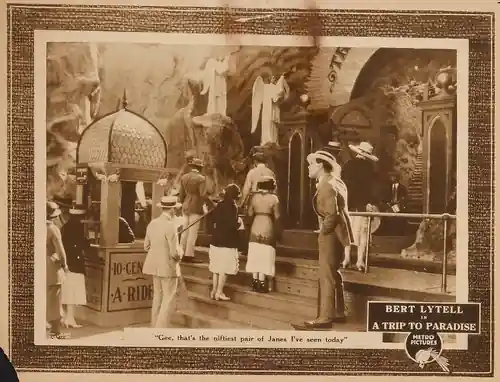
The film’s fulcrum, however, is the afterlife express—a hurtling phantom train rendered via double exposure and downward-key lighting. Windows reveal planetary vistas, yet the upholstery is threadbare; even eternity suffers budget cuts. Here the barker faces a tribunal of translucent functionaries whose faces dissolve before identification. Molnár’s original stage directions merely hinted at celestial bureaucracy; Mathis’s screenplay literalizes it into a bureaucratic fever dream staffed by clerks who stamp documents with star-shaped seals. The effect is Kafka before Kafka was fashionable, and it predates the similarly expressionist Macbeth corridor-of-mirrors sequence by a full decade.
Sent back to Earth for twenty-four posthumous hours, the barker becomes an invisible custodian. Glazer weaponizes the audience’s desire for sentimental closure: every time the ghost reaches to caress Julie’s hair, the camera racks focus so that his hand blurs into abstract smear, a visual assertion that penance is tactile only for the penitent. The sequence echoes—but predates—the domestic hauntings in Love, Honor and --?, yet carries none of that film’s moral tidiness. When he guides a doctor’s hand during the childbirth crisis, the film intercuts sub-second flashes of carnival gears, implying that the machinery of grace is as rigged as any rigged ring-toss.
Bert Lytell’s performance is a masterclass in graduated dissolution. Watch the way his shoulders, initially swaggering like a rooster’s breast, inch inward as guilt metastasizes. By the final reel his silhouette occupies a diminishing fraction of the frame, an inverse of Chaplin’s triumphant tramp. Silent-era histrionics? None. His agony is etched in micro-movements: the tremor of a cigarette never smoked, the swallow that travels the length of his throat like a marble down a pipe.
Eunice Murdock Moore counterbalances with a minimalist tremolo. Her Julie says little even in intertitles, yet her eyes—shot in lingering close-ups that border on the uncomfortable—harbor weather systems. In the penultimate scene she cradles her newborn while staring out at an urban sunrise that looks suspiciously like a magnesium flare. The viewer intuits that she senses the barker’s spectral presence; motherhood has tuned her to frequencies beyond the corporal.
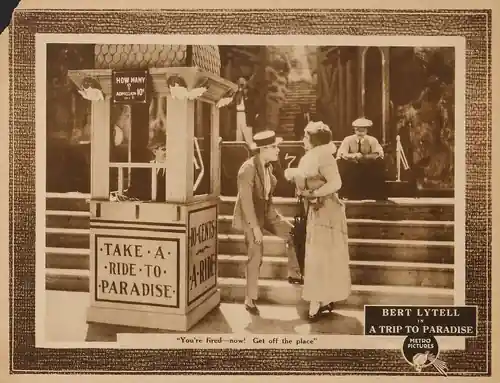
Technical footnote: cinematographer Jackson Rose employs diffused netting over the lens whenever Paradise—either the carnival or the astral—hoves into view. The gauze softens the image until highlights bloom like dandelions, a visual rhyme for the characters’ yearning for impossibility. Conversely, city interiors are rendered in hard tungsten, every shadow a scalpel. The tonal whiplash anticipates the later industrial grotesqueries in Congestion, though that film’s pessimism is more sociological than metaphysical.
The score, reconstructed by Maude Nell for the 2019 MoMA restoration, deploys a toy-piano motif whenever the barker’s conscience pricks. Critics allergic to whimsy may bridle, yet the brittle timbre evokes the very plywood illusions the carnival peddles. During the train-to-afterlife sequence, a theremin glissando seeps into the orchestra, decades before sci-fi codified the instrument as space-age cliché.
Gender politics? Complicated. Julie’s economic dependence on the barker is total; her later stoicism reads less as empowerment than survivalist resignation. Still, the film grants her the closing shot: a slow 360-degree pan that begins on her face and ends on an empty rocking chair where the ghost had sat. The camera movement is so fluid—accomplished via a primitive crane—that one senses the earth itself exhaling. Compare this to the more reactionary dénouements in Thoughtless Women or The Small Town Guy, where errant wives are ritually humiliated. Here the moral ledger stays unnervingly open.
Box-office trivia: the feature premiered at Manhattan’s Rialto amid a blizzard so severe that newspapers dubbed it “the white mortality.” Attendance plummeted, and the film vanished into rights limbo after distributor Metro’s 1923 bankruptcy. Only one 35 mm nitrate print survived—stored, of all places, beneath a Nebraska funeral home’s embalming table, presumably because the undertaker’s widow found the title comforting. Decades of vinegar syndrome had eaten the emulsion edges, leaving the center intact like a burning bush surrounded by ash.
Modern resonance? Viewers weaned on A24 afterlife comedies will recognize the structural DNA: the posthumous quest for redemption, the bureaucratic beyond, the refusal of tidy catharsis. Yet Paradise carries a documentary authenticity regarding tenement life—check the street-vendor montage where immigrant argots layer into polyglot fugue—that digital backlots rarely replicate. In an age when every indie filmmaker courts “elevated genre,” Glazer’s flick reminds us that elevation is meaningless without grubby traction on the ground.
Caveat emptor: certain intertitles betray the racial lexicon of the era. A 2022 streaming release appended content warnings, though the restoration team prudently refrained from Bowdlerization; to erase is to falsify historical aperture. Educators screening the print in academic settings might juxtapose these slurs with contemporaneous progressive journalism—e.g., The Crisis essays on color-line violence—to foreground Hollywood’s complicity in normalization.
Comparative coda: if you queue this alongside El hombre de acero, you’ll witness two antipodal 1921 meditations on masculinity in crisis—one via metaphysical noir, the other through Spanish melodrama. The binary illuminates how global cinema simultaneously deconstructed and reinforced the male ego after the Great War’s trauma.
Final verdict: A Trip to Paradise is neither quaint relic nor esoteric footnote. It is a nitrate rosary, flammable and luminous, whose beads string together guilt, grace, and the unbearable thinness of absolution. Watch it at midnight with all lights extinguished; let the projector’s mechanical heartbeat sync with your own. When the barker evaporates into the fairground dawn, you may find yourself staring at the screen several minutes after the credits fade, waiting for a ghost who never returns—proof that some silences echo louder than any talkie could articulate.
IMDb 5.2
1929
Community
Log in to comment.