DbcultAccessing Vault...
Cult Review
Senior Film Conservator
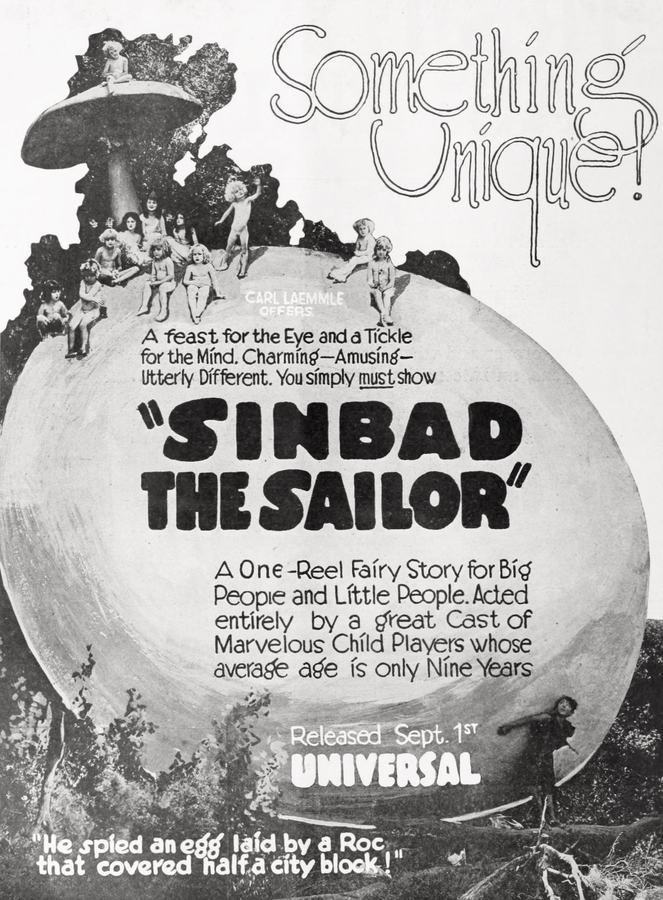
In the vast tapestry of early cinema, few works dare to unravel the very fabric of reality quite like Sinbad, the Sailor. This isn't merely an adaptation of the venerable Arabian Nights tales; it is a profound meditation on the power of imagination, a kaleidoscopic journey into the subconscious mind. The film eschews a straightforward narrative, instead inviting its audience into a deeply personal, almost solipsistic, expedition. We are introduced not to the legendary mariner himself, but to a young boy, his mind ablaze with the exploits of Sinbad. As the weight of the day gives way to the gentle tyranny of slumber, the boy's world dissolves, and he embarks upon an odyssey that transcends the boundaries of his bedroom, transforming him into the very hero he so ardently admires. This ingenious narrative device elevates the film from a simple adventure story to a psychological exploration, positioning the audience as privileged witnesses to the genesis of a dream, a true testament to the boundless potential of the human psyche when unfettered by waking constraints.
The brilliance of this approach lies in its ability to imbue the fantastical with a palpable sense of internal logic, a dream-logic that feels both arbitrary and utterly compelling. The transitions from the mundane reality of the boy's room to the shimmering, perilous seas of Sinbad's adventures are handled with an almost poetic fluidity, a testament to the directorial vision of the era. The seamless dissolve from a discarded book to the rolling waves of a tempestuous ocean is not just a clever edit; it's an invitation to surrender to the dream's embrace. Raymond Lee, as the dreaming protagonist, delivers a performance that is both understated and profoundly evocative. His initial expressions of youthful absorption in the book subtly morph into the determined gaze of a seasoned adventurer, a transformation that occurs not through overt theatricality, but through a nuanced portrayal of a mind fully immersed in its own creation. We witness the boy's psyche, unburdened by the constraints of waking life, conjuring landscapes of breathtaking beauty and terrifying menace. It’s a masterclass in how early cinema, often limited by technology, could still achieve immense psychological depth through clever storytelling and expressive acting, making the internal world a vibrant, tangible spectacle.
The visual language employed to depict these dreamscapes is nothing short of audacious for its time, pushing the boundaries of what was considered possible in cinematic spectacle. Through clever use of practical effects, meticulously crafted matte paintings, and perhaps early forms of superimposition, the film conjures a world that feels simultaneously ethereal and tangibly dangerous. The legendary Roc, that mythical avian terror, is rendered with a scale that genuinely inspires awe, its colossal shadow sprawling across miniature sets and menacing the tiny ship below, lending a terrifying grandeur to its appearance. The cyclopean creatures, with their singular, piercing eyes, the treacherous serpents coiling through forgotten ruins, and the cavernous treasure hoards glinting with untold riches are not merely static backdrops; they are dynamic elements that interact with the dreaming Sinbad, pushing the boundaries of what audiences expected from cinematic spectacle. The creative team understood that a dream's power lies not just in its imagery, but in its emotional resonance, and they expertly crafted sequences that evoke wonder, fear, and exhilarating triumph, often within the same breath.
One cannot help but draw parallels to later cinematic explorations of the subconscious, yet Sinbad, the Sailor predates them with a raw, pioneering spirit. Its willingness to commit entirely to the internal world of its protagonist sets it apart. While films like Daybreak or The Last Dance might delve into the psychological underpinnings of human relationships or societal pressures, often with a dramatic or melancholic tone, Sinbad bravely ventures into pure fantasy through the lens of a personal, internal journey. It posits that the most thrilling adventures are often those forged within the confines of our own minds, powered by the stories we consume and the desires we harbor. The film's pacing within these dream sequences is remarkably varied, shifting from moments of quiet contemplation, where Sinbad surveys a newly discovered, untouched island, to frenetic chases and desperate battles for survival against monstrous adversaries. This ebb and flow mirrors the unpredictable nature of dreams themselves, preventing any sense of monotony and keeping the audience utterly captivated by the unfolding, often surreal, narrative.
Beyond Raymond Lee's central turn, the supporting cast, particularly George Hupp, occupies a fascinating space within this dream narrative. Hupp, presumably embodying various figures within the boy's subconscious reimagining of Sinbad's world, delivers performances that are both archetypal and subtly distinct. Whether he appears as a treacherous merchant whose greed threatens to derail the expedition, a wise elder offering cryptic guidance, or a formidable antagonist whose very presence embodies a primal fear, his presence reinforces the idea that all characters within this dream are ultimately facets of the dreamer's own internal landscape. The interactions between Sinbad and these dream-figures are not merely plot devices; they are externalizations of the boy's internal conflicts, his fears of the unknown, and his aspirations for courage and mastery. The very notion that the boy's mind populates his dream with recognizable, yet transformed, faces from his waking life (even if not explicitly shown as such, it's implied by the nature of dreams) adds another layer of psychological realism to the fantastical premise, grounding the epic in a deeply personal foundation.
This nuanced approach to characterization, where actors play multiple roles or embody shifting personas, was a sophisticated technique for the era, hinting at a profound understanding of the human psyche. It speaks to a directorial understanding that a dream is not a linear play but a fragmented, symbolic experience, constantly shifting and reconfiguring itself. The emotions conveyed by Hupp and other supporting players, despite the visual grandeur of their surroundings, remain deeply grounded in universal human experience – greed, loyalty, fear, and courage. This ensures that even amidst the most outlandish scenarios, the audience remains emotionally invested in Sinbad’s plight, understanding that these external struggles mirror an internal battle. The film's strength lies in its ability to marry the epic scale of its source material with the intimate, personal journey of its young protagonist. It doesn't just show us Sinbad's adventures; it shows us what it feels like to dream them, to truly inhabit those mythical shoes.
At its core, Sinbad, the Sailor is a profound testament to the enduring power of literature and myth, a cinematic love letter to the very act of reading. The film argues that stories are not merely passive entertainment but active catalysts for imagination, capable of shaping our inner worlds and providing an unparalleled escape from the mundane. The boy’s immersion in the tales of Sinbad is not merely a pastime; it is a transformative act, a gateway to self-discovery and heroic embodiment. This theme resonates deeply, particularly in an era where cinema itself was a burgeoning new form of storytelling, competing with and complementing the printed word. The film implicitly acknowledges its own role as a purveyor of dreams, a medium that can transport audiences to realms far beyond their everyday existence, just as a good book can. It highlights the symbiotic relationship between reader and text, where the reader’s mind becomes a co-creator of the narrative, filling in the gaps and personalizing the experience, making the ancient legends vibrantly new.
In an era dominated by more straightforward melodramas and historical epics, the conceptual daring of Sinbad, the Sailor stands out with remarkable clarity. While films like The Glorious Adventure might offer swashbuckling thrills with historical backdrops and tangible stakes, Sinbad chooses a more introspective, albeit equally grand, path. It doesn't just present an adventure; it explores the very *source* of adventure within the human spirit, demonstrating how narrative fuels our capacity for wonder and courage. The film invites us to reflect on our own childhood encounters with heroic narratives, the moments when a book or a vivid tale ignited a spark of escapism and wonder, shaping our nascent understanding of good versus evil, bravery versus cowardice. This meta-narrative layer, though perhaps not explicitly intended as such by its creators, nonetheless enriches the viewing experience, transforming it into something more than just a spectacle. It becomes an inquiry into the very nature of human escapism, creativity, and the enduring psychological need for myth.
Technically, the film is a marvel of early cinematic ingenuity, showcasing an impressive array of creative problem-solving. The depiction of fantastical creatures and exotic locales would have been incredibly challenging with the rudimentary tools available to filmmakers of the period. Yet, the creative team employed a range of techniques, from meticulously crafted forced perspective shots that made small models appear monumental, to intricate model work and cunningly designed sets, to bring these grand visions to life. The sense of scale achieved, particularly in sequences involving giant birds or monstrous sea creatures emerging from the depths, is genuinely impressive and speaks to a profound understanding of visual storytelling and illusion. The lighting, though likely primitive by today's sophisticated standards, is used effectively to create mood and atmosphere, deftly shifting from the bright, sun-drenched deck of a ship cruising through calm waters to the ominous gloom of a subterranean cave teeming with unseen dangers. This meticulous attention to detail, even within the dream's inherent fluidity, grounds the fantastical elements, making them feel more impactful and believable within the dream's own reality.
The film’s legacy, while perhaps not as widely discussed as some of its contemporaries, lies in its bold conceptual framework and its innovative narrative structure. It dared to explore the interiority of its protagonist in a way that was innovative and forward-thinking for its time, setting a precedent for psychological depth in adventure cinema. It challenged the audience to look beyond the surface narrative and engage with the underlying psychological landscape, understanding that the greatest battles often occur within. In an era when cinema was still defining its grammar and exploring its capabilities, Sinbad, the Sailor demonstrated the medium's capacity for complex, layered storytelling. It showed that adventure could be found not just in distant, exotic lands, but just as profoundly within the boundless expanse of the human mind, echoing the power of ancient myths to capture universal human experiences. The film stands as a vibrant testament to the creative spirit of early filmmakers, who, despite technological limitations, envisioned and executed narratives that continue to resonate with themes of imagination, escapism, and the transformative power of dreams, proving that true spectacle is often born from ingenuity.
Its unique structure, where the entire adventure is framed as a dream, anticipates later works that would similarly blur the lines between reality and fantasy, making it a surprisingly modern concept for its time. It's a precursor to films that understand the subconscious as a fertile ground for narrative, a place where archetypes manifest and personal desires are played out on an epic scale, offering a safe space for the mind to process and explore. The film doesn't just tell a story; it illustrates the very *process* of storytelling as it unfolds within the human mind, a dynamic, interactive experience. The boy's journey through Sinbad's experiences is not merely an escape from his daily life; it's a profound form of self-discovery, a way for him to engage with universal themes of bravery, resilience, and the unknown from the creative, protective safety of his own imagination. This makes Sinbad, the Sailor a surprisingly sophisticated piece of cinema, one that rewards careful consideration and offers insights into the enduring appeal of myth and the human need for fantastical narratives.
The sheer audacity of grounding an epic adventure within the confines of a child's dream is what elevates Sinbad, the Sailor beyond a simple genre piece. It suggests that the grandest narratives are often born from the most intimate of experiences – a quiet afternoon, a well-worn book, and the limitless potential of a sleeping mind. The film doesn't need explicit fantastical creatures to be magical; its magic resides in its very premise, in the seamless transition from the prosaic to the fantastical, a testament to the power of suggestion and internal world-building. It's a reminder that imagination is the ultimate special effect, capable of conjuring worlds more vivid and compelling than any external reality, resonating deeply with anyone who has ever lost themselves in a story. This makes the film not just a historical curiosity, but a timeless exploration of human creativity and the profound impact of stories on our inner lives, a true gem of early cinematic artistry.

IMDb —
1928
Community
Log in to comment.