DbcultAccessing Vault...
Cult Review
Senior Film Conservator
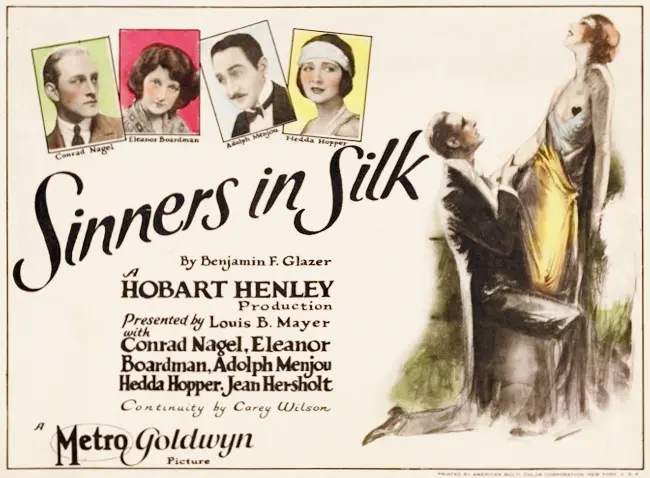
Stepping back into the Roaring Twenties, a decade synonymous with societal upheaval and cultural liberation, one encounters a cinematic artifact like Sinners in Silk (1924). This silent film, a fascinating product of its time, delves into themes that, remarkably, still resonate with contemporary audiences: the relentless pursuit of youth, the intoxicating allure of fleeting pleasures, and the profound journey of self-discovery. Directed with a keen eye for the era’s excesses and its underlying anxieties, the picture offers more than just a glimpse into Jazz Age hedonism; it presents a surprisingly nuanced moral fable, wrapped in the shimmering, often scandalous, trappings of a transformative decade.
At its heart lies Arthur Merrill, a character who embodies the existential ennui of a man grappling with the inexorable march of time. Merrill is not merely aging; he is decaying, or so he perceives. His weariness is palpable, a silent testament to a life perhaps lived too fully, or perhaps, not fully enough in the ways that truly matter. His encounter with Penelope Stevens aboard an ocean liner is the catalyst for his radical transformation. Penelope, a quintessential flapper, bursts onto the screen like a vibrant, rebellious splash of color in Merrill’s monochrome existence. Her vivacity, her daring spirit, and her uninhibited flirtatiousness are not just attractive; they are a siren call to Merrill’s dormant desires, sparking within him a desperate, almost pathological, yearning to reclaim his lost youth. This is not merely a desire for physical rejuvenation, but a profound yearning to recapture a spirit, a zest for life that he believes has long since deserted him. It’s a pursuit driven by a fear of irrelevance, a dread of fading into the background while the world pulsates with new energy.
The decision to undergo rejuvenation surgery, a fantastical concept even in the nascent scientific understanding of the 1920s, serves as a potent metaphor. It’s a desperate gambit, a Faustian bargain with the promise of eternal youth, highlighting humanity’s timeless obsession with defying mortality. The film doesn't shy away from presenting this as a somewhat grotesque, almost unnatural, endeavor. Merrill’s transformation isn't just physical; it’s an attempt at a spiritual rebirth, a shedding of his old, weary skin for a new, vibrant façade. The visual storytelling, characteristic of silent cinema, would have relied heavily on the actor’s portrayal of this metamorphosis – the initial weariness, the hopeful anticipation, and then the somewhat unsettling energy of his 'new' self. It’s a testament to the power of film, even without dialogue, to convey such complex internal struggles and external changes.
Post-transformation, Merrill plunges into Penelope's world, a maelstrom of wild jazz parties that serve as the film’s vibrant backdrop. These scenes are crucial, not just for their visual spectacle but for their thematic weight. They encapsulate the very essence of the Jazz Age – a period of unprecedented social change, moral loosening, and an almost frantic pursuit of pleasure. The flappers, with their bobbed hair, short skirts, and liberated attitudes, symbolized a seismic shift in gender roles and societal norms. Merrill, now ostensibly one of them, attempts to blend into this milieu, to become a part of the youthful exuberance he so craves. The film, through its depiction of these parties, offers a critique of the superficiality that often accompanied this newfound freedom. The laughter, the dancing, the alcohol – all are presented as a thin veneer, beneath which a deeper emptiness often resides. This is where the film begins to peel back the layers, revealing that external changes do not necessarily lead to internal fulfillment.
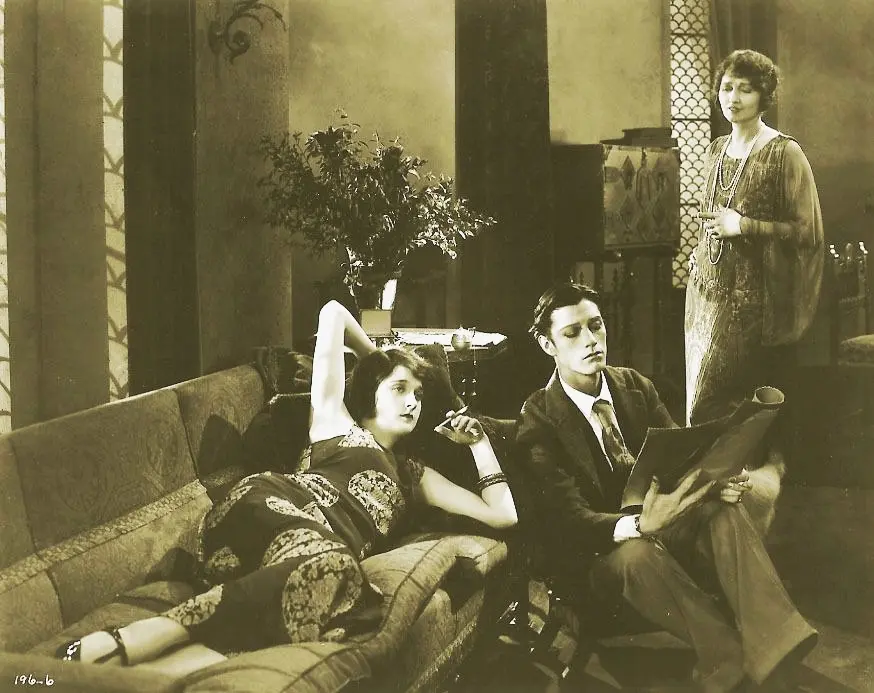
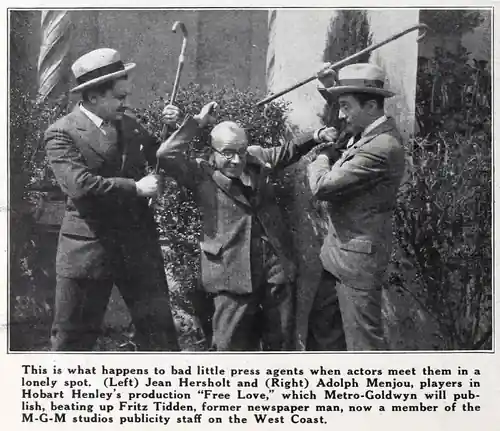
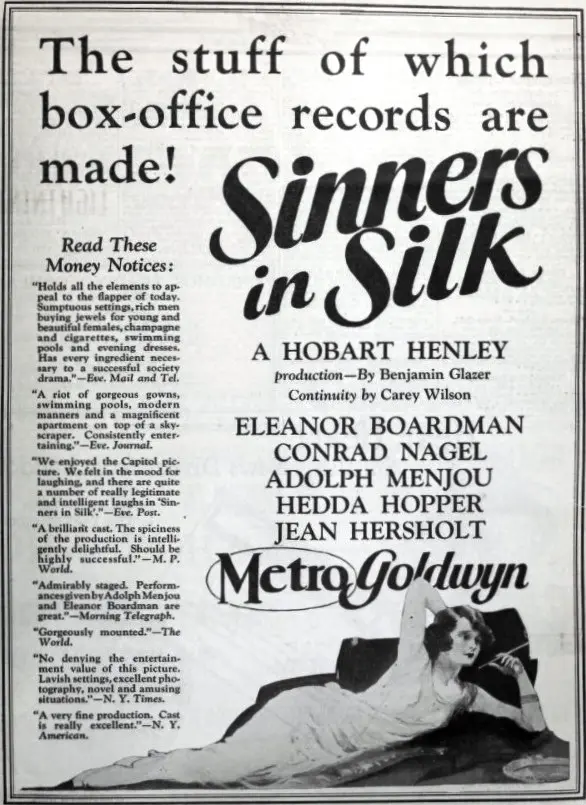
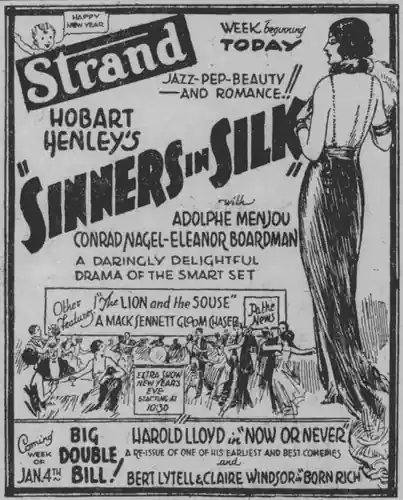
The ensemble cast of Sinners in Silk is a veritable who’s who of early Hollywood, featuring a fascinating mix of established stars and rising talents. John Patrick, as Arthur Merrill, would have had the formidable task of conveying a profound internal struggle through gesture and expression alone, charting a character arc from world-weary cynicism to misguided hedonism, and ultimately, to a quiet redemption. Eugenia Gilbert, as Penelope Stevens, embodies the contradictory spirit of the flapper – outwardly bold and independent, yet inwardly possessing a core of traditional values. Her performance would have been key to subverting the audience’s expectations, moving beyond the two-dimensional stereotype to reveal a character of unexpected depth. The supporting cast includes luminaries like Adolphe Menjou, known for his dapper sophistication, and the always compelling Conrad Nagel. Eleanor Boardman, Hedda Hopper, and Jean Hersholt also lend their considerable talents, contributing to the film’s rich tapestry of characters. Their presence alone suggests a production of significant ambition, aiming to capture the zeitgeist with a strong dramatic core. The silent era demanded a particular kind of acting, one of exaggerated yet precise gestures, of expressive eyes and nuanced body language, and these actors were masters of that craft.
The screenwriters, Carey Wilson and Benjamin Glazer, crafted a narrative that, while rooted in the popular sensationalism of the era (rejuvenation surgery!), ultimately delivers a timeless message. Their ability to weave together elements of social commentary, romance, and unexpected familial drama is commendable. The pacing, though often slower by modern standards, would have allowed for a deeper immersion into the characters' emotional states, a luxury afforded by the absence of spoken dialogue. The film doesn’t just show the events; it invites the viewer to feel them, to infer the unspoken thoughts and motivations of its protagonists. This is where silent cinema often excelled, in its capacity for visual poetry and its reliance on the audience’s imaginative engagement.
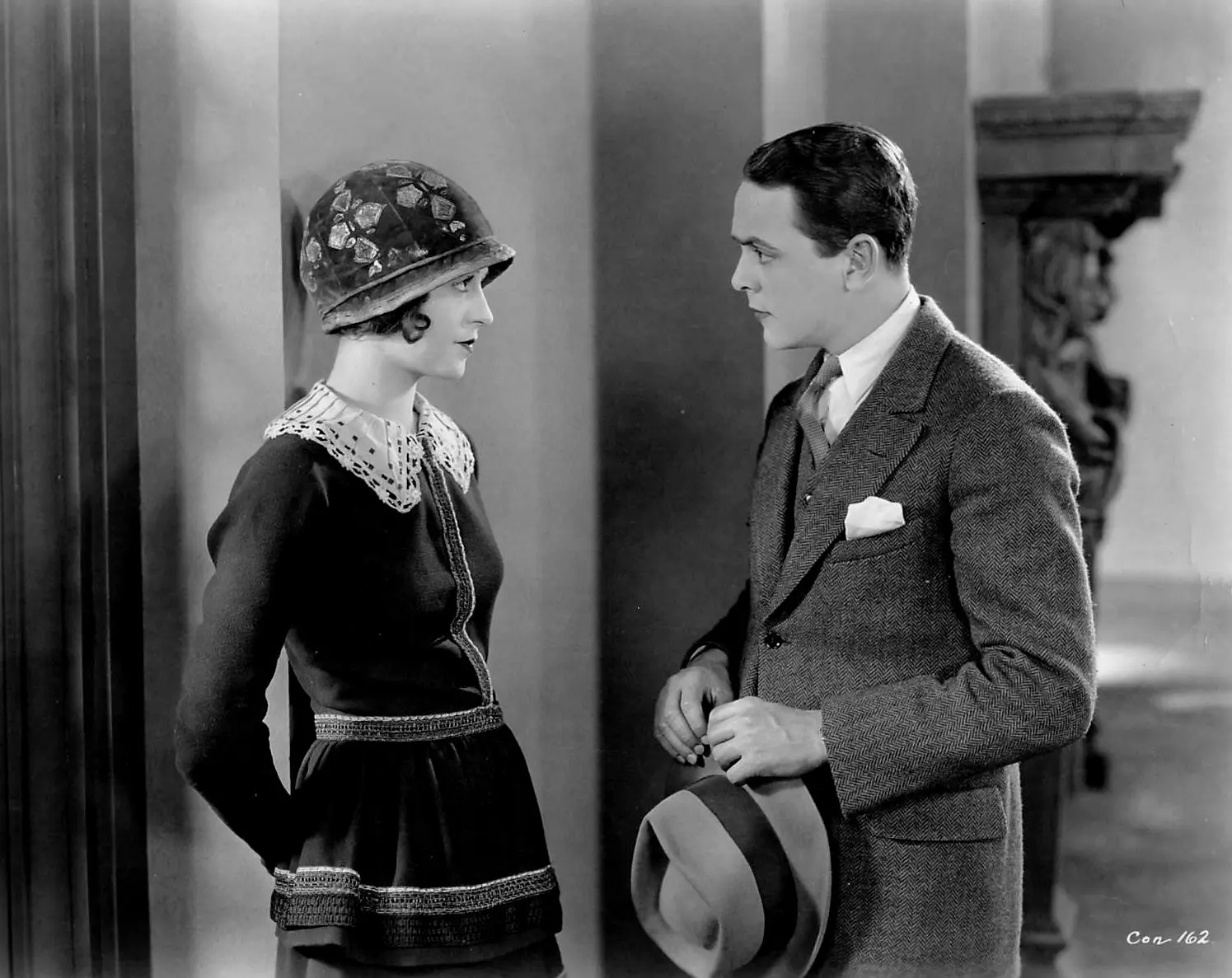
The pivotal moment arrives when Merrill persuades Penelope to visit his apartment. What begins as a seemingly successful seduction attempt quickly unravels. Merrill discovers that Penelope, despite her outward bravado and flirtatious demeanor, is a 'good girl' at heart. Her participation in the jazz parties is more a performance, an embrace of the era’s liberated spirit, than a true abandonment of her moral compass. This revelation is a crucial turning point, not just for Penelope, but for Merrill. It forces him to confront the superficiality of his own desires. His pursuit of youth was not about genuine connection or renewed vitality, but about a misguided attempt to recapture a feeling, to possess an image. The ensuing scare and lecture Merrill gives Penelope are surprisingly poignant. He becomes, in that moment, less a predator and more a disillusioned mentor, imparting a harsh truth born of his own bitter experience. It’s a moment of unexpected moral clarity, a crack in the façade of his rejuvenated self.
The dramatic reveal of Brock Farley as Merrill’s son is the narrative’s coup de grâce, a masterstroke of plot construction that recontextualizes everything that has come before. This unexpected familial connection fundamentally alters Merrill’s trajectory. His wild living, his desperate quest for youth, his pursuit of Penelope – all are suddenly rendered meaningless in the face of this profound, undeniable bond. It’s a moment of reckoning, a sudden realization that the true source of fulfillment lies not in external gratification or superficial transformation, but in the enduring ties of family and genuine human connection. This twist elevates Sinners in Silk beyond a mere morality tale of Jazz Age excess, infusing it with a deeper, more resonant emotional core. The immediate renunciation of his former life and his willingness to step aside for his son is a powerful act of redemption. It speaks to a fundamental shift in his values, a profound reorientation of his priorities. His return to a simple life is not a defeat, but a victory of self-awareness and moral rectitude.
The film, in its exploration of a man's misguided attempts to outrun time and his eventual spiritual awakening, touches upon themes echoed in other works of the era and beyond. While not a direct comparison, the idea of a secret or hidden identity dramatically altering the course of lives, or the revelation of a past that reshapes the present, can be seen in the dramatic tension of a mystery like The Mystery of the Poison Pool, where hidden truths similarly drive the narrative. The film also subtly critiques the societal pressures to maintain a youthful appearance, a theme that remains disturbingly relevant today. The Jazz Age itself, with its rapid changes and moral ambiguities, provided fertile ground for such stories. Films like Poor Men's Wives, for instance, also explored the social dynamics and moral dilemmas faced by individuals navigating a changing world, albeit from a different socioeconomic perspective. These films collectively painted a vivid picture of a society in flux, grappling with new freedoms and old values.
The narrative arc of Arthur Merrill, from jaded roué to rejuvenated hedonist, and finally to a man embracing humility and familial duty, is a compelling one. It's a journey from superficiality to substance, from self-absorption to self-sacrifice. The film suggests that true happiness and meaning are not found in chasing fleeting youth or external validation, but in authentic relationships and a clear moral compass. This message, delivered through the silent artistry of the 1920s, transcends the specific historical context and speaks to universal human experiences. The film's conclusion, with Merrill embracing a simpler life, is not a retreat but a progression, a testament to the idea that some transformations are not about becoming someone new, but about finally becoming one’s true self.
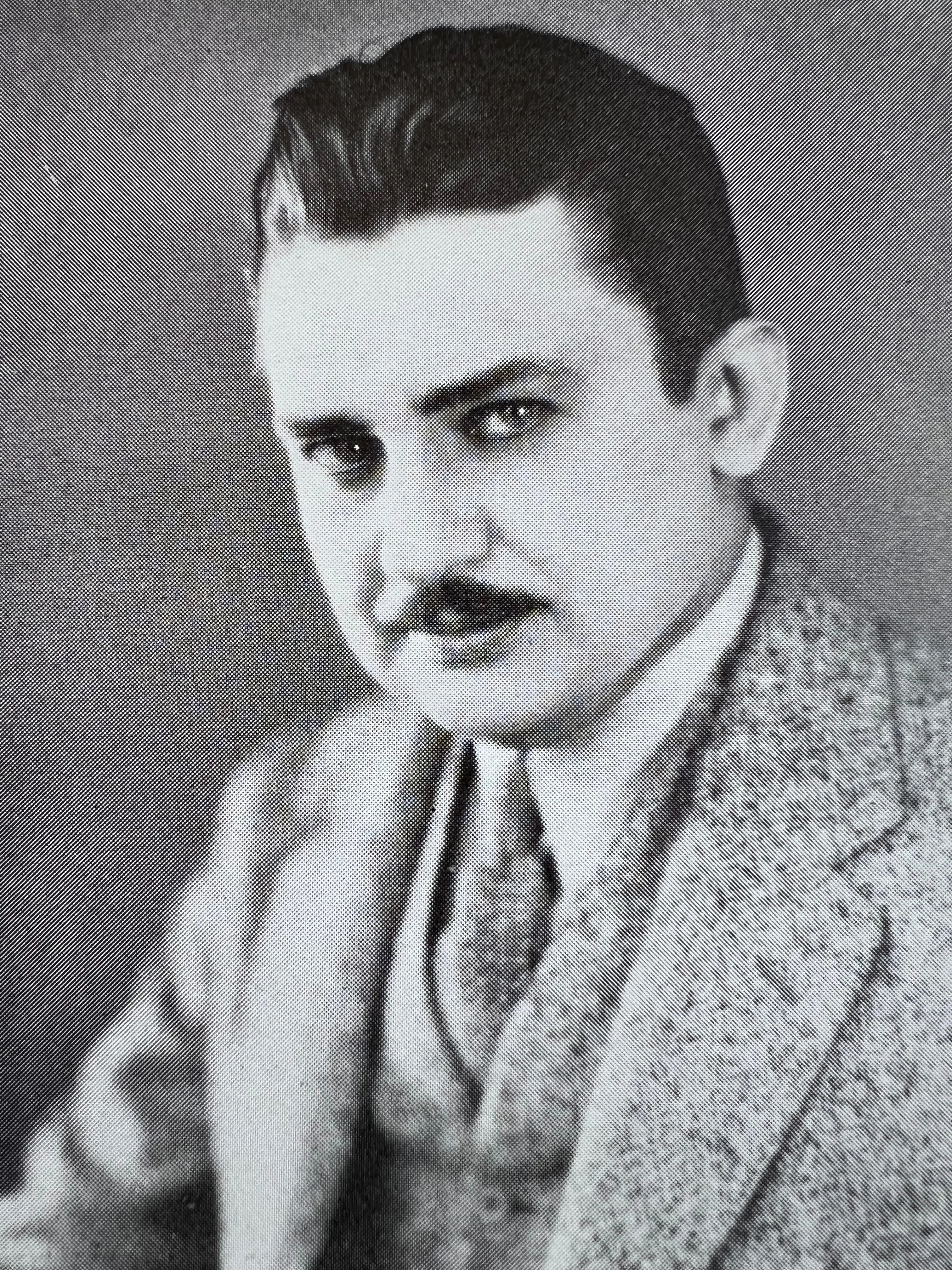
In terms of its aesthetic, Sinners in Silk would have utilized the visual language of silent cinema to great effect. The costumes, particularly Penelope's flapper attire, would have been crucial in defining character and era. The set designs, from the opulent ocean liner to the decadent jazz party venues and Merrill's lavish apartment, would have reinforced the film's themes of wealth, excess, and the pursuit of pleasure. The cinematography, though black and white, would have relied on dramatic lighting and expressive camera angles to convey mood and emotion, essential in the absence of spoken dialogue. The very title, Sinners in Silk, evokes the luxurious yet morally ambiguous world it portrays, hinting at the deceptive allure of appearances and the hidden truths beneath a polished surface. The 'silk' symbolizes the outward glamour and superficiality, while 'sinners' points to the moral ambiguities and the ultimate need for redemption.
The enduring appeal of a film like Sinners in Silk lies in its ability to capture a specific historical moment while simultaneously exploring timeless human dilemmas. It serves as a valuable historical document, showcasing the fashion, social mores, and anxieties of the 1920s. More importantly, it functions as a compelling narrative about the search for identity, the illusion of youth, and the profound impact of unexpected revelations. The film’s quiet resolution, with Merrill finding peace in a simpler, more authentic existence, offers a poignant counterpoint to the frenetic energy of the Jazz Age. It reminds us that sometimes, the most profound transformations occur not through radical external changes, but through an internal shift in perspective and a rediscovery of what truly matters. For those interested in the rich tapestry of early American cinema and the fascinating moral landscapes it explored, Sinners in Silk remains a compelling and thought-provoking watch, a testament to the power of silent storytelling to convey complex human truths with enduring resonance.
The film, with its intricate plot and character development, showcases the sophisticated storytelling capabilities of the silent era. It’s a reminder that even without spoken words, films could deliver powerful dramatic impact and explore profound philosophical questions. The work of writers Carey Wilson and Benjamin Glazer, alongside the performances of its stellar cast, ensures that Arthur Merrill’s journey from a disillusioned bon vivant to a man of quiet dignity is both believable and emotionally resonant. It’s a film that, despite its age, continues to speak to the human condition, making it a valuable piece of cinematic history that deserves to be revisited and appreciated. The dark orange, yellow, and sea blue colors, if applied to intertitles or promotional materials, would have further enhanced the visual richness and thematic depth of this intriguing silent classic, adding to its allure and hinting at the vibrant, sometimes turbulent, world it depicted.
IMDb 6.7
1934
Community
Log in to comment.