DbcultAccessing Vault...
Cult Review
Senior Film Conservator
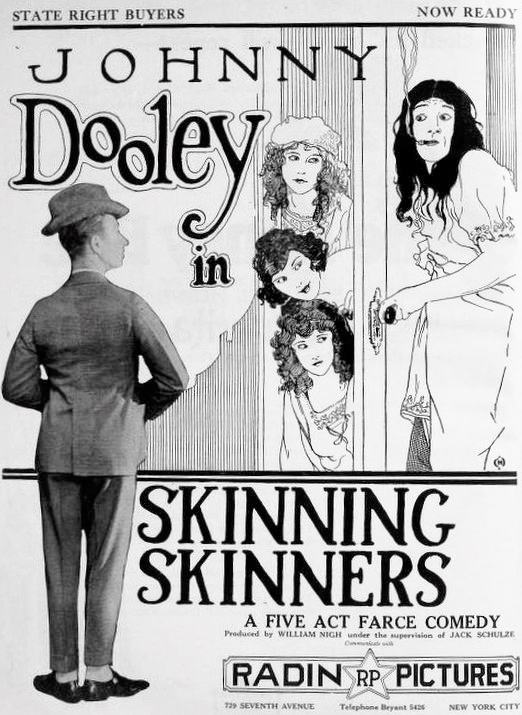
Early film comedies usually age about as gracefully as milk in July, yet Skinning Skinners arrives on the modern screen like a jeroboam of chilled champagne laced with strychnine: effervescent, lethal, and absolutely exhilarating. Shot in the autumn of 1914 while Europe’s trenches were being dug, this anarchic one-reeler feels eerily prophetic—an upper-class weekend orgy that cannibalizes itself before our eyes, leaving nothing behind but monocles cracked underfoot and the faint whiff of gunpowder.
Director-writer Frederick de Cordova (later famed for producing The Tonight Show) crams enough plot reversals into eleven minutes to fuel a contemporary miniseries. The result is a nickelodeon roller-coaster whose cars are upholstered in ermine and whose track is greased with malice aforethought.
De Cordova’s camera glides through drawing-rooms that reek of beeswax and betrayal. Every door sports a keyhole worthy of a peeping Tom; every tea service hides a listening device fashioned from silver spoons. The film’s visual grammar predates both Sylvia of the Secret Service and Buñuel’s The Exterminating Angel: aristocrats imprisoned by their own venality, unable to leave a house that is literally falling apart beam by beam.
Watch how cinematographer Rial Schell frames Lillian Hall’s entrance: a low-angle shot that makes her slender silhouette eclipse a stained-glass transom depicting Saint George skewering the dragon—an omen that the patron saint of England is about to be unhorsed by a guttersnipe in a thrift-shop hat.
Hall, a Broadway veteran who never quite clicked in features, delivers here a master-class in micro-gestures: the way her pupils dilate the instant she recognizes a diamond dog-collar is paste, the fractional tightening of her knuckles on a teacup when a duke calls her “my little colonial curiosity.” She weaponizes politeness the way a magician wields misdirection—every curtsey is a pickpocket’s flourish.
Irma Harrison, brittle as spun sugar and twice as sharp, plays the matriarch like Lady Macbeth reimagined by Punch magazine. Her line readings—delivered through intertitles that crackle with sardonic brevity—turn maternal concern into a shiv: “Do take care of the boy; he bruises like a peach—and bruised peaches fetch no price.”
Dan Mason’s robber-baron barks out fortune-hunting platitudes while literally measuring the library wainscoting for lumber resale. It’s a silent-era analogue to A Man’s Country, stripped of frontier machismo and dunked in drawing-room venom.
Maurine Powers’ trouser-clad photojournalist arrives clutching a Graflex camera the size of a tombstone. Within minutes she’s teaching the earl’s daughter how to knot a four-in-hand, effectively queering the household hierarchy long before the word gender-fluid existed. Their shared cigarette—lit behind a tapestry of Diana the Huntress—feels as transgressive as any scene in The Mysterious Lady, yet it’s played for breezy slapstick rather than tragic noir.
When the inevitable cross-dressing set-piece arrives—Hall disguised in a groom’s livery, Dooley’s valet poured into a debutante’s tea-gown—it’s not the customary Shakespearean confusion but a deliberate unmasking of social drag: everyone in this manor is already impersonating a role for which they’ve been miscast.
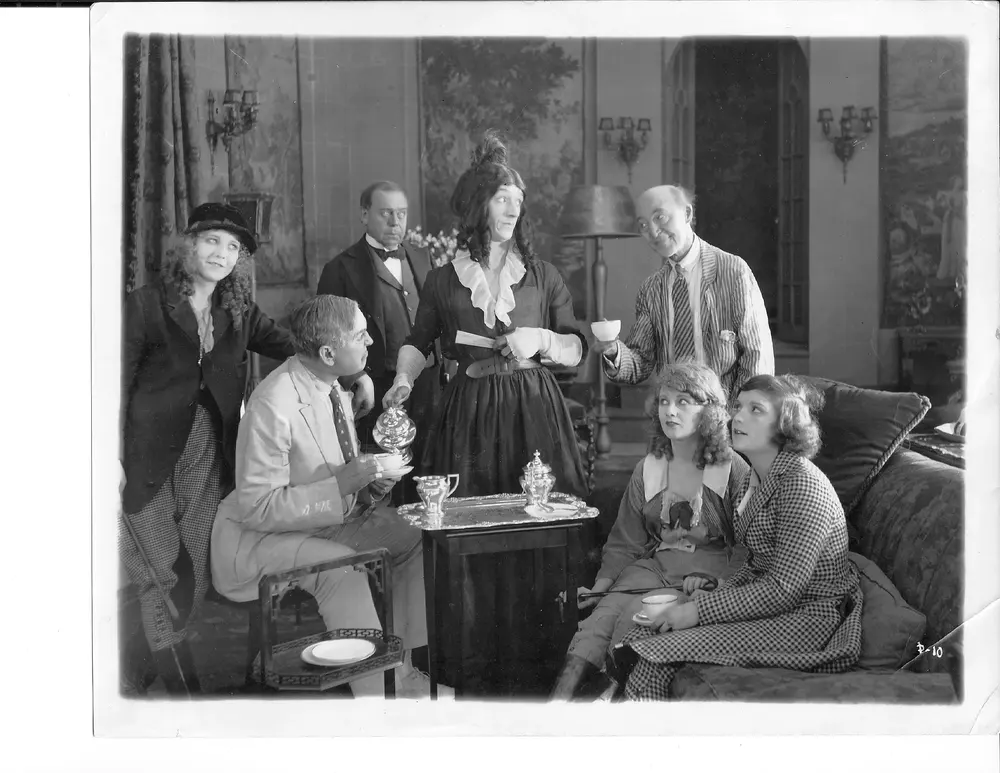
The central theft—an iridescent pearl necklace smuggled inside a hollowed-out croquet ball—unspools during a midnight game that turns into anarchic calisthenics. Characters scramble across the lawn like wind-up toys, silhouetted against a cyclorama painted with explosions of chalky moonlight. The effect is less Rules of the Game than Lord of the Flies in white tie, a savage reminder that the Edwardian garden party was merely a powder keg with cucumber sandwiches.
Editors in 1915 often punctuated slapstick with literal exclamation marks scratched onto the negative; de Cordova refuses such kid-glove condescension. He lets the mayhem play out in wide shots that recall Kissing Cup’s Race—only here the finish line is the dawn arrival of a local bobby who can’t decide whether to arrest the thieves or simply take notes.
Viewers weaned on Lubitsch’s Trouble in Paradise will spot pre-echoes in the way valuables change pockets mid-waltz; fans of Love Without Question will recognize the same cynical affection for crooks who adhere to a personal moral ledger. Yet Skinning Skinners predates them all, a prototype of the caper-comedy in which the loot is incidental to the pleasure of watching societal scabs ripped off.
Even the title itself—slang popular among shopgirls for “fleecing the rich”—functions like a battle cry. The phrase rolls off the tongue with the chewy satisfaction of a well-aimed stone lobbed at a chauffeur-driven Daimler.
The 4K restoration by EYE Filmmuseum reveals textures previously smothered in dupes: the shimmer of Harrison’s silk moiré, the caliginous shadows that pool like ink beneath card tables, the flicker of a servant’s clandestine smile. Composer Maud Nelissen supplies a jaunty chamber-score heavy on brass and snare, teasing out the militaristic undertone of a country house at war with itself.
Purists may carp that the tinting—amber for interiors, sea-green for gardens—leans toward the expressionistic, yet the palette only underscores the film’s thesis: civility is a veneer tinted by desire and desperation.
What lingers longest is not the gag-heavy set pieces but the chill recognition that these weekend cannibals are our contemporary oligarchs in embryo. Swap croquet for crypto, pearls for NFTs, and the same grifts echo across the centuries. The film’s closing iris-in on Hall’s wink feels less like a curtain call than a warning wink across time: We’re still picking your pockets, darling.
In an era when The Lion’s Claws celebrated imperial derring-do and A Daughter of the Poor romanticized virtuous poverty, Skinning Skinners occupies the delectable midpoint: it roots for nobody and everybody, a Marx Brothers romp without the sentimentality, a Buñuel banquet served at top speed.
Seek it out at an archive screening, stream it if some brave boutique label ever wrests the rights, but above all—should a 35 mm print surface in your grandmother’s attic—treat it like nitrate gold: combustible, priceless, and capable of lighting up the night like a stick of cinematic dynamite.
IMDb —
1917
Community
Log in to comment.