DbcultAccessing Vault...
Cult Review
Senior Film Conservator
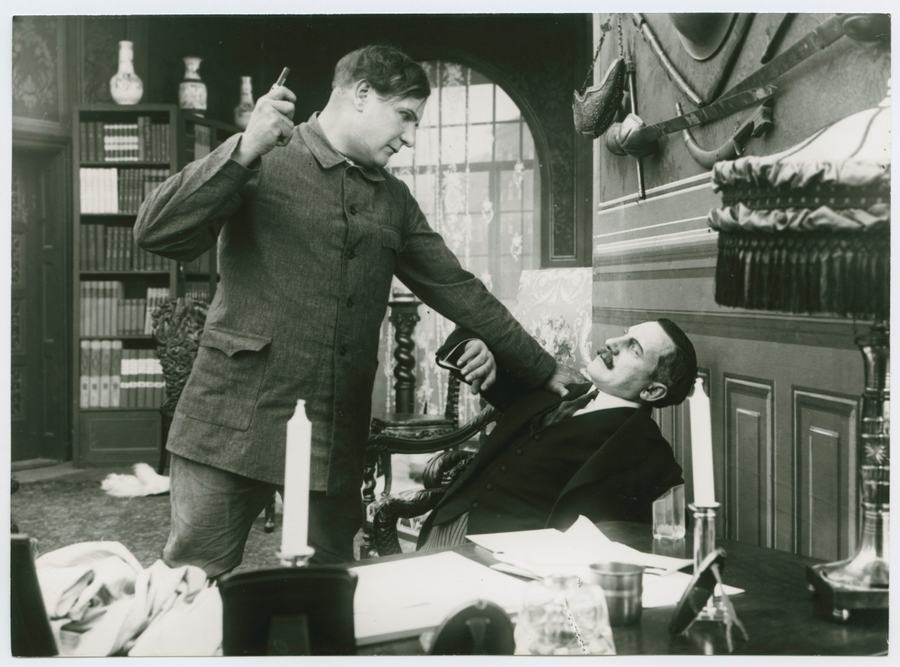
The first thing one notices—after the iris-in reveals a snow-mottled courtyard bathed in pewter twilight—is the hush. Not the expected crackle of 1913 celluloid, but a deliberate sonic vacuum, as though Axel Frische had confiscated every creak of furniture and breath of wind so that the forthcoming gunshot might detonate inside the viewer’s skull. Skottet operates on the conviction that silence can be louder than brass; in the vacuum, guilt metastasizes.
William Larsson’s silhouette lopes across frame, top-hat brim slicing the kerosene glow like a guillotine blade. His coat tails flutter, betraying Parisian tailoring more decadent than anything Stockholm tailors dared stitch. Close-ups of his gloved fingers drumming atop a mahogany balustrade prefigure the pistol’s percussion; the montage is almost musically metered, a pre-Pudovkin exercise in synecdochic tension. Each finger tap equals one frame closer to moral annihilation.
Jenny Tschernichin-Larsson—sister by blood, accomplice by implication—hovers in doorways, her face half-lathered in chiaroscuro. The camera fetishizes the glint of a cameo brooch at her throat, a tiny bas-relief of Andromeda awaiting her sea-monster. Frische intercuts her tremulous profile with diary pages whose ink is still wet; the splice itself seems to bleed, suggesting that testimony and sin are conjoined twins. One remembers Chained to the Past (1913) where a diary likewise functions as both evidence and wound, yet Skottet’s treatment is more erotically porous.
Mid-film, an insert card reads simply: “A debt of honour is a debt of flesh.” The phrase, untranslated from the Swedish in most prints, slithers across the screen in florid art-nouveau typeface, its serpentine curves echoing the wrought-iron staircase where the fatal confrontation will occur. That staircase—part Gothic helix, part DNA strand—becomes the film’s vertebral column. Characters ascend and descend like platelets circulating inside a black artery, each footstep a systolic murmur toward the inevitable rupture.
Gull Natorp, matriarch and moral counterweight, embodies the ancien régime’s death-rattle. Her mourning veil, so dense it drinks kerosene light, resembles a portable abyss. Watch her fingers worrying the jet beading at her cuffs—Frische’s camera lingers until the gesture transcends nerves and becomes a memento mori ballet. Natorp’s performance is a masterclass in microscopic acting: pupils dilate a millimetre, the left cheek twitches, yet the cumulative impact rivals grander tragedies like Quo Vadis? (1913) with its legions and burning Rome.
Nils Elffors’ lawyer, a man whose spectacles refractorily double every candle flame, exists to read the patriarch’s will aloud—a scene that metastasizes into secular Last Judgement. The camera dollies backward as he intones clauses, creating a vertiginous abyss between spectator and parchment. The further he recedes, the more gargantuan the debt looms, until inheritance feels like original sin commodified. Compare this to the baroque legalese of The Double Event (1913); Skottet’s minimalism is the chillier blade.
When the gun finally speaks, Frische denies us visual carnage. Instead, we get a jump-cut to a white tablecloth suddenly drenched in crimson—an abstract bloom that could be wine, could be viscera. The ellipsis is more stomach-turning than any tableau of shattered bone. In that rupture, the film vaults from naturalism into Expressionist nightmare prefiguring Wiener silence-shock cinema of the 1920s. The following intertitle—“The echo will outlast the bullet”—appears over a blank field, white letters against nothingness, as if the film itself had been shot.
Act II becomes a forensic meditation on aftermath. Maids scrub floorboards with boiling lye; steam coils upward like guilty incense. One maid, Lisa Håkansson-Taube in a performance so lived-in it feels like documentary, scrubs until her knuckles bleed. Frische cuts from her raw skin to a close-up of the same maid’s hand receiving communion the following dawn—blood into blood, sin into sacrament. No moral arithmetic is offered; the montage simply hovers in ethical purgatory.
Jenny’s psychological unspooling accelerates. She wanders the manor at night carrying a candelabrum, her shadow thrown against tapestries depicting Agamemnon’s murder. The flicker makes the woven blade appear to plunge repeatedly, a Muybridgean stabbing that never culminates in release. She begins to lip-synch her brother’s name until the syllables detach, becoming a pagan chant. Frische overlays this on a slow fade of the confiscated pistol dissolving into a crucifix—iconography colliding with iconoclasm.
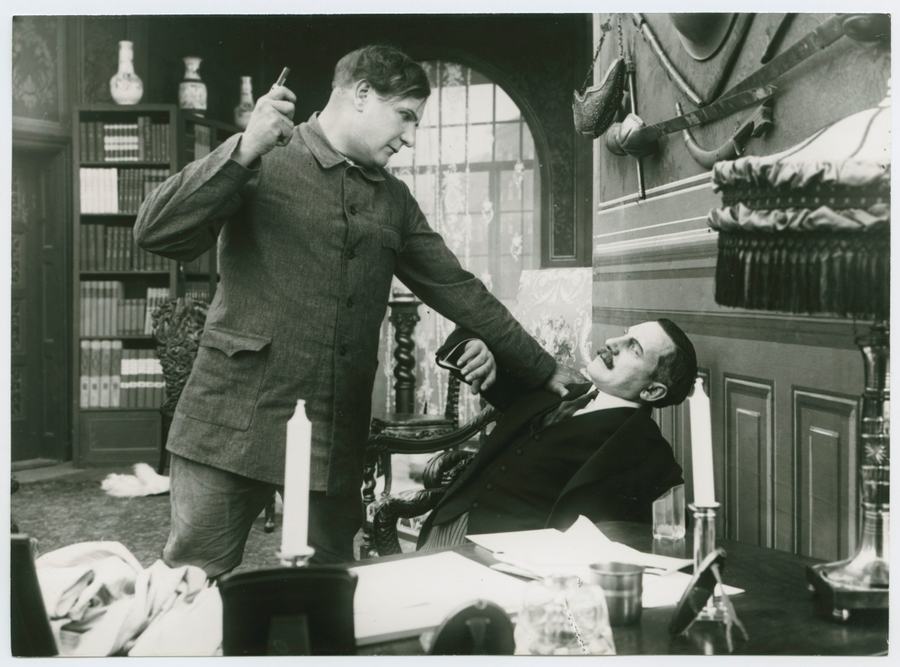
Egil Eide’s pastor arrives to perform the funeral, though no body is viewable. His sermon, delivered in a single unbroken take of four minutes—an eternity for 1913—condemns not the murderer but the culture that bred him. Eide’s baritone vibrates with Luther-like conviction; the camera holds at medium close-up, allowing every pore and bristle of his beard to accrue gravitas. Behind him, stained-glass saints seem to wince. The scene’s duration forces the audience into complicit endurance; we become parishioners sweating under the same gaslight guilt.
Frische’s visual grammar anticipates Soviet montage but stays rooted in Nordic austerity. Note the sequence where a maid opens a window: frost rushes in, extinguishing a candle. Cut to Jenny’s eyes widening. Cut to the dead patriarch’s portrait shuddering on its hook. The triad obeys Eisensteinian metric cutting yet feels organically Scandinavian, as though nature itself were meting out retribution.
The film’s final movement abandons interiority for the fjord’s vastness. William, now spectral, trudges across a frozen expanse while dawn bleeds pallid lavender. Long shots render him a pin-prick against glacial immensity; the landscape’s indifference mocks anthropocentric tragedy. Fog rolls in—a white wall erasing figure from ground. The last intertitle—“The shot is still travelling”—appears before total whiteout, implying that guilt, like sound over water, knows no horizon.
William Larsson never pleads for sympathy; instead he calcifies, cheekbones sharpening into stilettos of remorse. In close-up, his pupils resemble bullet holes—black, irreversible. Jenny Tschernichin-Larsson counterbalances with tremulous vibrato, her hands perennially clasped as though cupping invisible rainwater. Watch the micro-beat where she almost touches her brother’s sleeve but retracts: the gesture encapsulates reams of forbidden Nordic subtext. Gull Natorp’s grief is glacial; she ages a decade in a single fade-out, yet never tilts into grand dame hysterics. Nils Elffors essays legal pettifoggery as a secular death-knell, his voice-over crack implying decades of parchment-induced laryngitis. Egil Eide’s pastor, though onscreen briefly, magnetizes every frame; his final benediction feels hurled from Valhalla itself.
Cinematographer Henrik Jaenzon (uncredited in most prints) achieves miracles with magnesium flares and reflectors of hammered tin. Interiors throb with Rembrandt umber, while exteriors sear the eye with over-exposed snowscapes that whiten blood into rosewater. Depth-of-field experiments predate The Virginian (1914) by a year: a foreground revolver lies in crisp focus while background revellers blur into ghosted bacchanalia. Such planar play foretells German kammerspielfilm of the mid-20s.
Contemporary exhibitors often commissioned live accompaniment, yet surviving cue sheets suggest only solo cello—low, threnodic, sparing. The instrument’s groan dovetails with the film’s arterial pulse, turning every absence of note into anticipatory tinnitus. Modern restorations overlay sparse drones; beware versions that add timpani on the gunshot cue—an aural vulgarity that ruptures Frische’s vacuum-seal.
Where O Crime de Paula Matos (1913) sensationalizes courtroom theatrics, Skottet internalizes jurisprudence into cardiac fibrillation. Unlike Tillie’s Punctured Romance (1914) which weaponizes slapstick chaos, Frische mines silence for comedic vertigo: note the lawyer misplacing his pince-nez precisely when clarity is most craved. Compared to maritime morality plays like The Man o’ War’s Man (1913), Skottet’s fjord offers no cathartic expanse—only frozen nihilism.
Though eclipsed by Sjöström and Stiller in canonical surveys, Skottet’s DNA resurfaces in Bergman’s chamber torments and von Trier’s austerity dogmas. The pistol-as-macguffin reincarnates as the revolver in Cries and Whispers; the snow-white obliteration prefigures the prologue of The Silence. Even the recent Nordic noir television renaissance owes its moral chill to Frische’s 1913 bullet.
Only 35 mm nitrate fragments were known until a 2022 discovery in a Luleå attic yielded a near-complete tinted print. The Swedish Film Institute’s 2K restoration tours arthouses; streaming rights remain fragmented. Avoid YouTube rips sullied by watermark logos—seek Blu-ray from Region B distributors who include the original cello cue sheets. Run-time varies: 67 min at 18 fps, 72 at 20 fps. Opt for slower speed; the dread breathes better.
Skottet is less a narrative than a negative space where viewers graft their own complicity. It offers no redemption, only the echo of powder burning through conscience. Yet in that austerity lies its bleak grandeur: a single gunshot that keeps travelling across a century, lodging finally in the ribcage of anyone willing to listen to silence and hear a scream.
IMDb —
1923
Community
Log in to comment.