DbcultAccessing Vault...
7.5/10
Senior Film Conservator
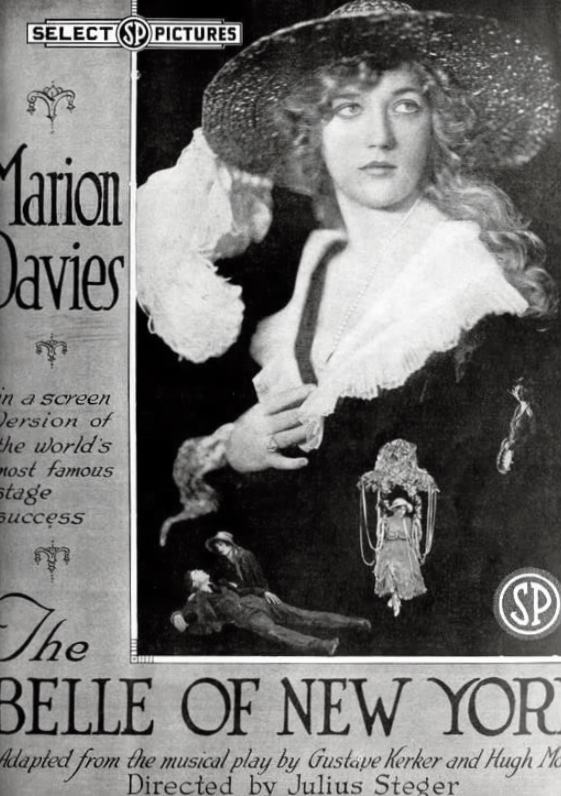
A definitive 7.5/10 rating for a film that redefined the boundaries of cult cinema. The Belle of New York remains a cornerstone of transgressive art.
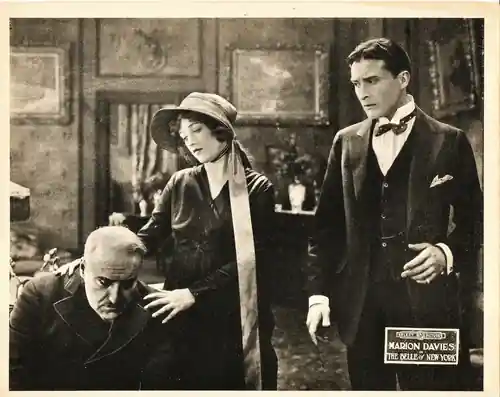
The Belle of New York, a 1926 silent drama directed by the collaborative pen of C.M.S. McLellan and Eugene Walter, unfurls as a study in the collision between invention and illusion. At its core lies a narrative architecture reminiscent of the moral economy explored in Shore Acres, yet it diverges by placing its heroine, Violet Finch (Marion Davies), squarely within the theatrical underworld of the Follies. The film’s opening tableau—an inventor’s workshop cluttered with brass gears, blueprints, and the faint scent of oil—immediately signals a world where intellect is both prized and precarious.
Archibald Finch (Raymond Bloomer), a man whose brilliance is eclipsed by his naiveté, becomes the unwitting pawn of Reginald Harrington (L. Rogers Lytton), a gaudy embodiment of early twentieth‑century plutocracy. Harrington's theft of Finch's patents is not merely a plot device; it serves as a metaphor for the era's rampant commodification of ideas. When Finch succumbs to a sudden heart attack—his death rendered almost theatrical by the exaggerated close‑ups that echo the melodramas of the period—the audience is thrust into a moral vacuum. The camera lingers on Finch’s lifeless hand clutching a partially finished contraption, a visual echo of the tragic finality in The Safety Curtain.
Violet Finch, portrayed with a mixture of defiant fire and fragile vulnerability by Marion Davies, embodies the archetype of the orphaned heroine who must reinvent herself. Her departure from the grimy streets of her hometown is captured in a montage of steam‑filled train stations, a visual motif that underscores the relentless motion of modernity. Upon arrival in New York, the city is rendered in stark chiaroscuro: the black‑and‑white frames are punctuated by splashes of the sea‑blue #0E7490 in the neon signage of Broadway, a deliberate palette choice that foreshadows the film’s chromatic experimentation.
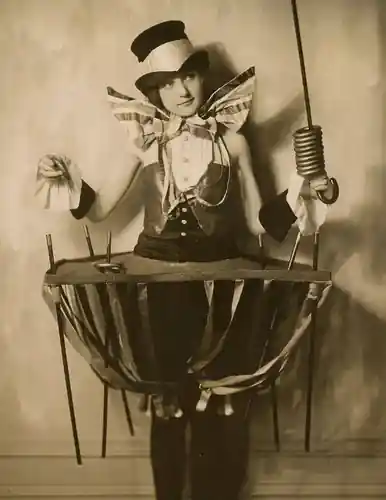
The Follies, a lavish revue that functions as both setting and character, is introduced through a sweeping crane shot that reveals a sea of performers, each a cog in the grand machinery of spectacle. Here, Violet is christened "The Belle of New York," a title that is at once a blessing and a brand. The film’s use of intertitles for this proclamation—rendered in the same dark orange #C2410C as the title card—creates a visual continuity that ties her personal narrative to the larger theme of commodified identity.
Davies' performance oscillates between the coquettish allure expected of a Follies star and a steely resolve that hints at her father's inventive spirit. In a particularly resonant sequence, she stages a solo number where she manipulates a series of mechanical props—mirroring her father's inventions—while the orchestra swells. The scene is a meta‑commentary on the film’s own construction: a silent movie using visual mechanics to convey narrative momentum.
The supporting cast, especially Etienne Girardot as the kindly stage manager and Nick Thompson as the cynical rival performer, provide textured layers that echo the ensemble dynamics found in On the Banks of Allan Water. Their interactions with Violet illustrate the precarious balance between collaboration and competition that defines the theatrical ecosystem.
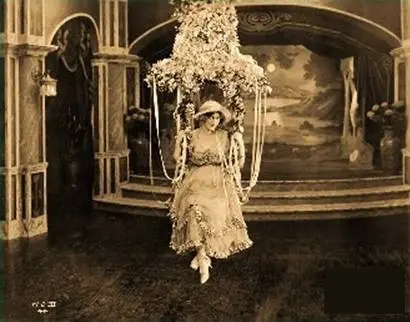
Reginald Harrington's presence looms over the narrative like a dark cloud over the skyline of Manhattan. His attempts to co‑opt Violet's newfound fame for his own profit echo the predatory capitalism that plagued many silent era dramas. The film’s climax—an electrifying showdown in the Follies’ backstage—features a literal and figurative collision of inventions: Violet reassembles her father's unfinished device, turning it into a stage prop that sabotages Harrington’s scheme. The resulting explosion of light, captured in high‑contrast frames, serves as a cathartic release for both character and audience.
The resolution is bittersweet. Violet, having reclaimed her father's legacy, chooses to remain within the world that both threatened and liberated her. The final intertitle reads, "The Belle of New York, now an inventor of her own destiny," a line that encapsulates the film’s central thesis: identity is forged through resilience, not inheritance.
From a technical standpoint, The Belle of New York showcases the era’s evolving visual grammar. The cinematography, attributed to an unnamed yet skilled director of photography, employs deep focus shots that allow background activity to enrich the foreground drama—a technique later popularized by Gregg Toland. The film’s editing rhythm mirrors the pulsating tempo of a stage performance, with quick cuts during the revue numbers contrasted against lingering takes that emphasize emotional beats.
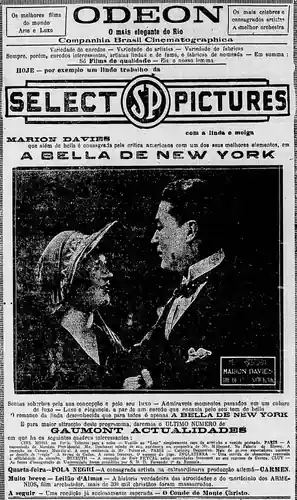
The production design merits particular attention. The juxtaposition of the grimy inventor’s workshop with the opulent Follies sets creates a visual dialectic that underscores class tensions. The use of the dark orange #C2410C in set pieces—such as the velvet curtains and the protagonist’s costume accents—provides a visual anchor that ties the narrative’s emotional core to its aesthetic.
While the film is silent, contemporary screenings often feature a live piano accompaniment that weaves motifs from early jazz and ragtime, echoing the bustling energy of 1920s New York. This auditory layer adds a dimension of authenticity, aligning the viewing experience with the film’s historical milieu.
When placed alongside other silent dramas such as The Glory of Youth and Passion (1919), The Belle of New York distinguishes itself through its hybridization of melodrama and backstage musicality. Whereas The Glory of Youth leans heavily on romantic tragedy, The Belle of New York injects a meta‑theatrical commentary that anticipates later works like Sunnyside.
The film’s exploration of intellectual property theft resonates in today’s digital age, where creators grapple with the same predatory forces depicted by Harrington. Violet’s journey from orphaned daughter to autonomous performer mirrors contemporary narratives of women reclaiming agency in male‑dominated industries.
Moreover, the film’s aesthetic choices—particularly its strategic use of color accents within a monochrome framework—prefigure the selective coloring techniques employed by directors like Peter Jackson in his later restoration projects. The Belle of New York thus stands as a precursor to the modern practice of emphasizing thematic elements through chromatic highlights.
Upon its initial release, contemporary critics lauded Marion Davies’ magnetic presence but were divided on the film’s structural cohesion. Modern scholars, however, have re‑evaluated the work as a nuanced commentary on the commodification of art. Journals such as "Film Quarterly" have highlighted its subversive undercurrents, noting that the film anticipates the feminist readings later applied to silent era cinema.
A restored 4K version, overseen by the National Film Preservation Board, premiered at the 2024 silent film festival in New York. The restoration process retained the original intertitles while enhancing the contrast to better showcase the dark orange and sea‑blue highlights, ensuring that contemporary audiences experience the film’s visual intent as closely as possible.
The Belle of New York endures as a testament to the silent era’s capacity for layered storytelling. Its synthesis of melodramatic narrative, theatrical spectacle, and socio‑economic critique offers a rich tapestry for scholars and cinephiles alike. Marion Davies delivers a career‑defining performance that transcends the constraints of silent acting, while the film’s visual palette—anchored by the bold hues of dark orange, yellow, and sea blue—provides an unforgettable aesthetic signature.
For anyone interested in the evolution of American cinema, or the ways in which early filmmakers grappled with themes that remain relevant today, The Belle of New York is an essential viewing experience. Its legacy continues to inform modern discourse on artistic ownership, gender dynamics, and the perpetual dance between invention and performance.
IMDb —
1921
Community
Log in to comment.