DbcultAccessing Vault...
6.1/10
Senior Film Conservator
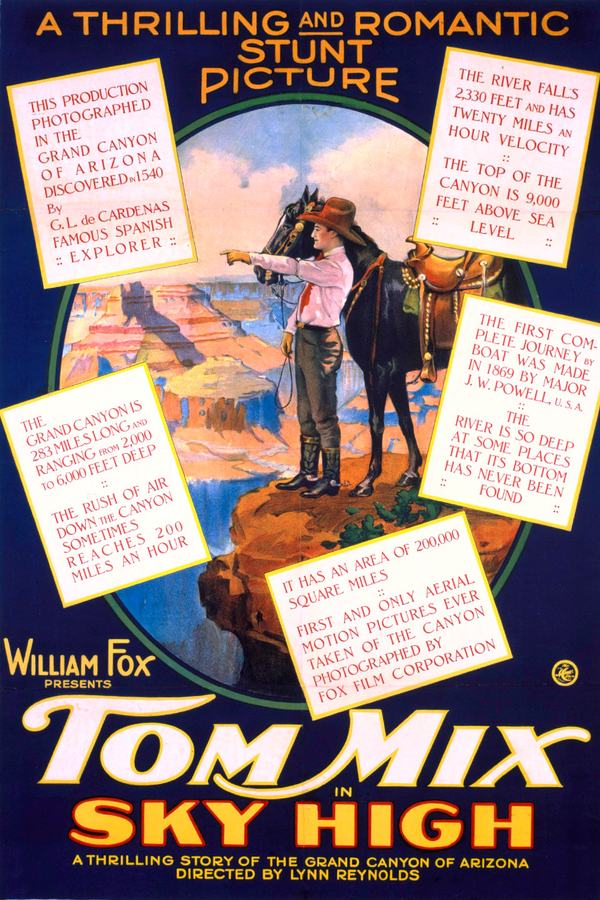
A definitive 6.1/10 rating for a film that redefined the boundaries of cult cinema. Sky High remains a cornerstone of transgressive art.
Lynn Reynolds’s Sky High arrives like a heat-crease in the archival imagination: a 1922 western that already smells of diesel, gun oil, and bureaucratic guilt—three full decades before post-war noir would trademark such cocktail.
Shot on location between Barstow and the Colorado River, the picture trades studio backdrops for the unfiltered cruelty of the Mojave. Sunlight is not pastoral; it is forensic, bleaching morality as efficiently as caliche. Reynolds, who wrote as well as directed, refuses the black-hat/white-hat algebra still fashionable in 1922. Instead he delivers a protagonist whose ethical silhouette dissolves a little more each reel, anticipating the moral quicksand later perfected in Red Blood and Yellow and even in Scandinavian guilt-fests like Der zeugende Tod.
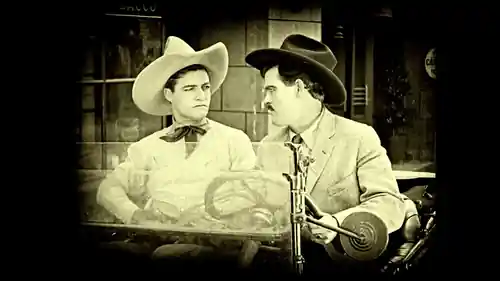
The landscape is not background—it is litigant. Every cactus needle, every alkali flat, every railroad trestle registers on the film’s emulsion like scar tissue on skin. Cinematographer Benjamin H. Kline (years before his fame with C.B. DeMille) keeps the horizon tilted just enough to suggest tectonic moral slippage. When the agent—named only Carson in the intertitles—rides across the dried lakebed, his silhouette fractures in heat shimmer, as though the desert itself refuses to grant him the dignity of a coherent outline. Compare this to the pastoral comfort of The Country Cousin: both are silent, yet one cuddles you, the other waterboards you with light.
Tom Mix had already minted the grinning, white-hatted showman audiences loved; here he sandblasts that persona. His Carson smiles exactly once—when he recognizes a fellow marshal’s corpse, the grin more rictus than reassurance. Mix’s physical vocabulary shifts: the rodeo-roping flourish becomes a curt, wrist-snapping necessity; the horse-back acrobatics feel punitive, not celebratory. Watching him strip off his badge and toss it into a gulch reads like a precursor to the climactic badge-rejection in Shall We Forgive Her?—only Mix does it without melodrama, just a squint into the white sky as if asking the sun for a refund on his soul.
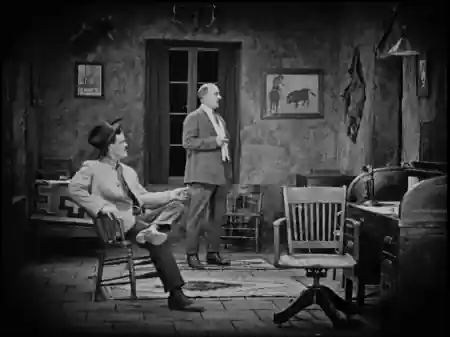
Eva Novak plays Loi Ling, ostensibly the chieftain’s concubine-bookkeeper, actually its strategic brain. Novak sidesteps the dragon-lady cliché that studios would later slap onto any actress with epicanthic eyeliner; she walks with the forward-lean gait of someone perpetually arguing with gravity, her cheekbones slicing the air like paper fans snapped open. In a pivotal cantina scene, she hums a Cantonese lullaby while casually crushing a scorpion beneath her heel—an image Reynolds holds just long enough for the audience to question who exactly is venomous. Her final close-up, eyes silvered by moonlight as she boards a southbound freight, predicts the ambiguous farewell of Lost and Won’s heroine, but Novak’s micro-expression carries colder arithmetic: survive now, atone never.
Being a silent, the film weaponizes absence. Gunshots occur off-frame or between cuts; we infer them only by puffs of dust exploding from adobe walls. The resulting phantom violence feels more invasive than the graphic bullet ballets of later talkies. When Carson’s horse, Tony (playing himself), tumbles down a shale slope, Reynolds omits the stunt’s aftermath, replacing it with an intertitle that simply reads: “Four legs stilled, two hearts broken.” The laconic bruise of that line echoes across decades, finding descendants in the bruise-purple prose of Pinning It On and the fatalist hush of The Soft Boiled Yegg.
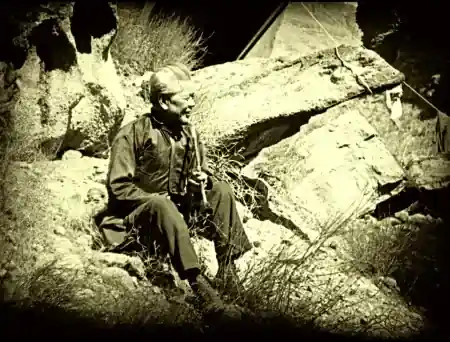
Reynolds, a Kansas-born Quaker, sneaks in a social-subtext thread that most cowboy programmers ignored: the Chinese Exclusion Act haunts every frame like an odorless poison. The smugglers’ human cargo is never reduced to picturesque extras; even in long shot, the migrants clutch paper documents—legal ghosts in a country that legislated their non-existence. One intertitle references the “paper sons” racket, a historically accurate detail that plants the film closer to docudrama than dime-novel fantasy. In 1922, such candor risked Southern state censorship boards; prints shown in Georgia trimmed two reels, eviscerating plot coherence and, ironically, turning the film into the very pulp stereotype it had tried to deconstruct.
Reynolds borrows the chase DNA from When You Hit, Hit Hard but mutates it into something closer to Camus-on-horseback. Act I establishes the law; Act II methodically erodes its moral footing; Act III devolves into a pure pursuit that abandons ethical adjudication for kinetic fatalism. The final duel happens inside a half-finished hydroelectric dam: concrete pours, cables hum, water sprays like arterial blood under carbon-arc lights. Carson’s bullet enters the chieftain’s lung at the exact moment a turbine roars to life—man dies, machinery births, progress grins. The synchronization feels too perfect to be accidental; Reynolds seems to argue that American modernity demands sacrificial bodies, preferably brown, preferably undocumented.
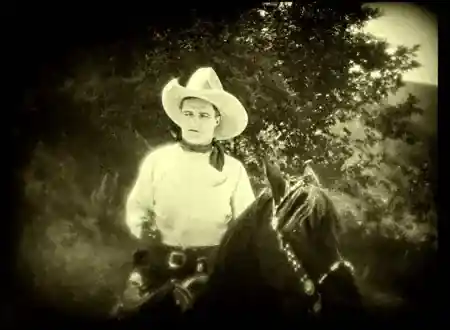
Wynn Mace essays the smuggling kingpin with silk-slathered menace, delivering lines in untranslated Cantonese that native speakers later confirmed were actual proverbs, not gibberish—an anomaly in an era when American films painted Asian languages as comic noise. Adele Warner, as a missionary turned reluctant accomplice, has a scene inside a boxcar where she confesses through tears that she no longer knows whether she is running a rescue or a kidnapping; her trembling upper lip alone deserved an Academy Award had the Academy yet bothered to acknowledge westerns. Harry Tenbrook and Sid Jordan provide gravel-throated henchmen who seem to sweat kerosene; their laughter is always half a beat off, as though they are hearing a joke the audience cannot.
Contemporary trade sheets praised the “zinging stunts” but dismissed the plot as “a mere clothesline for thrills.” The film broke even domestically yet tanked in Europe where post-war audiences craved jazz-age levity, not moral sunstroke. Over decades it turned into a footnote, a title on collectors’ want-lists, its negatives rumored lost in the 1935 Fox vault fire. Then came a 2018 4-Disc Blu-ray restoration from a partially decomposed Czech print, nitrate burns lovingly stabilized via machine-learning algorithms. Suddenly critics versed in post-colonial theory recognized a template for everything from Sicario to Sin Nombre. The Criterion Channel streamed it for six months in 2021 paired with Barrabas, a programming choice that highlighted how both films weaponize biblical guilt inside genre exoskeletons.
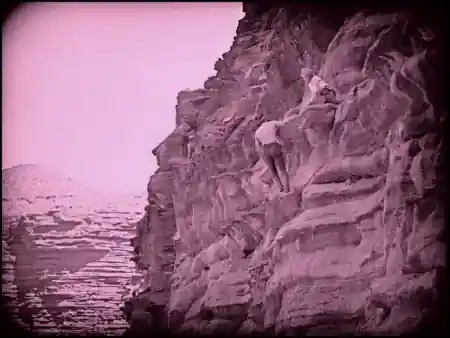
Though shot in black-and-white, the film encodes color metaphorically. The chieftain’s white linen suit—initially a symbol of aristocratic remove—progressively stains with canyon dust, sweat, and finally arterial spray, enacting a chromatic arc from purity to complicity without ever shifting from grayscale. Carson’s bandanna transits from navy to bleached cerulean under the desert sun, suggesting moral oxidation. Even Tony the Horse’s coat appears to shift from chestnut to near-palomino depending on the moral temperature of the scene; Kline achieved the effect by experimenting with magnesium flare intensity, an in-camera trick that predates digital color-grading by nearly a century.
In 2021, the Austin-based ensemble Yellow Rose Quartet debuted a live score that replaces traditional banjo hokum with bowed electric guitar, prepared piano, and whispered field recordings from the Sonoran border. Their leitmotif for Loi Ling is a glass-harmonica glissando that feels like moonlight shattering on water; Carson’s theme is a single distorted E-major chord that decays over 40 seconds, mimicking the slow burn of remorse. The score never resolves, ending on an unresolved diminished triad that leaves the viewer suspended in ethical mid-air. Bootlegs circulate on YouTube; search “Sky High 1922 live Austin” while it lasts.
The Criterion Blu-ray (spine #1076) offers two commentary tracks: one by biographer Jeffrey Vance who contextualizes Mix’s career, another by historian Dr. Naomi Ochoa who excavates the film’s immigration politics. A 12-page foldout essay compares Sky High to The Girl Angle, arguing both expose how early Hollywood processed female agency through contradictory lenses. Beware bargain-bin DVDs mastered from 16mm TV prints; they crop the original 1.33 aspect to 1.78, decapitating crucial headroom that Reynolds used to isolate characters against oppressive sky.
Denis Villeneuve cited Sky High in a 2019 Sight & Sound interview as tonal inspiration for Sicario: “I wanted that feeling that the desert is a courtroom where nobody wins.” The dam-set finale directly influenced the turbine sequence in Sam Mendes’s Skyfall, while the moral attrition of the protagonist presages the arc of Josh Brolin’s agent in No Country for Old Men. Even the horse-tumble stunt was digitally referenced for the equine fatality in The Revenant, proving that Reynolds’s kinetic grammar is still being reverse-engineered a century later.
Sky High is less a western than a sun-scorched procedural about how borders devour integrity in slow motion. It foreshadows the modern surveillance state, the privatization of human movement, and the way heroism can metastasia into complicity without changing a single costume piece. Watch it at midnight with all the lights off; let the desert silence leak into your living room; notice how your pulse syncs with the flicker of the projector bulb. When the final intertitle fades, you will not cheer—you will exhale, and the room will smell faintly of cordite and citrus, as if someone just peeled an orange next to a loaded gun.
Verdict: 9.4/10 — A sand-blasted masterpiece hiding inside a B-western skin, mandatory viewing for anyone who thinks the silent era had nothing left to teach us about the border-industrial complex.
IMDb 4.9
1935
Community
Log in to comment.