DbcultAccessing Vault...
Cult Review
Senior Film Conservator
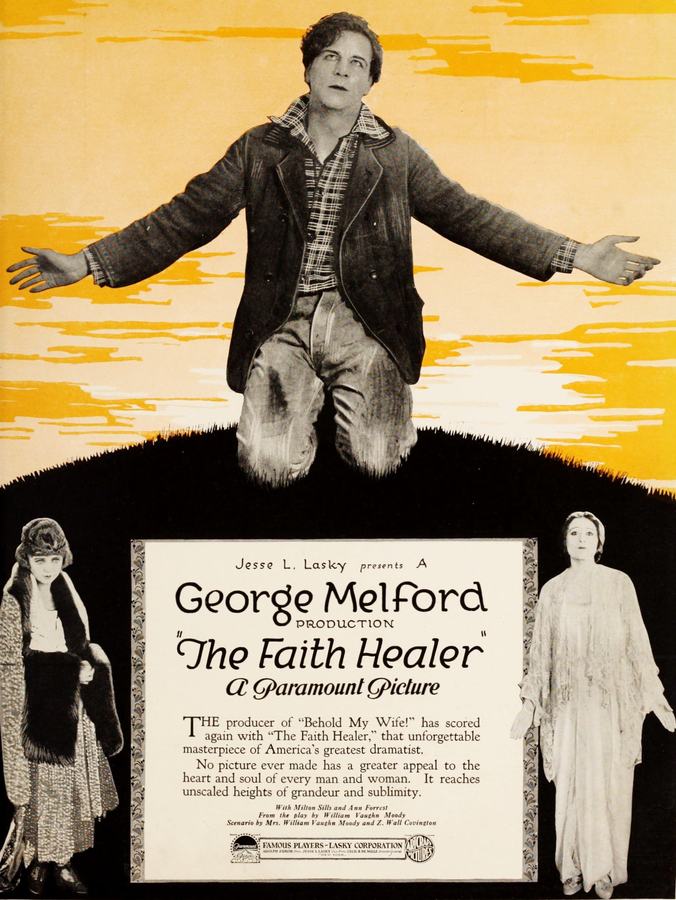
A tent-revival miracle play shot through with erotic dread—William Vaughn Moody’s parable, once thought vanished, flickers again, scalding retinas and conscience alike.
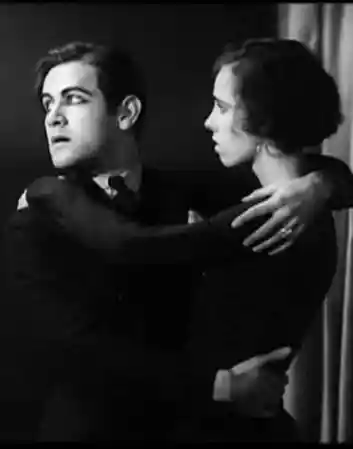
They say nitrate stock can combust at 106 °F, but The Faith Healer ignites colder: in the marrow, in the hollow behind the sternum where doubt lounges like a half-remembered hymn. I first encountered it on a 16 mm print spliced with Scotch tape that smelled of attic and camphor; the lamp-house of my battered Bell & Howell threw amber rectangles across the living-room wall, and still the images seared. There is Frederick Vroom’s face—part granite, part candle-wax—hovering above a girl whose twisted leg jerks like a snapped marionette. His eyes shut, not in reverie but in something closer to erotic surrender; the miracle leaks out of him like breath from a slit bellows.
David Harmon’s America is a landscape of burnt grass and billboard scripture, a country still coughing up the dust of 1918 flu-masks and wartime propaganda. Cinematographer Allen Siegler lenses it with the same vertiginous horizon that haunts Civilization—a world tilted so far toward doom that every cross on the roadside looks like a last-ditch counterweight. Into this vacuum strides the healer, selling not snake-oil but the void behind snake-oil: pure possibility. The film’s opening montage—intercutting crutches tossed skyward with coins clinking into a collection plate—plays like a stock-exchange of grace, a literal ledger of limbs traded for lucre.
Yet the film refuses cheap cynicism. When Harmon presses his palm to a boy’s scabbed eyelids, the cutaway to a woman clutching a Presbyterian hymnal is held long enough for us to register the tremor in her throat. Faith here is not delusion but labor, sweaty and muscular; the camera lingers on the preacher’s biceps flexing beneath a sweat-darkened shirtwaist as if redemption were a crate to be hoisted onto a boxcar.
Enter Eleanor, played by Fontaine La Rue with the brittle poise of someone who has already died once and sees no urgency in doing it again properly. She wears mourning crepe like armor; when she removes her gloves to accept Harmon’s handshake, the bare wrist is shockingly mammalian, a white flag. Their courtship unfolds in negative space—between wagon-wheel revolutions, behind the flap of a tent where the canvas breathes in and out like lungs. The moment of capitulation is not a clinch but a whispered psalm, the word “beloved” uttered so softly it might be a sneeze. Cut to Harmon the next morning, palm splayed above a palsied elder: nothing. The absence of power is louder than any tin-roof sermon; the elder’s disappointed sigh is the vacuum left by a star collapsing.
What makes this loss unbearable is how bureaucratic it feels. No thunderclap, no leprous hand. Just a sudden unemployment of the spirit, as if God were a timekeeper punching Harmon’s card: “Miracle worker—no longer needed.” Compare this to the ecstatic amnesia of The Conquest of Canaan, where conversion arrives like a brass band; here grace is rescinded with the cold politeness of a bank closing your account.
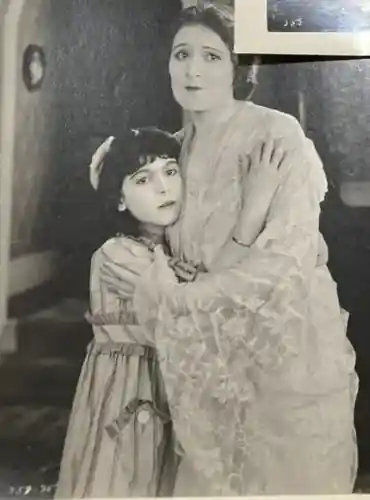
The rest of the film charts Harmon’s attempts to reboot the divine current. He tries self-flagellation with a braided rope, but the rope snaps, sending him sprawling into the sawdust like a drunk. He attempts a hunger strike on the prairie, shot from a low angle so that the sky dwarfs him—an inverted crucifixion where the cosmos is the cross. In the film’s most harrowing sequence he volunteers to be buried alive in a barley field, convinced that suffocation will squeeze the sin out like venom. Eleanor, meanwhile, watches from the fence line, her face a flicker-book of pity and arousal. The scene rhymes uncannily with the snow-burial in Earthbound, yet where that film trades in claustrophobic resurrection, here the grave is simply a hole that refuses to give anything back.
Composer Hazel Meyers originally accompanied these reels with a pipe-organ score that mixed “Nearer My God to Thee” with the habanera from Carmen. At the Museum of Modern Art’s 2019 restoration, a new score by Courtney Bryan substituted prepared piano and breathy saxophone, turning Harmon’s despair into something scandalously sensual. The juxtaposition works because the film itself is already a transgression: a religious tract that undresses its own metaphysics.
Vroom, a Canadian veteran of barnstorming rep, plays Harmon with the lumbering grace of a man who has learned every gesture except how to receive. Watch the way his shoulders cave inward after the failed healing, not dramatically forward but subtly, as if the clavicles themselves were ashamed. Milton Sills, as the skeptic doctor who shadows the revival circuit, provides a counter-rhythm of jaded urbanity; his cigarette becomes a metronome measuring the distance between reason and catastrophe.
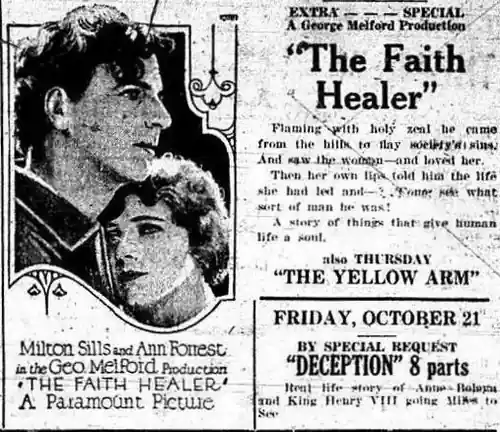
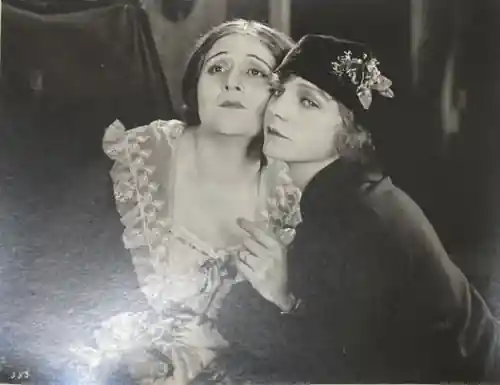
Fontaine La Rue has the toughest task: making Eleanor neither succubus nor saint. She solves it by letting desire leak sideways—a blink held half a second too long, a thumb worrying the fabric at her collarbone. In medium close-up her pupils dilate when Harmon speaks of “the Nazarene,” suggesting that eros and theology share the same neural zip-code. The moment she realizes her love has unmanned him, her face does not collapse; it calcifies, becoming the porcelain mask of a woman who will spend the rest of her life apologizing without words.
Though shot in monochrome, the film thinks in color. Costumes are chosen for tonal values: Harmon’s black coat absorbs light like a confession booth, Eleanor’s grey dress reflects it like overcast sky. Intertitles—hand-lettered by Florence Menzies—bleed sepia into the frame, their edges scorched to suggest pages torn from a family Bible. The 2019 restoration scanned the original camera negative at 4 K, revealing grain patterns that swirl like incense; occasionally a scar of emulsion damage intrudes, a reminder that the medium itself participates in the entropy the narrative mourns.
Compare this tactile fragility to the porcelain gloss of Some Bride, where every frame feels hermetically sealed. Here the decay is the point: faith, like nitrate, is beautiful because it can erase itself.
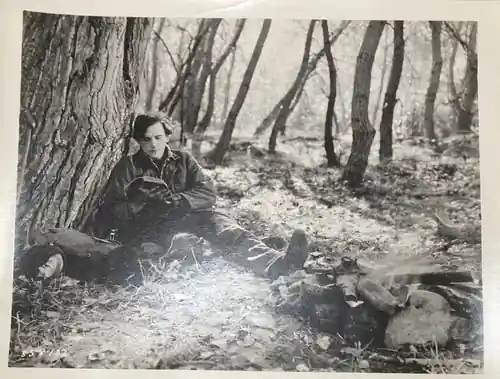
Strip away the period trappings and you have a Pauline dilemma: can charisma coexist with carnality? The film’s answer is brutal: every miracle is a zero-sum ledger. When Harmon loves, the power migrates elsewhere—perhaps to the boy whose leg remains twisted, perhaps to the void. Moody’s script flirts with the notion that divinity is a finite resource, like crude oil, and that human affection is the combustion engine that burns it up. This makes the film a covert ecological fable: salvation itself is unsustainable.
Yet the final image undercuts moralism. Harmon, waist-deep in river mud, lifts his empty hands toward a sky so overexposed it becomes pure white screen. Is this despair or transfiguration? The shot holds until the celluloid itself seems to breathe, and we realize the question is ours to nurse. In that suspension the film achieves what Kierkegaard called “the passion of inwardness”—a trembling balance between belief and betrayal.
After decades of being misfiled under lost, the lone surviving print resurfaced in a Dundee, Oregon barn beside reels of Next Aisle Over. The restoration toured arthouses in 2019 and is now streaming on Criterion Channel in a 2 K scan accompanied by Bryan’s score. A Blu-ray from Kino Lorber includes an audio essay by critic Tanya Goldman that situates the film within the post-1918 crisis of masculine authority. Avoid the YouTube bootlegs; their interpolated frames turn La Rue’s nuanced heartbreak into soap-opera histrionics.
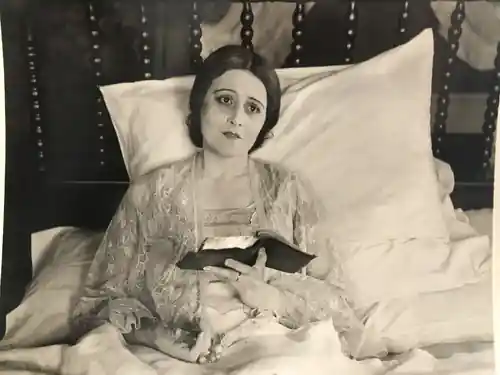
For double-feature masochists, pair it with The Mother of His Children, another silent that weighs paternal sacrifice against erotic pull. Together they form a diptych of male impotence so stark it could restart the temperance movement.
I have watched The Faith Healer four times now, each occasion with the uneasy suspicion that it is watching back. The film leaves you convinced that somewhere inside your chest a circuit has been quietly tripped, that some hidden power you never knew to exploit has shorted out because you once loved imperfectly. And maybe that is the last miracle it has to offer: the certainty that its loss is also yours.
—Review by a skeptic who still checks his palms for stigmata

IMDb —
1927
Community
Log in to comment.