DbcultAccessing Vault...
Cult Review
Senior Film Conservator
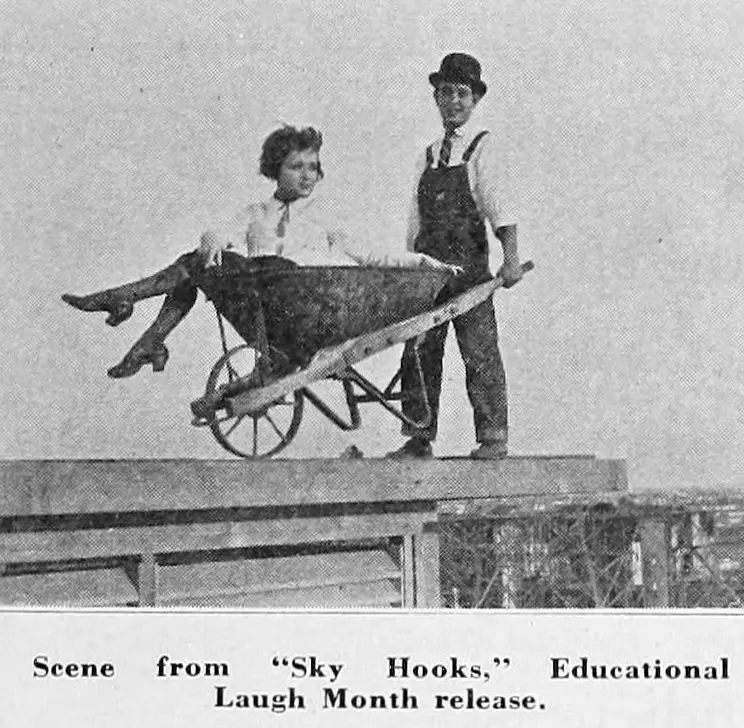
Is 'Sky Hooks' worth watching today? Short answer: yes, but with significant caveats that demand a specific viewing palate. This silent-era short is a fascinating historical artifact and a testament to early physical comedy, making it a compelling watch for film historians, silent film enthusiasts, and those curious about the roots of slapstick. However, it is decidedly not for viewers seeking modern narrative complexity, nuanced character development, or a consistently polished cinematic experience.
This film works because of its audacious physical comedy and the sheer novelty of its high-altitude setting, showcasing a daring practical effects approach that feels genuinely thrilling even a century later. This film fails because its narrative is paper-thin, its characters are broad caricatures, and the humor, while effective in bursts, can feel dated and repetitive to a contemporary audience. You should watch it if you appreciate the raw, unrefined energy of early cinema, enjoy silent slapstick, or have a keen interest in the evolution of stunt work and comedic timing in film history.
The silent era, a period often romanticized for its cinematic innocence, was in fact a hotbed of innovation, experimentation, and often, sheer audacity. Before the advent of synchronized sound, filmmakers relied entirely on visual storytelling, and nowhere was this more evident than in the realm of comedy. Physicality reigned supreme, with performers like Buster Keaton, Charlie Chaplin, and Harold Lloyd pushing the boundaries of what was physically possible and comically effective on screen. Many lesser-known shorts, like 'Sky Hooks,' contribute significantly to this rich tapestry, offering snapshots of a filmmaking style that prioritized immediate, visceral reactions over intricate plots.
These films were not just entertainment; they were often technical marvels, showcasing practical effects and stunt work that would make modern audiences wince. 'Sky Hooks' belongs to this tradition, a brief but impactful demonstration of high-stakes slapstick. It strips away all pretense of deep character study or profound social commentary, focusing instead on a primal conflict fueled by desperation and revenge, all unfolding on a literally elevated stage.
The narrative thrust of 'Sky Hooks' is refreshingly, almost brutally, simple. We are introduced to Cliff, a man clearly down on his luck, desperate for work in an unforgiving urban landscape. His opportunity arises through an employment agency, but it’s not for him. Instead, it’s for a hulking figure, a 'husky' type, who embodies physical dominance. In a swift, morally dubious move, Cliff intercepts and steals this golden ticket to employment.
His ill-gotten gains land him a job as a brick-carting laborer on a skyscraper under construction—a setting that immediately elevates the stakes, both literally and figuratively. The sheer scale of the building, reaching precariously into the sky, serves as a constant visual reminder of the danger. It’s a workplace where a single misstep could lead to catastrophe, a detail the film exploits for both tension and dark humor.
The true conflict ignites when the wronged husky, through a twist of cruel fate, is also hired, but as Cliff's assistant. This immediate reversal of power dynamics, where the victim becomes the subordinate of his deceiver, sets the stage for a series of escalating, physically punishing pranks. The husky's mission is clear: to make Cliff's working life an absolute misery. This straightforward premise allows the film to dive headfirst into its core competency: a relentless barrage of physical gags and a surprisingly mean-spirited brand of humor that defines much of its runtime.
In silent cinema, acting is a dance of exaggeration and precise physical communication. Cliff Bowes, as our protagonist, Cliff, delivers a performance that is less about subtlety and more about conveying immediate, often painful, reactions. His body language is key: the hunched shoulders of desperation at the outset, the nervous glances once his tormentor arrives, and the increasingly frantic flailing as the husky’s pranks escalate. One particularly memorable sequence involves Cliff struggling to maintain balance while carrying a massive load of bricks across a narrow beam, his face a contorted mask of fear and exertion. It’s a physically demanding role, and Bowes commits fully to the comedic suffering required.
The 'husky' character, whose name isn't given but whose presence is undeniable, functions almost as a force of nature. He embodies a silent, brooding menace, his large frame and impassive expressions telegraphing his intent without a single intertitle. His performance is less about complex emotion and more about deliberate, often brutal, actions. He doesn’t just trip Cliff; he orchestrates elaborate, almost Rube Goldberg-esque mechanisms of torment, such as strategically placed obstacles or sudden, jarring movements that threaten to send Cliff (and his bricks) plummeting. The dynamic between Bowes' frantic victim and the husky's methodical tormentor is what drives the humor, creating a palpable sense of escalating, if comical, dread.
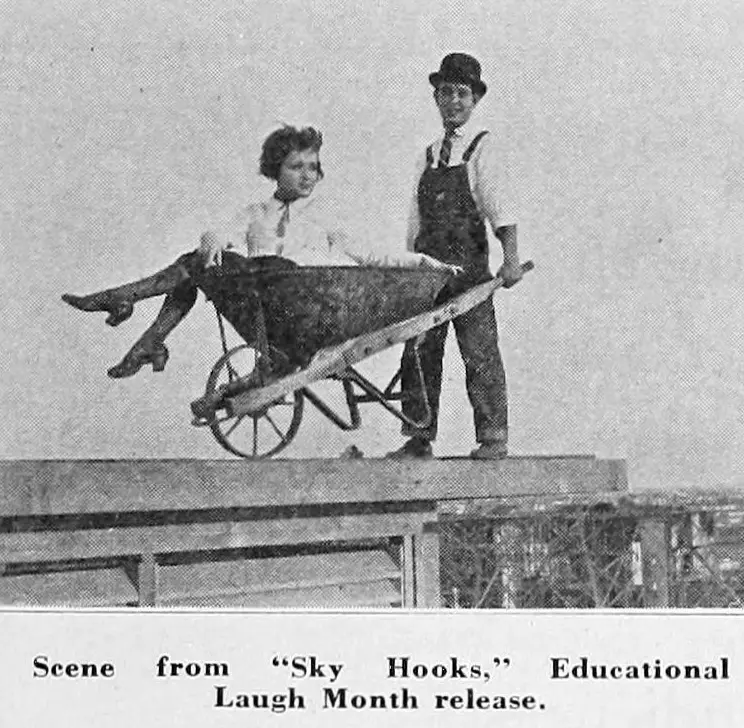
The direction in 'Sky Hooks' is remarkably effective in its simplicity and its commitment to practical, on-location spectacle. The unnamed director (as writers are uncredited, we infer the director’s strong hand) understands the inherent drama and comedy of the skyscraper setting. There’s no attempt to hide the heights; indeed, the camera often emphasizes them, looking down from dizzying angles to underscore the peril. This isn't just a backdrop; it's an active participant in the gags, a character in itself.
The staging of the gags is straightforward but impactful. There’s a clear progression from minor annoyances to genuinely dangerous situations, each orchestrated to maximize visual impact. For instance, the scene where the husky deliberately jostles Cliff's cart on a narrow ledge is filmed with a keen eye for tension, even though the comedic intent is clear. The director knows exactly when to use a wide shot to show the scale of the building and the precariousness of the workers, and when to cut to a closer shot to capture Cliff's exaggerated reactions. It’s a testament to early filmmaking that such a simple premise could be rendered so effectively without elaborate special effects, relying instead on clever angles and daring stunt work.
The cinematography, while basic by modern standards, is surprisingly adept at conveying the dizzying heights and the sheer physical effort involved in construction work. The camera often positions itself to emphasize the verticality of the skyscraper, offering glimpses of the bustling city far below. These shots are crucial; they ground the comedy in a very real, very dangerous environment, preventing it from feeling entirely cartoonish. The visual contrast between the small figures of the men and the immense structure they are building is a constant theme.
The framing of the action is generally clear, allowing the audience to fully appreciate the physical comedy and the stunts. There are no fancy camera movements or complex compositions; instead, the focus is on clarity and impact. The use of natural light on the open-air construction site also gives the film a raw, documentary-like feel, enhancing its sense of realism even amidst the slapstick. The visual storytelling is direct, ensuring that every gag, every near-miss, is perfectly legible to the viewer.
'Sky Hooks' is a short film, and it uses its brevity to its advantage, maintaining a relentless pace from start to finish. There's little time for exposition or character development beyond the initial premise. Once the husky arrives on the scene, the film becomes a continuous series of escalating pranks and physical tribulations. This rapid-fire succession of gags ensures that boredom never sets in, keeping the audience engaged through sheer momentum.
The tone is broadly comedic, but with an underlying current of almost cruel humor. The husky's actions are not just playful; they are genuinely malicious, designed to cause maximum discomfort and fear. This blend of slapstick and subtle sadism is a fascinating aspect of early silent comedy, often overlooked. It’s a humor born out of physical pain and social humiliation, which, while effective for its time, can feel jarring to contemporary sensibilities accustomed to more benign forms of comedy. The film doesn't shy away from the harshness of the situation, making the laughs feel earned, albeit sometimes uncomfortably so.
So, should you watch 'Sky Hooks'? Yes, if you understand its historical context. It’s a short, impactful piece of film history. It showcases early stunt work. It's an excellent example of silent-era physical comedy. Don't expect a deep story. Do expect some genuine laughs and impressive practical effects. It’s a film that speaks volumes about the ingenuity of early filmmakers and the enduring appeal of physical humor, even when it veers into the uncomfortable. It’s a vital, if niche, viewing experience for anyone interested in the foundational elements of cinema.
While some might dismiss it as mere slapstick, 'Sky Hooks' is, in its own primitive way, a daring exploration of workplace dynamics and the brutal realities of early 20th-century labor, albeit wrapped in a comedic package. The film's reliance on physical discomfort for humor, while characteristic of the era, feels surprisingly mean-spirited for a comedy, almost bordering on a proto-sadism that modern audiences might find uncomfortable. This isn't just a simple revenge plot; it's a commentary on the desperate measures people take to survive and the petty cruelties that can flourish in harsh environments. The husky, in an unconventional reading, isn't just a villain; he's a symbol of karmic retribution, an inevitable force that corrects a social injustice. His methods are brutal, but his motivation is clear. It works. But it’s flawed.
What truly sets 'Sky Hooks' apart is its raw, unpolished energy. It feels less like a meticulously crafted studio product and more like a daring documentary of a very bad day at work, spiced with comedic exaggeration. The fact that actual construction sites were used, with real heights and real physical demands, gives the film an authenticity that many more polished productions lack. It’s a testament to the resourcefulness of early filmmakers who leveraged their environments to create spectacle. This film doesn't aim for elegance; it aims for impact, and in that, it largely succeeds.
Ultimately, 'Sky Hooks' is a fascinating, if niche, piece of cinematic history. It’s a robust example of silent-era physical comedy, showcasing impressive practical stunts and a relentless pace that holds up remarkably well for its short runtime. While its narrative simplicity and the occasionally jarring nature of its humor may not appeal to everyone, its historical value and the sheer audacity of its execution make it a compelling watch for those with an appreciation for early cinema. It’s not a 'masterpiece' in the traditional sense, but it is a vital artifact that reminds us of the foundations upon which modern filmmaking was built. Give it a watch if you’re curious about the roots of screen comedy and don’t mind a little (staged) workplace brutality.

IMDb 7.2
1927
Community
Log in to comment.