DbcultAccessing Vault...
Cult Review
Senior Film Conservator
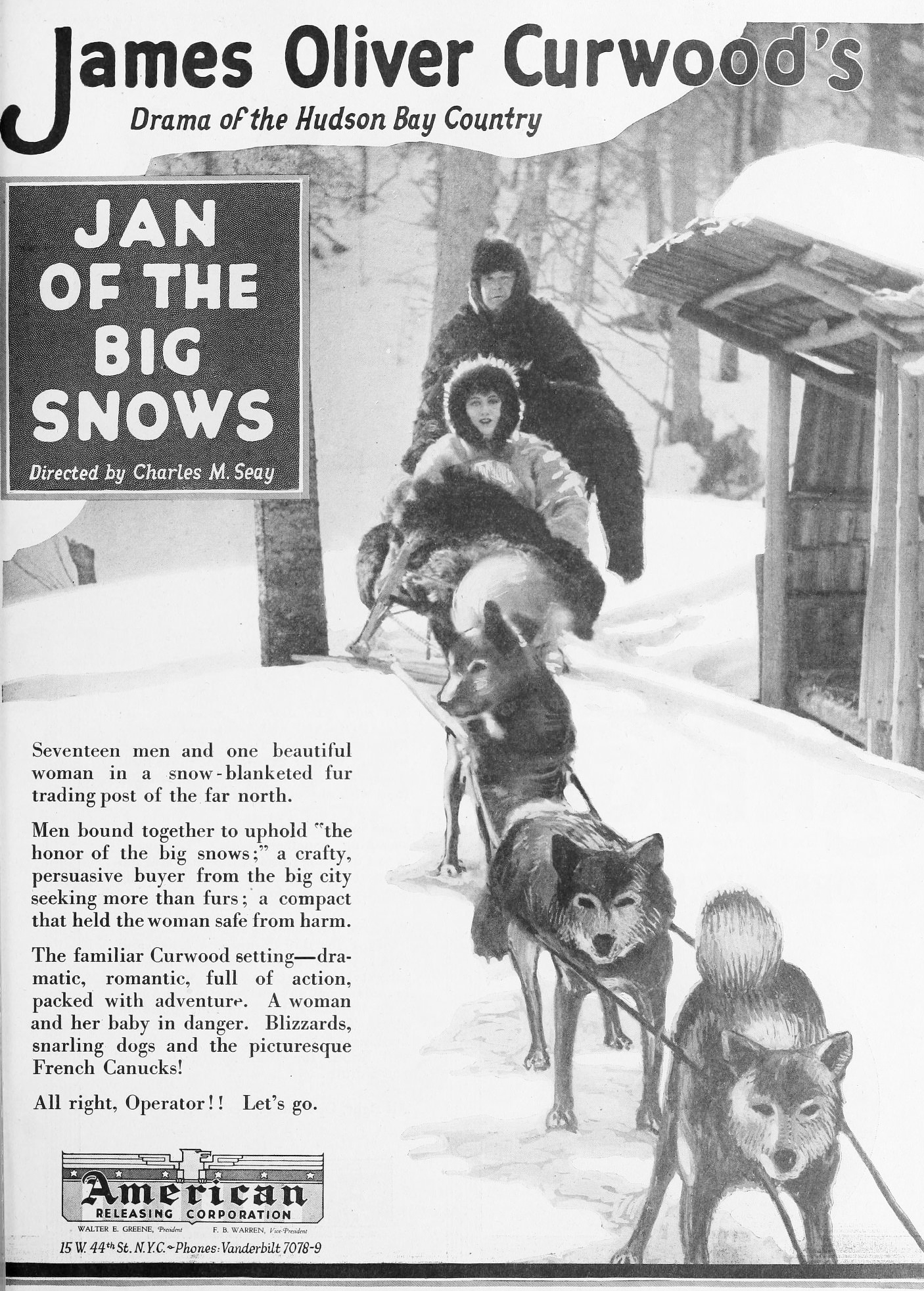
To witness Jan of the Big Snows is to step into a sepia-toned purgatory where the elements are as much characters as the flesh-and-blood actors. Directed with a surprising grasp of spatial isolation, this 1922 adaptation of James Oliver Curwood’s prose captures a specific brand of North American romanticism—one that views the wilderness not as a resource to be exploited, but as a crucible for the human spirit. The film operates on a frequency of pure emotion, stripped of the cynical veneers that often plague modern survivalist cinema. It is a work of stark contrasts: the white blindness of the tundra against the dark, cramped interiors of the trading post; the purity of Jan’s devotion against the oily machinations of the urban intruder, Blanding.
The narrative architecture is deceptively simple, yet it carries the weight of a classical tragedy. When Nancy arrives at the post, she isn't merely a woman; she is a catalyst for a collective spiritual awakening among the seventeen men stationed there. This dynamic reminds me of the psychological undercurrents in A Hungry Heart, where domestic longing becomes a transformative force. However, in the Hudson Bay, this longing is tempered by a rugged code of honor that borders on the religious. Jan Allaire, played with a wide-eyed, almost feral sincerity by Richard Neill, becomes the self-appointed guardian of this icon. His love is not possessive; it is hagiographic.
The equilibrium is disrupted by Blanding, the New York fur trader. In the lexicon of 1920s cinema, the city is often a shorthand for moral decay, a theme echoed in films like Pitfalls of a Big City. Blanding represents a sophisticated malice that Jan and his companions are ill-equipped to handle through rhetoric alone. His advances toward Nancy are not merely an insult to her marriage but a desecration of the sanctuary the men have built around her. The tension between the 'Code of the North' and the predatory opportunism of the 'South' provides the film's primary friction.
"In the silence of the big snows, every whisper of betrayal echoes like a gunshot. The film captures this acoustic of the soul with remarkable visual clarity."
The conflict escalates when Fred Cummings, Nancy’s husband, disappears. The discovery of his frozen corpse is a moment of profound cinematic pathos. Jan’s decision to lie—to tell Nancy that Fred is merely injured—is a pivotal moral ambiguity. Is it an act of supreme kindness or a desperate attempt to keep her within his orbit? This manipulation of truth for the sake of emotional preservation is a recurring motif in silent era dramas, much like the narrative deceptions found in The Wakefield Case.
Visually, Jan of the Big Snows utilizes its locations to achieve a sense of overwhelming scale. The cinematography avoids the staginess common in earlier silent productions, opting instead for wide shots that emphasize the insignificance of man against the monolithic frost. This aesthetic approach shares a lineage with the documentary realism of Kino-pravda no. 3, though Curwood’s narrative remains firmly rooted in melodrama. The use of light—often harsh and unforgiving—serves to highlight the weathered faces of the cast, particularly Warner Richmond and Louise Prussing, whose expressions convey more than any title card ever could.
The physical confrontation between Jan and Blanding is choreographed with a raw, unpolished energy. It lacks the stylized grace of modern action sequences, which only adds to its impact. It feels like a struggle for survival, a purging of the 'civilized' rot that Blanding brought to the post. This visceral quality is something we see in other films of the era that deal with the clash of classes and ideologies, such as The Strike Breaker.
What sets this film apart from a standard 'Northwoods' adventure is its ending. There is no triumphant union, no easy resolution. Nancy’s departure is a crushing blow to Jan, yet it is framed as an inevitability. She belongs to the world of the sun, and he is a creature of the ice. This sense of fated separation is as poignant as the tragic arcs in Anna Karenina (1914). Jan’s hope—that she might one day return—is his sustenance, but to the audience, it feels like a beautiful, tragic delusion.
The film explores the concept of 'togetherness' in a way that is both communal and deeply isolating. While the seventeen men are Together in their shared isolation, Jan is fundamentally alone in his devotion. His character arc is one of maturation through loss, a theme that resonates with the stoic masculinity portrayed in Tell It to the Marines, though Jan’s battlefield is one of internal fortitude rather than military discipline.
When comparing Jan of the Big Snows to its contemporaries, one notices a distinct lack of the frivolousness found in films like Her First Elopement or the lighthearted charm of At Your Service. Instead, it aligns more closely with the somber explorations of human truth seen in Notte, verità degli uomini. There is a gravity here that demands the viewer's full attention. Even the inclusion of the child, Baby Eastman Haywood, isn't used for mere sentimentality but to heighten the stakes of Nancy’s precarious situation.
The film also touches on the corrupting influence of wealth and social standing, a theme central to The Grain of Dust. Blanding’s wealth gives him a sense of entitlement that the men of the post find abhorrent. In the North, your worth is measured by your ability to endure and your loyalty to the group, not by the quality of your furs or the size of your bank account. This rejection of external status in favor of internal character is the film’s moral backbone.
In the grand tapestry of silent cinema, Jan of the Big Snows remains a vital, if overlooked, thread. It captures the essence of the James Oliver Curwood ethos—that the wilderness is a place where the soul is laid bare. It avoids the easy pitfalls of the genre, opting instead for a nuanced portrayal of love, grief, and the agonizing weight of honor. While it may not have the historical footprint of How We Beat the Emden or the overt symbolism of Smiles, its emotional resonance is undeniable.
The final shot of Jan, standing amidst the vast, uncaring snow, waiting for a ghost, is one of the most haunting images of the era. It speaks to the universal human condition—our tendency to build shrines to the things we have lost and our stubborn refusal to let go, even when the frost begins to settle in our bones. For those seeking a film that is as visually arresting as it is emotionally taxing, Jan of the Big Snows is an essential journey into the heart of the great white silence. It is a reminder that even in the coldest climates, the heat of human passion can still burn with a terrifying, beautiful intensity, much like the lure of Gambler's Gold, though the stakes here are far more spiritual than material.
© 1922 Film Critique Archives - A Study in Silent Borealism
IMDb —
1916
Community
Log in to comment.