DbcultAccessing Vault...
Cult Review
Senior Film Conservator
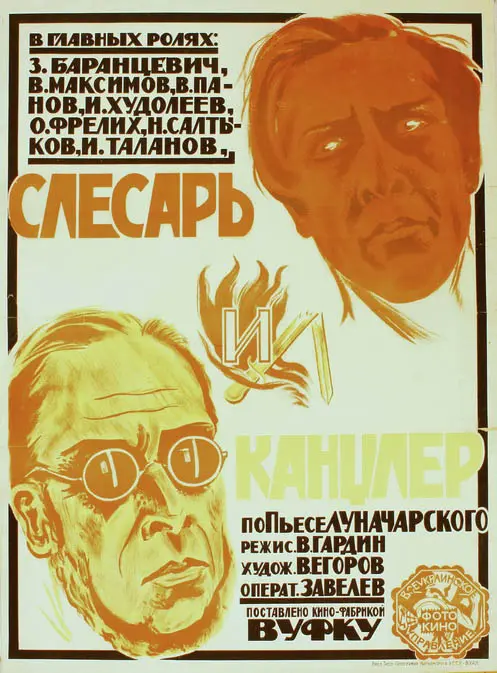
In the nascent years of Soviet cinema, before the totalizing grip of Socialist Realism became the singular aesthetic mandate, there existed a fascinating period of experimental transition. Slesar i kantsler (Locksmith and Chancellor), released in 1923, stands as a monumental pillar of this era. Directed by the veteran Vladimir Gardin and co-written by the intellectual titan Anatoli Lunacharsky alongside a young, burgeoning Vsevolod Pudovkin, the film is an intricate tapestry of political agitation, melodramatic flair, and sophisticated social commentary. It does not merely depict a revolution; it theorizes the very mechanics of state collapse.
The film transports us to the fictional realm of Norland, a setting that serves as a thinly veiled surrogate for the crumbling empires of the early 20th century. The conflict with Galikania is presented not as a heroic endeavor, but as a quagmire of aristocratic ego. Unlike the escapist narratives found in contemporary Western imports like The Fortune Teller, Gardin’s work demands a visceral engagement with the socio-economic realities of war. The Norlandic government, led by a cadre of out-of-touch bureaucrats and military brass, is portrayed with a biting satirical edge that highlights the absurdity of their continued belligerence despite mounting defeats.
The screenplay, penned by Lunacharsky, reflects the sophistication of a man who was not only the People's Commissar for Education but also a playwright of considerable depth. There is a palpable tension between the theatrical origins of the script and the evolving language of cinema. While many films of 1923, such as A Pair of Sixes, leaned heavily into situational comedy or light melodrama, Slesar i kantsler utilizes the screen to project a macro-level view of historical inevitability.
The central conflict is anchored by the performances of Nikolai Panov and Vladimir Maksimov. The Chancellor, played with a chilling, calculated reserve, embodies the old world’s desperate attempt to maintain hegemony through tradition and terror. Opposite him, the Locksmith represents the latent power of the industrial worker. This isn't the simplified, poster-style characterization often associated with later agitprop. Instead, there is a psychological density here that mirrors the complexity of real-world political actors. The Locksmith is not merely a symbol; he is the fulcrum upon which the narrative tilts.
The supporting cast, including Mariya Arnazi-Borshak and Iona Talanov, populates this world with a richness that avoids the hollow tropes found in more commercial fare like Don't Call Me Little Girl. Even the minor roles, such as those played by Olga Preobrazhenskaya and Oleg Frelikh, contribute to an atmosphere of pervasive anxiety and impending change. The ensemble succeeds in creating a sense of a living, breathing society on the precipice of total transformation.
One cannot discuss this film without acknowledging the presence of Vsevolod Pudovkin. Though he is credited as a writer and actor here, his burgeoning theories on montage are already beginning to germinate in the film’s rhythmic structure. The juxtaposition of the lavish, decadent interiors of the Norlandic court with the stark, utilitarian environments of the workers' quarters creates a visual dialectic. This is far more advanced than the linear storytelling seen in Pure Grit or the episodic nature of Beatrice Fairfax Episode 9: Outside the Law.
Gardin’s direction utilizes the camera to scrutinize the characters' faces, searching for the internal rot of the ruling class and the rising resolve of the oppressed. The cinematography captures the smoke-filled rooms of conspirators and the wide, desolate expanses of the war-torn landscape with equal efficacy. There is a certain chiaroscuro intensity to the lighting that anticipates the height of German Expressionism, yet it remains firmly rooted in a materialistic reality. The film’s visual ambition rivals the epic scale of Michael Strogoff, but replaces that film's romanticism with a cold, analytical eye.
To fully appreciate Slesar i kantsler, one must view it within the context of its global contemporaries. While American audiences were being entertained by the light-hearted antics of Call a Taxi or the whimsicality of June Madness, Soviet filmmakers were weaponizing the medium. This film represents a departure from the purely sensationalist thrills of Fantomas - On the Stroke of Nine. Where *Fantomas* uses mystery to obfuscate, Gardin uses the screen to clarify—to peel back the layers of social artifice and reveal the gears of the machine.
Even when compared to more somber works like Armenia, the Cradle of Humanity under the Shadow of Mount Ararat, which deals with profound national tragedy, Slesar i kantsler distinguishes itself by its focus on the active overthrow of the status quo. It is not a lamentation; it is a blueprint. It lacks the surrealist playfulness of Le peripezie dell'emulo di Fortunello e compagni, opting instead for a gravity that demands the viewer's intellectual participation.
The dialogue (conveyed through intertitles) is sharp, avoiding the flowery sentimentality common in the silent era. Lunacharsky’s influence is evident in the way the film debates political theory through the mouths of its characters. The Chancellor’s justifications for the war are presented with a logical consistency that makes his eventual downfall all the more satisfying. He is not a cartoon villain, but a man blinded by his own ideological rigidity. This intellectual honesty is what elevates the film above mere propaganda.
The narrative trajectory—from the initial defeats in Galikania to the final uprising in Norland—is paced with a relentless momentum. It avoids the narrative sagging found in Her Moment or the predictable beats of What Love Will Do. Every scene serves a purpose, either to illustrate the suffering of the masses or to demonstrate the hubris of the elite. The film is a masterclass in building tension through social friction rather than just physical action.
Technically, the film is a marvel of its time. The set designs for the Chancellor’s palace are opulently suffocating, filled with heavy drapes and ornate furniture that seem to close in on the characters. In contrast, the factory settings are shot with a raw, unvarnished aesthetic that feels remarkably modern. This visual dichotomy reinforces the film’s central theme: the inevitable collision of two worlds that cannot coexist. It is a far cry from the dusty, open-air simplicity of Bull Arizona - The Legacy of the Prairie.
The legacy of Slesar i kantsler lies in its successful fusion of high-brow intellectualism with popular cinematic forms. It proved that cinema could be a vehicle for complex political discourse without sacrificing narrative engagement. While films like Monty Works the Wires were perfecting the art of the gag, Gardin, Pudovkin, and Lunacharsky were perfecting the art of the cinematic revolution. They understood that the screen was a mirror, a window, and a hammer.
Viewing Slesar i kantsler today requires an appreciation for the historical context in which it was forged. It is a document of a world in flux, captured by filmmakers who were consciously attempting to invent a new way of seeing. The performances remain compelling, the direction is assured, and the script's biting critique of imperialist folly remains uncomfortably relevant. It is a foundational text of Soviet cinema that deserves to be studied not just as a historical curiosity, but as a vibrant, breathing piece of art that challenged the boundaries of what film could achieve.
In the grand scheme of 1920s cinema, this film occupies a space of profound significance. It bridges the gap between the theatrical traditions of the past and the montage-driven future of Eisenstein and Vertov. It is a testament to the power of collaboration between the political mind and the artistic eye. For those seeking a cinema that provokes as much as it performs, Slesar i kantsler remains an essential, albeit demanding, experience. It is the sound of an old world breaking and a new one being hammered into shape on the anvil of history.
IMDb —
1918
Community
Log in to comment.