DbcultAccessing Vault...
Cult Review
Senior Film Conservator
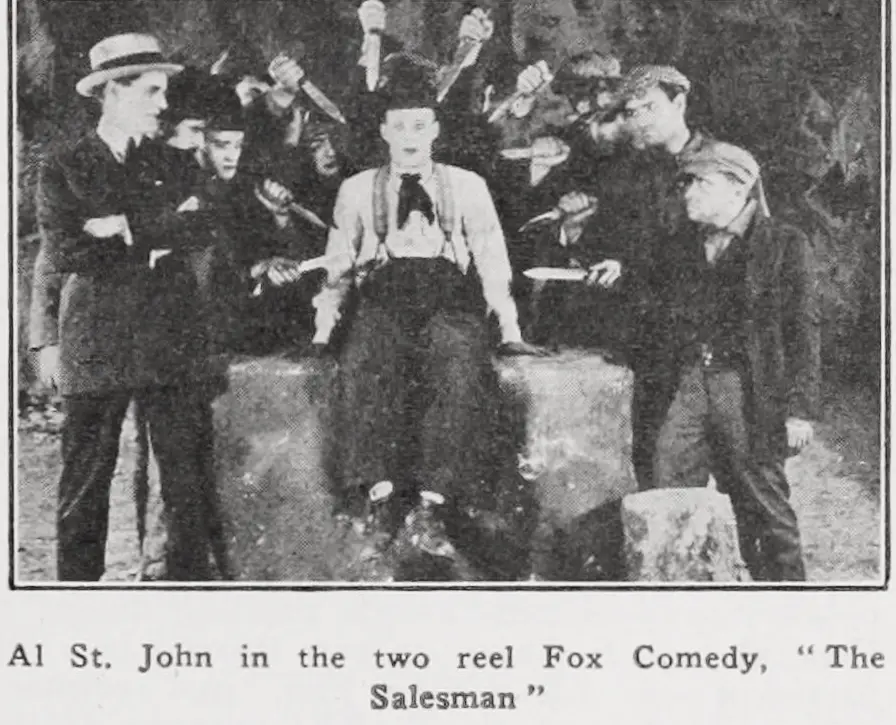
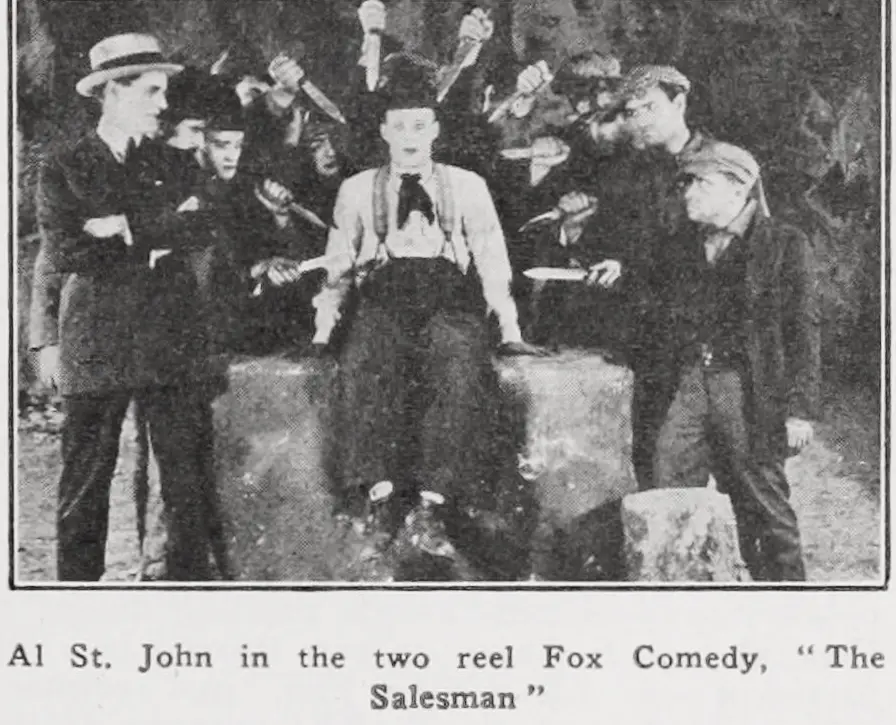
The Salesman opens on a sun‑bleached main street where the only sign of civilization is a weather‑worn wooden storefront, its paint peeling like old memories. Al (Al St. John), whose lanky frame seems perpetually on the verge of toppling, is introduced sweeping the porch with a broom that squeaks in protest. The camera lingers on his exaggerated gestures, establishing a tone that oscillates between earnest pathos and slapstick absurdity.
From the outset, the narrative positions Al as a reluctant custodian of a community’s quotidian needs. The first customer, a garrulous farmer clutching a sack of wilted lettuce, demands a refund for produce that never left the field. Al’s attempts to placate the man devolve into a chaotic chase through aisles stacked with canned beans, each tumble punctuated by a resounding thud that reverberates against the blackened walls of the set. This opening set‑piece is not merely comic relief; it subtly underscores the precarious balance between service and survival in a rural economy.
Enter the rival, a silver‑tongued itinerant salesman whose name remains deliberately unspoken, a narrative choice that renders him an archetype rather than a fully fleshed individual. He arrives on a polished bicycle, his coat immaculate despite the dusty surroundings, and instantly commands attention. His dialogue is peppered with hyperbolic claims—"the finest wares this side of the Mississippi"—which contrast starkly with Al’s halting, sincere pitches.
The rivalry is not confined to commerce; it extends into the realm of affection. Al’s sweetheart, a spirited young woman named Mae, is depicted in a brief but luminous vignette where she tends to a garden of wildflowers. Her laughter, captured in a soft focus shot, becomes the emotional fulcrum upon which Al’s desperation pivots. The rival’s flirtations, delivered with a practiced wink, threaten to eclipse Al’s earnest, if clumsy, declarations of love. This tension is reminiscent of the dynamic explored in The Last Sentence, where personal ambition collides with romantic fidelity.
The screenplay, though credited anonymously, displays a deft understanding of pacing. Scenes oscillate between rapid-fire physical comedy—such as Al inadvertently triggering a cascade of tin cans that clatter like a percussive orchestra—and slower, contemplative moments where the camera lingers on Mae’s hands planting seeds, symbolizing hope amidst hardship. This juxtaposition creates a rhythm that keeps the audience engaged while allowing thematic undercurrents to surface.
A recurring motif is the broken clock perched above the store’s entrance, its hands frozen at 12:00. The clock serves as a visual metaphor for the stagnation felt by the townsfolk, whose lives seem trapped in a perpetual loop of unmet expectations. Al’s attempts to repair the clock—only to cause it to strike loudly at inopportune moments—mirror his broader struggle to mend the fractures in his personal and professional life.
Al St. John, best known for his work in silent-era comedies, brings a physicality that feels both nostalgic and refreshingly contemporary. His pratfalls are choreographed with a precision that recalls the kinetic brilliance of Buster Keaton, yet his facial expressions convey a vulnerability rarely afforded to slapstick protagonists. In a poignant scene where Al watches Mae from behind a stack of flour sacks, his eyes betray a lingering fear of inadequacy—a moment that transcends the film’s comedic veneer.
The rival, though less fleshed out, is portrayed with a suave confidence that serves as an effective foil. His occasional glances toward Mae are calculated, highlighting the power dynamics at play. The supporting cast—comprising a nosy postmistress, a laconic blacksmith, and a perpetually bewildered child—provide textured layers that enrich the narrative tapestry, each character contributing a distinct voice to the chorus of small‑town life.
When placed alongside Full of Pep, The Salesman shares an exuberant energy that propels the story forward, yet it diverges by grounding its humor in a more intimate, character‑driven context rather than relying on overt spectacle. Similarly, the film’s exploration of personal ambition versus communal responsibility echoes themes found in The Steadfast Heart, though The Salesman opts for a lighter tonal palette.
The visual palette—dominated by muted earth tones punctuated by the vivid hues of the storefront sign—recalls the aesthetic sensibilities of The Eternal City (1923), where set design serves as a narrative character in its own right. The deliberate use of shadows and stark lighting not only underscores the film’s black‑background aesthetic but also accentuates moments of emotional revelation.
The film’s auditory design is an understated triumph. Ambient sounds—creaking floorboards, distant cicadas, the clatter of horse hooves—immerse the viewer in the rural setting. The musical score, a jaunty fiddle interwoven with a plaintive piano motif, mirrors Al’s oscillation between comedy and melancholy. At key junctures, such as the climactic porch showdown, the music swells in a crescendo that amplifies tension without overwhelming the visual narrative.
The film’s denouement unfolds on the weather‑worn porch, a liminal space where public scrutiny meets private confession. Al, armed with a battered ledger and a resolve forged through countless mishaps, confronts the rival in a dialogue that teeters between earnest pleading and sharp sarcasm. The rival, in turn, delivers a monologue laced with promises of prosperity, attempting to sway the townsfolk with grandiose visions.
The tension reaches its apex when Mae steps forward, her voice steady yet tinged with resolve. She articulates a sentiment that reframes the entire conflict: authenticity outweighs polished persuasion. This moment, delivered without melodrama, resonates with the thematic core of the film— the triumph of sincere effort over superficial allure. The rival’s departure, marked by a quiet bicycle ride away from the porch, leaves a lingering sense of loss rather than defeat, suggesting that ambition, when unchecked, can be as isolating as it is alluring.
In the aftermath, Al resumes his duties with a renewed sense of purpose, his interactions with customers now tinged with a subtle confidence. The final shot—a lingering view of the broken clock finally ticking forward—serves as a visual metaphor for the community’s collective forward momentum. The Salesman, while rooted in the conventions of early twentieth‑century comedy, manages to infuse its narrative with a modern sensibility that emphasizes character depth over mere gag execution.
From a scholarly perspective, the film contributes to the ongoing discourse on the representation of rural America in cinema, challenging the trope of the static, unchanging countryside by portraying a community capable of growth, conflict, and emotional complexity. Its blend of physical comedy and heartfelt drama positions it alongside works such as Rose di sangue and The Light Within, which similarly navigate the interplay between external chaos and internal resolve.
Strengths: The film excels in its choreography of physical humor, the nuanced performance of Al St. John, and its deft weaving of thematic concerns—particularly the tension between authenticity and artifice. The visual design, anchored by a stark black backdrop and punctuated with the three signature colors—dark orange, yellow, and sea blue—creates a distinct aesthetic identity that differentiates it from contemporaneous releases.
Weaknesses: The rival’s character, while effective as a foil, suffers from underdevelopment; a deeper exploration of his motivations could have enriched the narrative stakes. Additionally, certain subplots—such as the postmistress’s secret romance—are introduced but left unresolved, potentially leaving attentive viewers yearning for closure.
Audience Appeal: Fans of classic slapstick, admirers of character‑driven storytelling, and viewers seeking a film that balances levity with emotional resonance will find The Salesman rewarding. Its homage to silent‑era physical comedy, coupled with a modern thematic lens, makes it a compelling case study for cinephiles interested in genre hybridity.
In sum, The Salesman stands as a testament to the enduring power of earnest humor and the universal quest for validation—both personal and professional. It invites audiences to laugh, reflect, and, ultimately, appreciate the quiet heroism embedded within everyday struggles.

IMDb 4.7
1927
Community
Log in to comment.