DbcultAccessing Vault...
Cult Review
Senior Film Conservator
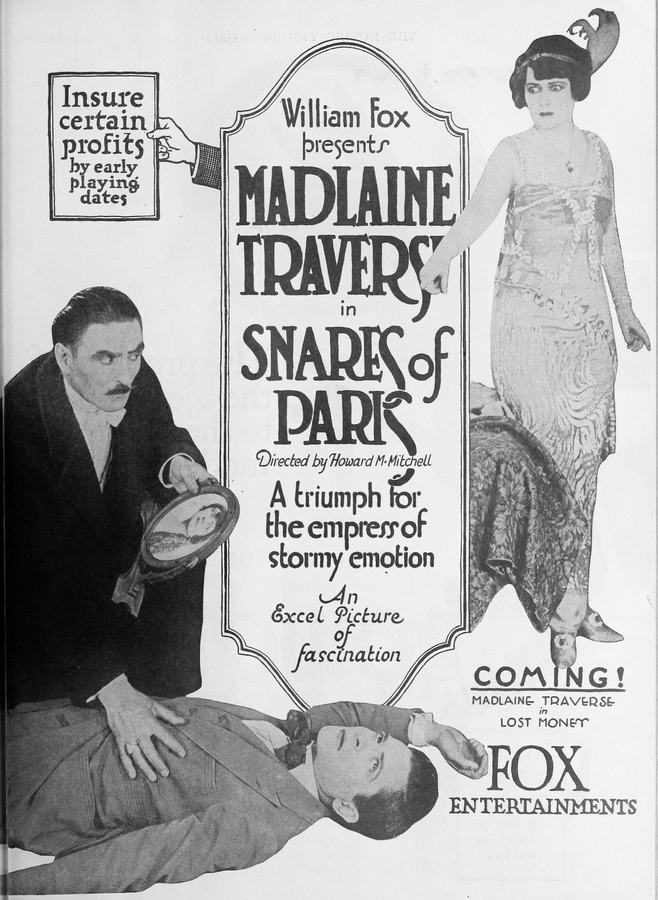
Denison Clift's Snares of Paris (1923) coils like a venomous serpent through the opulent drawing rooms of France's political elite—a masterclass in suppressed hysteria where whispered secrets carry the weight of guillotines. More than a mere melodrama, it’s an archaeological dig through the sediment of bourgeois morality, exposing how institutionalized hypocrisy festers beneath gilded moldings and diplomatic decorum. Traverse’s Marguerite embodies the film’s central tension: a woman simultaneously crucified by patriarchal expectation and liberated through maternal sacrifice.
Clift constructs Coullard’s château as a metaphysical prison. High windows flood rooms with deceptive light while shadows pool in corners like stagnant secrets. Watch how cinematographer George Richter frames Marguerite against barred garden gates during Fernand’s arrival—visual poetry underscoring her lifelong entrapment. Unlike the suffocating urban spaces in Værelse Nr. 17, here oppression wears velvet drapes and serves cognac in crystal snifters.
Frank Leigh’s Belloc slithers into this environment with reptilian grace. His first interaction with Marguerite—fingers lingering over a proffered book—radiates menace through courtly ritual. Leigh eschews mustache-twirling villainy for something far colder: the casual cruelty of a man who views human beings as negotiable instruments. His performance echoes the transactional sadism found in The Guilty Man, but refined through aristocratic breeding.
Madlaine Traverse delivers career-defining work as Marguerite. Observe the micro-tremors in her hands when pouring tea for Belloc—a physiological betrayal her placid smile cannot override. In the convent flashback (shot through gauze like corrupted memory), her transformation from luminous innocence to shamed ruin lands with visceral brutality. Traverse weaponizes silence: the way her breath catches when Fernand calls Coullard "father" conveys oceans of grief. This isn’t acting; it’s emotional excavation.
Charles Arling’s Coullard fascinates as a man dismantling his own moral scaffolding. His final forgiveness feels revolutionary—not born of weakness, but conscious rejection of societal vengeance. Compare this to the toxic masculinity in Strife: Arling trades bluster for devastating stillness. His fingers tracing the safe’s violated lock after Belloc’s theft communicates more rage than any monologue.
Jack Rollens’ Fernand—swaying between alcoholic belligerence and childlike need—avoids cliché through raw physicality. His trembling during the theft sequence suggests tectonic plates shifting beneath his psyche. When he grapples with Belloc, it’s not heroism but feral desperation—a rabid dog defending its only source of love.
Clift’s script dissects the violence of secrecy. Marguerite’s past isn’t some abstract scandal—it metastasizes through generations, poisoning Fernand’s identity and compromising state security. The stolen trade agreement mirrors Marguerite’s stolen autonomy: both become commodities for male exploitation. In a genius narrative parallel, Belloc’s brokerage collaborators are essentially pimps trading in different flesh.
Forgiveness becomes the film’s radical thesis. Coullard’s absolution dismantles the very foundation of patriarchal honor culture. His quiet "The convent girl wasn’t you—she was someone they created" lands like a spiritual grenade. Unlike the punitive endings of Appearance of Evil, Clift posits mercy as ultimate rebellion.
Visual motifs accrue chilling resonance. Recurring shots of shattered glass—a carafe knocked over during Fernand’s drunken rage, the window through which Belloc falls—evoke irreparable damage. Marguerite’s convent cross reappears clutched in her hand during the theft, not as piety but as a shiv against memory.
The safe itself—glowing with metallic coldness—becomes a vaginal metaphor. Belloc’s violation of it parallels his earlier defilement, while Fernand’s protection of it suggests Oedipal territorialism. Production designer Eugene Gaudio layers the set with decaying flowers: hothouse orchids drooping beside documents, foreshadowing how political artifice withers when truth blooms.
While Under the Crescent explores cultural clashes through exoticism, Snares locates warfare within matrimonial beds. Its closest kin might be Love and Hate in examining maternal sacrifice, but Clift rejects sentimentalism. Marguerite’s choice to install Fernand isn’t nurturing—it’s a Hail Mary pass with gunpowder-smeared fingers.
The film’s moral complexity anticipates The Measure of a Man by decades. Fernand—product of violation yet capable of violent protection—exists in ethical penumbras. When he watches Belloc fall, his expression mingles horror with ecstatic release. Rollens makes us complicit in our relief.
Clift’s boldest stroke lies in the aftermath. No police investigation mars the château’s tranquility; Belloc’s death becomes one more secret buried beneath rose gardens. The true climax occurs in the breakfast scene three days later: Coullard butters Marguerite’s toast while Fernand stares into his coffee—a triptych of survivors bound by collective trauma. The trade agreement proceeds unsigned, its insignificance now glaring. Diplomacy, Clift whispers, is performance art for the damned.
Josef Swickard’s dying attorney De Brionne—appearing only in the prologue—haunts every frame. His delivery of "Raise him as your atonement" to Marguerite isn’t absolution but condemnation. Swickard imbues eight minutes of screen time with gravitational weight, his wheezing breaths a metronome for impending doom.
Often misclassified as a thriller (marketing emphasized Belloc’s theft), Snares transcends genre through psychological audacity. Its restoration by the Cinémathèque Française in 2018 revealed astonishing subtleties: the sweat blooming on Traverse’s décolletage during the safe sequence, the almost imperceptible nod between Coullard and Fernand in the final scene—a fragile bridge between strangers bound by blood and silence.
Unlike the flamboyant heists in The Brass Bullet, the crime here feels like surgical excision. Belloc doesn’t want wealth—he wants to reassert ownership over Marguerite’s body through her complicity. The documents become mere proxies in this psychosexual warfare.
Clift’s feminist subtext screams through the decades: Marguerite’s redemption isn’t earned through suffering but seized through truth-telling. When she whispers "He fell" to Coullard, it’s not deception—it’s the first stone hurled at the cathedral of lies that imprisoned her. In this light, Fernand becomes both damaged heir and unwitting liberator.
What resonates across a century isn’t the mechanics of plot, but the harrowing intimacy of performances. Traverse and Arling generate thermonuclear heat in stillness—their final embrace communicates more through clavicle tremors than dialogue could convey. Richter’s camera lingers on the crumpled legal documents beside Belloc’s corpse: society’s contracts rendered trash against the magnitude of human feeling.
Snares of Paris stands as a landmark of silent-era maturity—a film that understands how the loudest devastations occur in the space between heartbeats. Its power lies not in the fall from the window, but in the excruciating lift of Coullard’s hand toward his weeping wife: a benediction that rewrites the rules of love itself.

IMDb —
1921
Community
Log in to comment.