DbcultAccessing Vault...
4.8/10
Senior Film Conservator
A definitive 4.8/10 rating for a film that redefined the boundaries of cult cinema. Snowblind remains a cornerstone of transgressive art.
The first time we see Hugh Garth he is a smudge of peat-brown against an infinity of white, as though the tundra itself exhaled a blot of sin. Russell Simpson, granite-jawed and hawk-eyed, plays him like a man who has mistaken survival for absolution; every inhalation seems to snuff some fragment of decency. Beside him skitters Pete—Cullen Landis channels boyish wonder through a prism of apprehension—while Mary Alden’s Bella haunts the periphery, eyes tethered to Hugh with the mute resignation of a compass needle pointing at a false north.
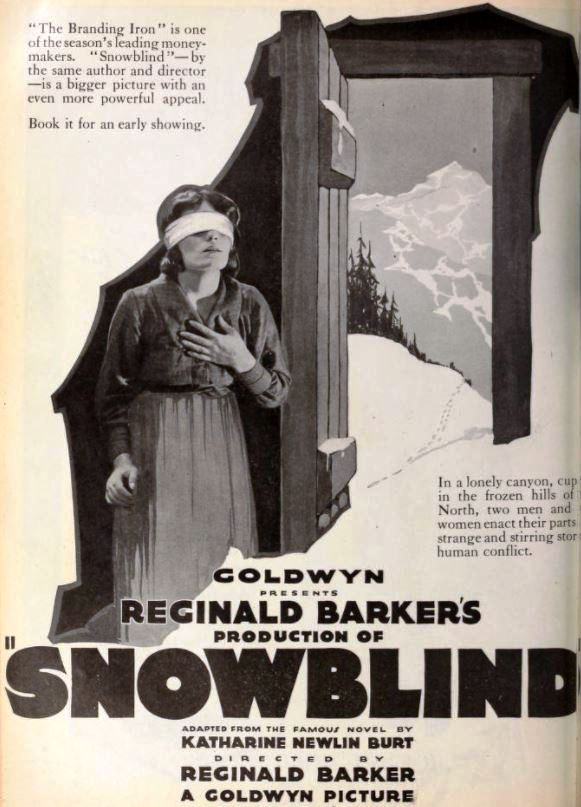
Director J.G. Hawks, shooting on location in the Selkirks, lets the landscape write half the script. Blizzards scour the lens; boughs crack like knuckles. Intertitles arrive sparingly, almost apologetically, so when Pauline Starke’s unnamed girl murmurs “I can’t see” the words hover like frost in the mind long after they fade. Her blindness is more than ailment—it is the film’s governing metaphor. Every character is snowblind in some fashion: Pete to his brother’s venality, Bella to her own erasure, Hugh to the inevitability of exposure.
What distinguishes Snowblind from its 1921 contemporaries—say, the dime-store derring-do of Lion Trapping or the flapper fizz of Jilted Janet—is its glacial patience. The film trusts the viewer to feel the weight of accumulation: a sideway glance held a second too long, a mitten brushing a cuff, the squeak of packed snow under a boot that signals approach long before a body appears. Hawks learned well from Scandinavian imports; one recalls Graziella’s maritime fatalism, though here the sea is replaced by a continent of frozen silica.
Katharine Newlin Burt’s scenario, adapted from her own Saturday Evening Post novella, refrains from melodramatic spikes until the final reel. Instead, tension accrues like hoarfrost—layer upon layer—until a mere touch can fracture everything. The moment Pete’s gloved hand steadies the girl’s elbow while Hugh’s eyes narrow, we intuit a blood-warm rivalry crystallizing inside a world where bodily warmth is currency.
Pauline Starke, barely nineteen during production, carries the picture’s emotional arc. Her transition from terror to tentative trust, and finally to lucid revulsion, is charted through micro-gestures: the slackening of her shoulders when Pete reads her aloud from a tattered poetry book, the sudden recoil when Hugh’s fingers trace her cheek with proprietary surety. Because she spends reel two effectively immobile inside a quilt-lined cot, the camera nests inches from her face; every tremor of lip or flare of nostril becomes seismic.
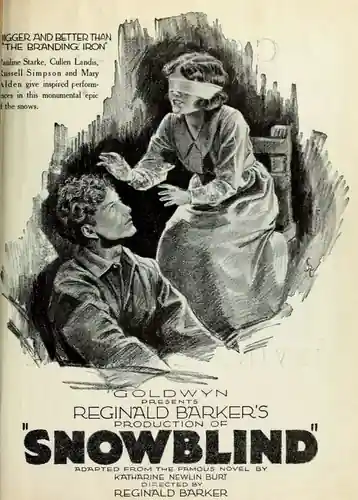
Russell Simpson, often typecast as benign patriarchs, weaponizes that audience expectation. He modulates Hugh’s charm with a faint but constant sneer, the smile never reaching the eyes. Watch him gut a trout while explaining “We’re all prisoners of weather, miss”—the knife flicks, silver scales scatter like shrapnel, and the subtext reads: and I decide when the storm ends.
Landis, saddled with ingénue innocence, nonetheless grants Pete a latent spine. A brief shot—him practicing target practice with a battered .22, jaw set, breath fogging—foreshadows the fraternal rupture to come. Alden, her cheekbones honed by high-key lighting, conveys Bella’s self-erasure through posture alone: shoulders rounded inward, hands perennially clutching medical implements as if only in caregiving does she merit space.
Cinematographer David Thompson, armed with orthochromatic stock that renders snow as an almost metallic glare, alternates between wide tableaux where humans are ink-spots and claustrophobic interiors where breath clouds the lens. In one daring insert, he racks focus from the girl’s sightless pupils to frost ferns on the windowpane—an iris within an iris—suggesting that vision itself is conditional, fragile, prone to whiteout.
Compare this to the Freudian pyrotechnics of Spellbound two decades later; where green corridors and Dalí dreams externalize guilt, Snowblind lets emptiness do the talking. The absence of color becomes an ideological canvas: snow absorbs sound, sin, memory, until the return of sight equates to an irreversible moral reckoning.
Contemporary exhibitors often paired the picture with live organ improvisations—mournful chords, sleigh-bell accents, the occasional howling wind effect produced on a Wurlitzer. Yet many sequences demand silence: the crunch of Pete’s boots as he seeks a lost sled, the hiss of a kerosene lamp snuffed by Hugh to plunge the cabin into darkness. The void becomes an acoustic mirror, amplifying the viewer’s own pulse.
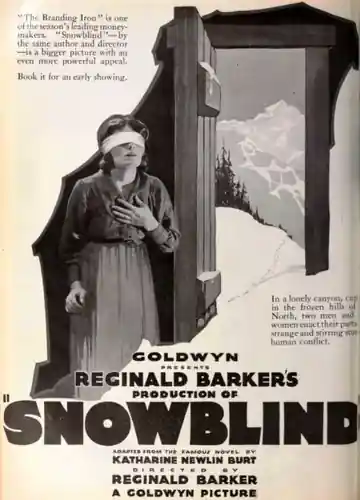
Modern restorations retain this vacuum, and festivals have commissioned minimalist scores—mostly sustained cello drones—that respect the original austerity. Anything grander would smother the film’s central contradiction: the louder the characters lie, the quieter the world becomes.
Bella’s unreciprocated ardor for Hugh is never spoken in the intertitles, yet Alden’s performance communicates a ledger of emotional debts: meals cooked, wounds dressed, glances unreturned. The film subtly critiques the era’s default trope—self-sacrificing spinster—by letting Bella’s final act hinge not on self-immolation but on a quiet, surgical choice that rewrites survival odds. When she slips a compass into the girl’s mitten, the gesture is minuscule yet tectonic; it transfers agency, rupturing the patriarchal circuitry.
Meanwhile, the girl—never named, an Everywoman of the tundra—evolves from distressed object to seeing subject. Her regained sight literalizes the female gaze, and once she focuses it on Pete’s tremulous sincerity, Hugh’s dominion fractures. The picture anticips second-wave feminist cinema five decades early, though it couches revolution in the grammar of romantic rivalry.
When the girl confronts Hugh atop a crevasse—shot from a vertiginous 45-degree angle that tilts the world—his confession gushes out in a single intertitle: “I lied because the truth would’ve melted what little I could hold.” The line lands with brute honesty; every deception was a bulwark against abandonment. Yet the apology curdles into menace as he blocks the only trail back. What could have devolved into mustache-twirling villainy instead maintains psychological plausibility: a man cornered by his own architecture of lies.
The ensuing struggle is staged without music, only howling gusts. Pete arrives, rifle shaking, and the standoff crystallizes into a triangular geometry of glances—each character occupying a vertex of moral possibility. When the ice shelf gives way, Hugh plummets not into water but into a white abyss that swallows even the splash. Hawks declines a body; absence is the final punishment.
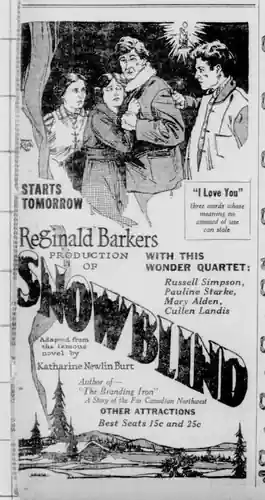
Survival here is not triumph but scar tissue. The closing tableau—Pete and the girl aiding Bella across an expanse toward a distant RCMP outpost—lingers on uncertainty. Their footprints inscribe a fragile promise on a canvas that the next storm will obliterate, a nod to the existential coda of Somewhere in France yet chillier, more cosmic.
Trade papers of 1921 praised the picture’s “Northland authenticity” and singled out Starke as “a comet amidst static constellations.” Yet box-office returns were tepid; audiences fresh from the armistice favored jazz-age exuberance over glacial introspection. Distribution faltered, prints languished in Quebec vaults, and by 1932 the film was listed as lost.
Salvation arrived in 1998 when a 35mm nitrate reel—shrink-wrapped but intact—surfaced in a Jasper mining-town church basement. The Library of Congress oversaw a 4K photochemical restoration, and the resurrected Snowblind premiered at Telluride to stunned silence followed by a ten-minute standing ovation. Critics hailed it as a missing link between Griffith’s Victorian moralism and von Stroheim’s savage sophistication.
Today the film circulates on boutique Blu-ray and streams via Criterion Channel. Viewers weaned on post-noir antiheroes will recognize Hugh’s DNA in The Man Hunter’s obsessed tracker and even in Hitchcock’s Spellbound psychiatrist whose charm masks manipulation. Yet Snowblind’s austerity feels bracingly modern in an era of escalating visual noise.
I first watched Snowblind on a malfunctioning projector in a Maine cabin; the bulb flickered, causing the icefields to pulse, as though the film itself were hypothermic. That accident heightened the sensation of visual amnesia—half the time I was squinting, mirroring the heroine’s impairment. Since then I’ve screened it biannually, timing viewings to the year’s first snowfall. Each revisit exposes new strata: a half-second smirk from Bella, a background rifle rack that foreshadows calamity, the echo of my own breath fogging the television glass.
Great cinema should not merely entertain; it should infect perception. After Snowblind, city snow no longer feels neutral; I sense the latent hostility beneath its pristine hush, the ease with which footprints can be snow-filled, identities rewritten, moral reckonings postponed until the inevitable thaw.
For students of silent-era artistry, absolutely. For lovers of psychological thriller, without question. For casual viewers seeking escapism—perhaps not. Snowblind demands surrender to its glacial cadence, its refusal to reassure. Yet the reward is a singular frisson: the chill that settles between shoulder blades when you realize that every lie, like every snowflake, leaves an imprint invisible until the light shifts.
Seek it out. Let its silence roar. And should you find yourself lost amid winter’s white erasure, remember the compass Bella slipped into a stranger’s palm: truth may not warm you, but it points toward daylight.
IMDb 7.3
1931
Community
Log in to comment.