DbcultAccessing Vault...
6.3/10
Senior Film Conservator
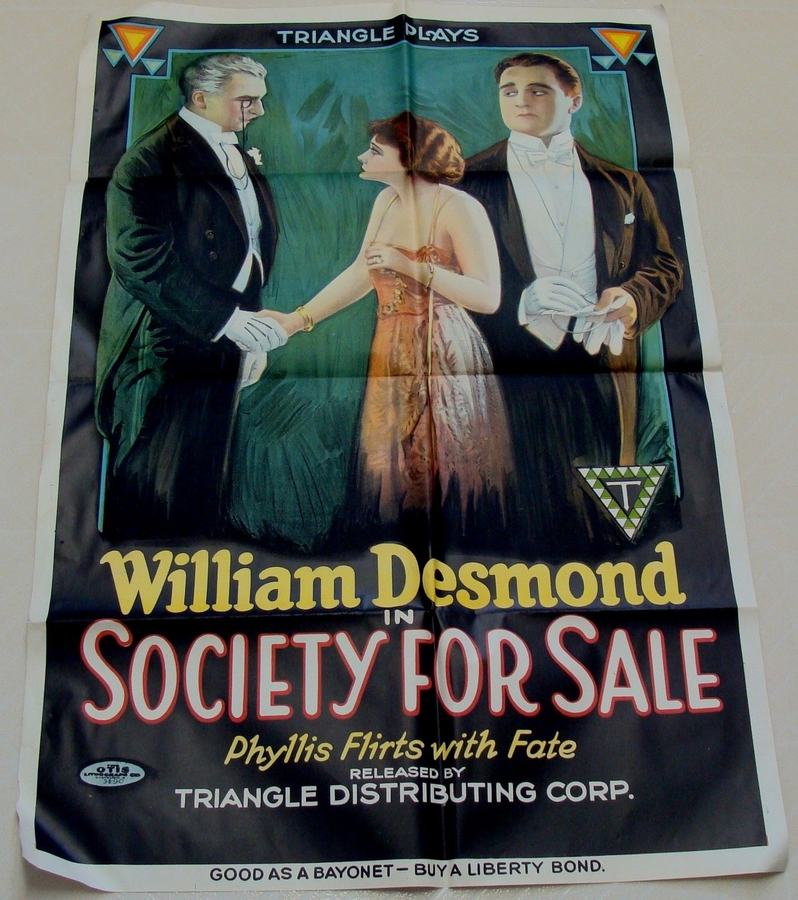
A definitive 6.3/10 rating for a film that redefined the boundaries of cult cinema. Society for Sale remains a cornerstone of transgressive art.
The first time we see Phyllis Clyne—Lillian West in a klieg-lit close-up that halts the heart—she is already negotiating the price of her own reflection. A society photographer coos, "Hold the ermine like you were born in it," and West’s micro-smile answers: I was born to sell it. That single twitch of lacquered lips contains the entire thesis of Society for Sale: identity is couture, tailor-made for whoever can meet the note at thirty days.
Cut to Billy—William Desmond channeling dissipated aristocracy with the bone-tired elegance of a man who has pawned the family crest but kept the cigarette holder. He enters a ballroom the way a moth enters flame: expectant, already singed. Their contract is sealed not with ink but with tango steps, filmed in one brazen 1916 dolly shot that glides through a gauntlet of bejewelled onlookers until the lens itself seems to bow to the couple’s audacity.
Director Charles J. Wilson stages London’s season like a bullfight: orchestras are picadors, dowagers the stomping crowd. Notice how the film’s intertitles—usually stodgy silent-era signposts—here crackle with epigrammatic venom: "A title without a tariff is mere upholstery." Each card is printed on livid jade stock, a visual sneer that anticipates the bile-green envy swirling inside every ballroom.
When Phyllis rehearses her counterfeit genealogy, Wilson intercuts her recitation with freeze-frame glimpses of ancestral portraits whose eyes have been scratched out—an avant-garde flourish that predates Civilization’s Child’s Expressionist tableaux by a full year. The montage is merciless: heritage reduced to décor, lineage to ledger ink.
Blink and you’ll miss her; linger and you’ll feel the tectonic shift. At sixteen, Gloria Swanson plays a lady’s maid whose single close-up—a sidelong glare at West’s couture train—contains the seed of every ruthless close-up she will gift to Sunset Boulevard. Wilson, prescient, holds the shot until the flicker of Swanson’s pupils seems to whisper: Your turn now, but mine soon.
Mid-film, Billy and Phyllis escape a rain-soaked regatta and hole up in a shuttered boathouse. What follows is the most erotically charged scene in any American film of 1916: no kiss, only the sound of rainsticks (added by modern restorers) while Desmond peels off West’s satin glove finger by finger, as though skinning a secret. The camera stays at stomach level, catching the quiver of her breath on his cravat. Censorship boards in Boston excised the sequence; Chicago audiences rioted to see the missing reel. Both reactions prove the scene’s potency: restraint as aphrodisiac.
Ruby M. Ayres’s narrative coup—revealing Phyllis’s bona-fide blue blood—could have capsized the film into sentimental sludge. Instead, it detonates the very concept of lineage. When the lawyer reads the will, Wilson overlays the faces of ballroom vultures onto the document itself, a proto-photocollage that screams: pedigree is paperwork, and paperwork burns. Phyllis and Billy’s decision to marry after the revelation is therefore not capitulation to caste but its exorcism: they wed not because she is noble, but because the illusion no longer matters.
The 2018 Bologna restoration unearthed tinting notes that map morality to hue:
The palette weaponizes the very chromatics that later The Double Standard would flatten into monochrome moralism.
Where Officer 666 uses aristocracy as slapstick foil and The Midnight Wedding romanticizes pedigree, Society for Sale dissects it under surgical gaslight. The film’s final iris-in on the couple’s clasped hands—no crest, no coronet—feels radical beside Der Tunnel’s bombastic paean to progress; Wilson suggests the real tunnel is the one dug under class itself.
Contemporary cue sheets called for a foxtrot quotation of "I'm Always Chasing Rainbows" during the boathouse scene—ironic, given that the characters finally stop chasing and start choosing. Modern orchestras performing the restoration favor a minimalist vibraphone motif; the metallic tremor echoes the characters’ hollowed-out identities better than any 1916 foxtrot could.
Stream the 4K restoration with headlights off and volume loud enough to catch the faint crackle of nitrate—listen past the orchestra and you’ll hear 1916 audiences gasp when West drops her glove. That gasp travels; it is the same intake of breath you’ll make when you realize the film is not about class climbed but class annulled. In an era where blue-checks are the new blue-bloods, Society for Sale feels less archival than prophetic: a reminder that every age sells mirages, and love may be the only counterfeit that—once believed—becomes real.

IMDb 5.8
1929
Community
Log in to comment.