DbcultAccessing Vault...
Cult Review
Senior Film Conservator
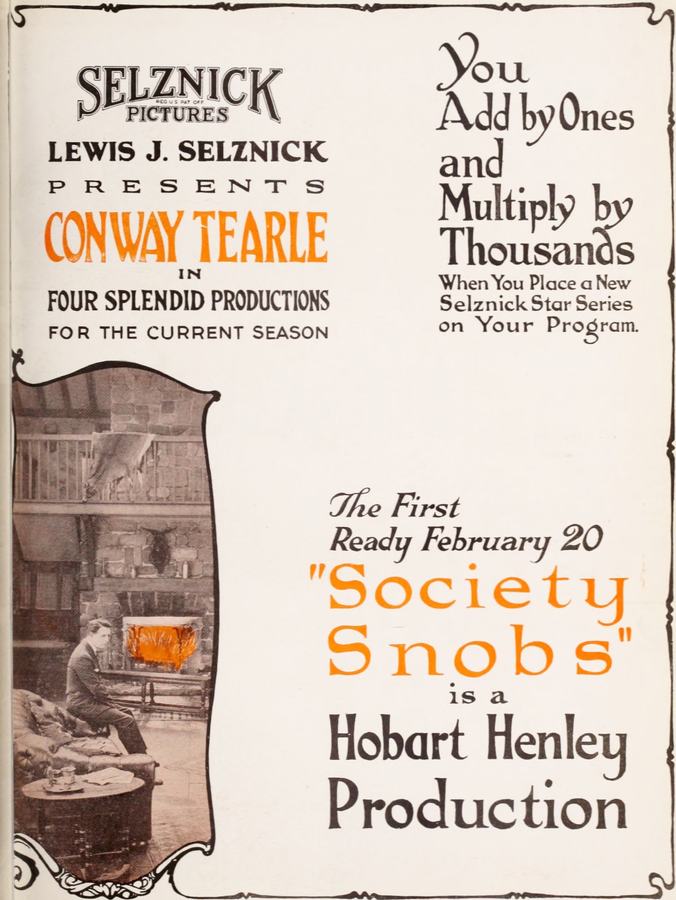
Society Snobs is a film that crackles with the electric tension of a society poised to implode under the weight of its own contradictions. In 1930 Hollywood, as the Great Depression clawed at the American psyche, director-writer Conway Tearle delivered a pre-Code gem that weaponizes farce to skewer the hollow rituals of the upper class. The film’s most audacious act isn’t its lead character’s masquerade as a European aristocrat, but its refusal to grant the audience a moral compass—no character is spared the scalpel of satire, and that’s precisely what makes it endure.
Conway Tearle’s performance as Lorenzo Carilo is a masterclass in understated bravado. The character is introduced not as the romantic hero of a classic rags-to-riches tale, but as a pragmatic idealist. His rejection of "select" jobs that pay poorly—positions that demand pedigree over skill—resonates with the 1930s sensibility that meritocracy was a myth perpetuated by the powerful. When Tearle’s Lorenzo adopts the persona of the Duc de Montclair, his physical transformation is subtle: a slight tilt of the chin, a measured cadence of speech, and an almost imperceptible widening of his eyes. These minute adjustments speak volumes about the performative nature of class identity.
The film’s most incisive observation comes in its portrayal of the Forrester family’s wealth as a grotesque parody of aristocracy. Unlike the refined decadence of The Magic Skin or the gothic opulence of The Black Stork, the Forrester mansion is a jungle of gaudy art and poorly curated antiques. The family’s obsession with status is so transparent that their interactions with Lorenzo—whom they believe to be a foreign nobleman—play out like a game of charades where everyone knows the rules but nobody dares call foul.
Martha Mansfield’s portrayal of Vivian Forrester is the emotional linchpin of the film. Her character isn’t a mere trophy for the protagonist to win; she embodies the tragicomedy of youth trapped in a gilded cage. In one standout scene, Vivian rehearses her French accent while gazing at a portrait of Napoleon, a visual gag that underscores the absurdity of her aspirations. Mansfield’s physical comedy—particularly her awkward attempts to mimic European elegance—is both hilarious and heartbreaking, recalling the similarly conflicted characters in Painted Lips and Mistress Nell.
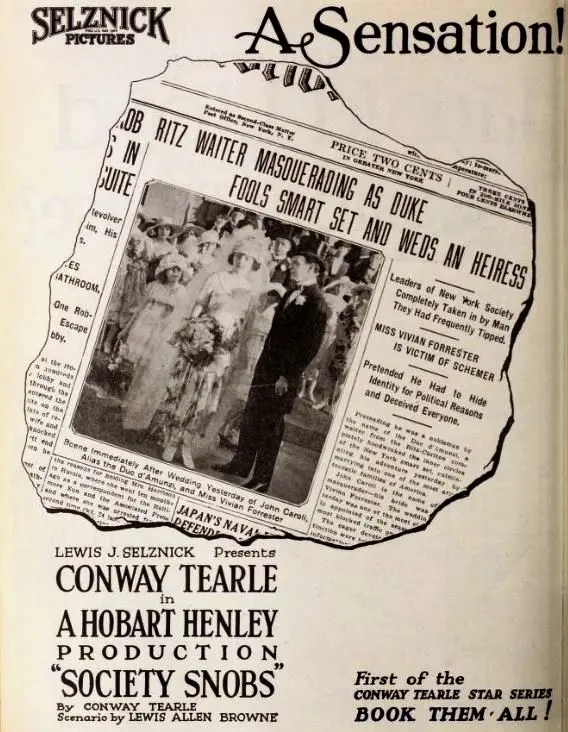
The chemistry between Tearle and Mansfield is electric, but it’s built on a foundation of mutual manipulation. Their romance isn’t the product of genuine connection, but of parallel delusions—she believes in the fantasy of being courted by a nobleman; he believes in the fantasy of being someone else. This meta-awareness elevates the film beyond simple satire, transforming it into a psychological study of identity. When Lorenzo’s deception begins to unravel, the stakes aren’t just social—they’re existential.
The film’s visual language is a masterstroke of subtext. The Forrester estate is bathed in golden hour light in scenes of grandeur, the warm hues contrasting with the stark shadows of Lorenzo’s humble lodgings. This chiaroscuro technique isn’t just aesthetic—it’s thematic. The richness of the Forrester world is artificial, a veneer that crumbles under scrutiny. When Lorenzo visits the mansion for the first time, the camera lingers on a chandelier that’s clearly draped in tinsel, a visual punchline that doubles as social commentary.
Costume design plays a similarly subversive role. Vivian’s wardrobe, a kaleidoscope of pastel silks and faux pearls, becomes a recurring motif. Her eventual rejection of these costumes—opting instead for simpler attire in a pivotal scene—mirrors her awakening to the futility of the life she’s built. This sequence is a direct antithesis to the hyper-stylized fashion in The Third Generation, where clothing is both armor and weapon.
Society Snobs thrives in its exploration of identity as performance. Lorenzo’s masquerade isn’t just about deception—it’s about the malleability of the self in a society obsessed with labels. This theme finds echoes in Caridad, where identity is similarly fluid, and in Impéria, which examines how poverty and pretense intersect.
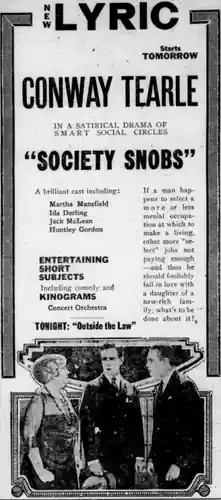
The film’s ending—where Lorenzo and Vivian’s relationship collapses under the weight of truth—isn’t a tidy moralizing conclusion. Instead, it’s a quiet acknowledgment that both characters were playing roles in a system designed to exploit them. This refusal to offer easy resolutions is a hallmark of Tearle’s direction, a choice that elevates the film from comedy to tragedy.
Though released in 1930, Society Snobs feels disturbingly relevant. The Forrester family’s obsession with titles and status mirrors modern celebrity culture, while Lorenzo’s climb up the social ladder echoes the hustle culture of today’s influencer economy. The film’s most prescient moment comes in a scene where a journalist asks Lorenzo, "What’s the difference between a man who’s born rich and a man who becomes rich?", a question that still sparks debate in 2024.
In the context of Tearle’s filmography, Society Snobs is a crowning achievement. Unlike the more straightforward melodrama of The Law That Failed or the action-driven plots of Cyclone Smith Plays Trumps, this film showcases his versatility as a storyteller. The script, co-written by Tearle and Lewis Allen Browne, is a tight, dialogue-driven affair that rewards repeat viewings with new layers of subtext.
Society Snobs is more than a period piece—it’s a mirror held up to the absurdities of class consciousness. Its brilliance lies in its refusal to offer easy answers, instead inviting viewers to question their own complicity in systems of hierarchy. Whether you watch it for the razor-sharp dialogue, the performances brimming with hidden depths, or the visual poetry of its satire, the film remains a testament to the power of cinema to expose the folly of human pretension. In an era where social media has turned everyone into a performer, Lorenzo Carilo’s masquerade feels less like a relic of the past and more like a warning for the future.
Rating: ★★★★½ (4.5/5)
IMDb —
1920
Community
Log in to comment.