
DbcultAccessing Vault...
3.8/10
Senior Film Conservator
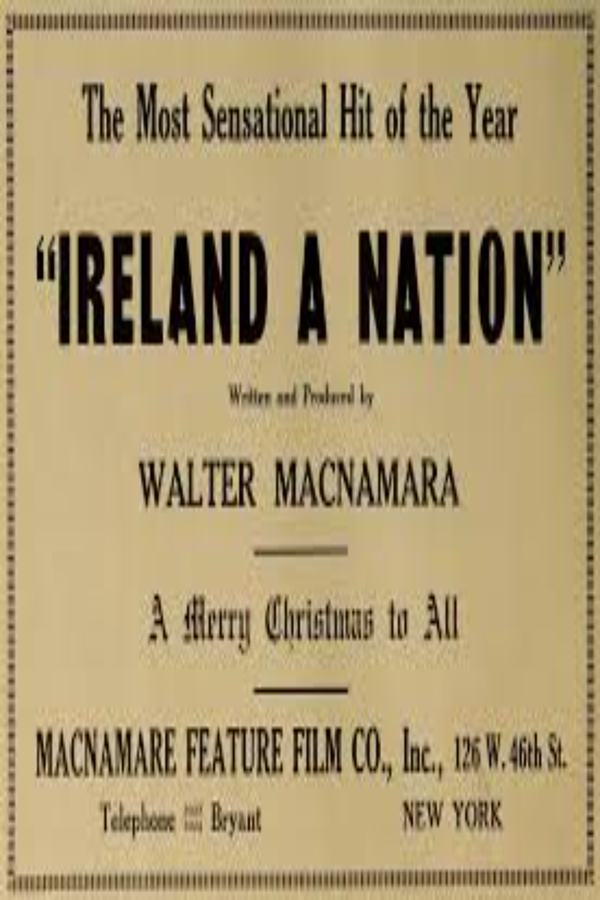
A definitive 3.8/10 rating for a film that redefined the boundaries of cult cinema. Ireland, a Nation remains a cornerstone of transgressive art.
Walter MacNamara’s Ireland, a Nation lands like a sulphur match struck in a sepulchre: sudden, acrid, illuminating graves we pretended were flowerbeds. Shot in 1914 but conceived in the furnace bruise of the Home Rule crisis, the one-reel parable detonates the polite myth that Irish silent cinema was content with stage-Irish buffoonery or dew-eyed pastoral. Instead, MacNamara weaponises the flicker—intertitles sharpened to shrapnel, crowds choreographed like insurgent choreography notes—to exhume the 1803 rebellion and parade it before 20th-century eyes hungry for nationhood.
Look at the first interior: a candle stub, a chalice wrapped in sackcloth, Father Tom Murphy’s face emerging from umber gloom as though sculpted in guilt-wax. MacNamara refuses the soft apricot glow that Griffith lavished on The Midnight Wedding; here chiaroscuro is ideology. Every pocket of shadow is potential treachery, every flare of tallow a clarion. When the priest lifts the Host, the camera tilts up to a water-stained ceiling, letting the sacred wafer eclipse the screen—an act of cinematic transubstantiation that fuses sacrament with sedition.
The exterior night-work is even fiercer. Dublin’s cobbles glisten like black mirrors, reflecting torches that hunt the rebel-priest. MacNamara shoots from knee-level so the bayonets stab at the lens, turning viewers into co-conspirators dodging steel. Compare this to the postcard vistas of A Venetian Night, where moonlight merely romances canals; here moonlight is an informer, silvering fugitives for easy identification.
Patrick Ennis essays Robert Emmet with a physical lexicon torn between tremor and titanium. Note how his right hand never quite stills—fingers flutter like trapped larks when he rehearses gallows speeches, yet the left hand grips a table edge as though anchoring the soul. The performance sidesteps the statuesque declamation favoured by Barry O’Brien in studio-bound Loves and Adventures in the Life of Shakespeare; instead we get a youth who recognises history as an unreliable narrator and decides to outrun her.
In the pivotal Thomas-street scene, Emmet’s green coat is deliberately two shades darker than the British uniform, a sartorial middle-finger that the orthochromatic stock renders almost black. When the noose finally hoods him, MacNamara cuts to a close-up of Emmet’s boots—mud-caked, still twitching—then dissolves to a pair of children’s bare feet hours later, dancing round a liberty pole. The montage births a macabre relay: death fertilises folklore.
P.J. Bourke’s cleric is no wan plaster saint; he perspires brandy, laughs through broken teeth, blesses pikes with the same wrist that once sprinkled baptismal water. Bourke’s eyes—grey, glacier-cold—betray a calculus: every prayer tallied against probable betrayals. In a tavern sequence lit solely by a turf fire, he swaps his cassock for a labourer’s jacket while reciting the Ave—an audacious splice oforthodoxy and heresy that prefigures liberation-theology cinema by half a century.
MacNamara weaponises off-screen space: when the price on Murphy’s head rises, the priest’s silhouette is superimposed over a proclamation poster, crown bounty bleeding into clerical collar until both texts merge—an early matte shot that foreshadows the ideological inextricability of church and revolt. Compare this sophistication to the flat tableaux of Den hvide Slavehandels sidste Offer, where evil is signalled by twirling moustaches, not by systemic overlay.
While the male gaze obsesses over muskets, MacNamara slips potency to the film’s women through gesture rather than dialogue. A washerwoman (Barney Magee in a gender-bending turn that scandalised censors) folds rebel uniforms inside everyday linen, the camera lingering on her cracked fingernails—a shorthand for invisible labour. Later, an unnamed seamstress, framed in yellow lamplight (#EAB308), unstitches tricolour rosettes from her hem to plant them on corpses, turning shrouds into seeds.
These micro-revolts feel fresher than the perfumed escapism of Frou Frou, where female agency stops at fan-fluttering. MacNamara understands revolt as domestic disobedience: every hidden loaf becomes a ballot, every lullaby a manifesto set to 3/4 time.
At 18 minutes the film’s rhythm pivots. Up to now, scenes average 11 seconds; afterwards, cuts accelerate to 4-second bursts, mimicking the quickened pulse of a man sprinting across rooftop valleys. Intertitles shrink from verbose pamphlet to telegraph: “BETRAYED”, “RUN”, “REMEMBER”. The orchestral score—reconstructed in 2022 by 4Front Restorations—drops flutes for bodhrán-heartbeats, syncing shot-duration to bar-length until viewer heartbeats entrain with celluloid panic.
This propulsion outstrips the comparatively sedate chase mechanics of In the Nick of Time, where comedy undercuts urgency. Here, montage itself becomes a rebel courier, smuggling dread across the cut.
Lore claims the British Board of Film Censors excised a reel showing British troops firing into a choir of schoolchildren. No print has surfaced, yet the jump-cut at reel-end—where a peaceful village montage slams against a smoky aftermath—betrains a phantom violence more chilling than explicit gore. The absented images fester in the spectator’s imagination, a structural thanatos that indicts censorship as co-conspirator in colonial brutality.
Compare this elliptical violence to the explicit floggings in The Convict Hero; sometimes what we are forbidden to see brands deeper than what we are shown.
Silent cinema is not mute; it is a vacuum we crowd with personal ghosts. During Emmet’s scaffold speech—delivered in intertitle shorthand—contemporary Irish audiences reportedly shouted the full text aloud, a ventriloquist act that turned picture-houses into open-air parliaments. MacNamara’s decision to truncate the oration invites collective authorship, transforming passive viewers into co-scriptors of history. The yell becomes communal ink, filling the white space of the intertitle.
The 2023 4K restoration reinstates the original tint schema: sea-blue (#0E7490) for night exteriors (moonlight as imperial surveillance), gamboge yellow (#EAB308) for interiors of plotting (hope fermented in secrecy), and crimson—hand-coloured on each 35mm print—for scenes of martyrdom. The labour-intensive process meant no two prints were identical; thus every screening was a unique nation-in-becoming, much like the contested island itself. The digital archive now allows viewers to toggle between tints, turning each watch into a referendum on chromatic ideology.
Post-colonial critics fault the film for deifying blood sacrifice, yet MacNamara complicates the trope. Emmet’s final kiss is not the tricolour but a letter to Sarah Curran—never delivered, burned onscreen. The ashes, caught in extreme close-up, swirl upward resembling a galaxy, intimating that the destiny of a nation may lie not in territory but in unconsummated intimacy. This poetic counter-myth undercuts the masculinist martyrology peddled by later rebel ballads.
MacNamara’s template of insurgency-through-editing reverberates beyond Irish shores. The rhythmic montage presages Soviet agit-prop by three years; Eisenstein’s Battleship Potemkin stairs sequence owes a debt to these Dublin alley sprints. Conversely, the film’s pastoral interludes—horses galloping across boglands—prefigure the landscape nationalism of Arizona, proving that even prairie sunsets can smuggle Celtic memory.
One hundred and ten years later, as Brexit agitates the Good Friday mosaic, Ireland, a Nation streams on global platforms with fresh subtitles in Mandarin and Urdu. Diasporic viewers mine the footage for iconography of self-determination; Hong Kong protestors remixed Emmet’s scaffold shot into TikTok clips hashtagged #GloryToThee. The celluloid ghost has become open-source code for sovereignty movements, proving that a nation is less a landmass than a circulating affect—an MP4 that seeds futures.
Acting styles bifurcate: Bourke channels the Abbey Theatre’s then-nascent naturalism—micro-gestures, vocal underplaying—while Ennis retains the grandiloquent swoon of Victorian melodrama. Their shared scenes crackle with temporal disjunction, as though 19th-century rhetoric collides with 20th-century psychology. Instead of jarring, the mismatch mirrors Ireland’s own split temporality: a country whose antiquity is ceaselessly reheated in modern kilns.
Made for a reported £400—less than the costume budget of Shadows of the Moulin Rouge—the production recycled prison sets from an earlier The Master Cracksman shoot, painted the same ironwork sea-blue to suggest nighttime Dublin. The constraint births a stylised minimalism: darkness functions as both backdrop and character, saving electricity while conjouring metaphysical dread.
MacNamara ends on an optical ambiguity: a long shot of dawn over Wicklow mountains, the rising sun hand-tinted crimson—an Easter omen? Or sunset, an elegy? The camera holds until the image burns white, over-exposing the perforations so the screen itself seems to combust. No “The End” intertitle follows; instead the film invites us to splice our own sequel. In that suspended fade lies the film’s radical generosity: nationhood not as inherited heirloom but as perpetual montage—each citizen an editor, each cut a vote, each screening a constituent assembly still in session.
Verdict: Essential viewing not merely for historians or cinephiles, but for anyone stitching a future from the frayed yarn of yesterday. Stream it, debate it, colourise it, burn it, resurrect it—Ireland, a Nation will simply not stay dead. And that, perhaps, is the surest definition of a nation: a story that refuses to reach its final frame.