DbcultAccessing Vault...
Cult Review
Senior Film Conservator
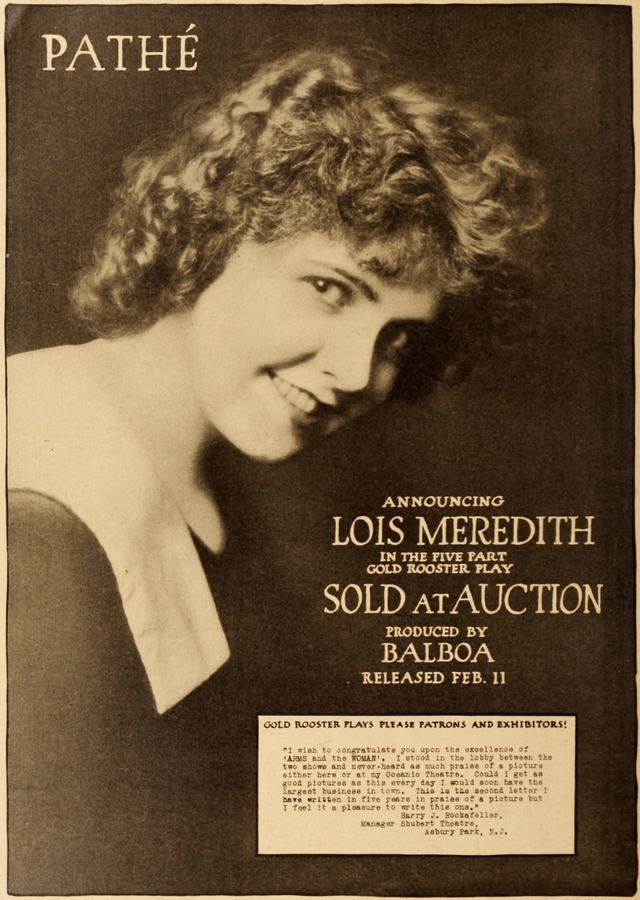
If you believe silent cinema whispers only sweet lullabies of slapstick and swoon, Sold at Auction will slap that assumption into next week.
Daniel F. Whitcomb’s screenplay is a scalpel: it flays open the polite skin of Edwardian America to expose the raw musculature of class, race, and paternal delusion. The narrative machinery creaks with Dickensian coincidence, yet every gear is greased by emotional kerosene; you smell the scorch long before the conflagration.
Let’s talk visuals—because in 1915, visuals are the oxygen.
Cinematographer friend-of-the-director (uncredited, as was habit) frames Nan’s first dawn in the Hopkins cellar through a slanted window—light sliced into prison bars across her face. The image predates German Expressionism by half a decade, yet vibrates with the same cosmic injustice. Later, when the matrimonial-agency sequence arrives, the camera abandons its usual mid-shot propriety and glides—yes, glides, on improvised dollies—past rows of satin-clad women exhibited like Lalique figurines. The kino-eye doesn’t blink; we do.
Performances oscillate between melodrama’s grand semaphore and something eerily modern.
Lucy Blake as adult Nan carries the heaviest cross: her eyes must semaphore years of hunger, shame, and stubborn hope without the crutch of spoken word. Watch the micro-clench of her jaw when Mrs. Hopkins pronounces the racial slur—it lasts four frames, but it detonates. Opposite her, Frank Mayo’s Hal is all forward momentum, a newsman whose moral compass spins only north; yet Mayo knows when to underplay, letting his trench-coat slacken like a deflating ego the instant he recognizes Nan on the auction block.
William Conklin’s Stanley is the film’s Moral Möbius strip: a man who can outbid plutocrats yet can’t buy absolution. Conklin opts for a rigid carriage—shoulders squared like a mausoleum—until the climactic recognition, when every vertebra seems to melt into oatmeal. The moment he lowers his paddle—hand trembling as though the auctioneer’s gavel were a guillotine—is the film’s most hushed horror.
Lois Meredith’s Mrs. Hopkins deserves a venal medal: she makes Lady Tremaine look like a Montessori instructor.
Meredith plays the tyrant with Puritanical chill—her mouth a permanently puckered hyphen, her hands forever clutching a rosary that clearly missed the Sermon on the Mount. She weaponizes motherhood itself, turning nurture into indenture. When she hisses the ‘mulatto’ calumny, the word isn’t merely spoken; it is exhaled like brimstone, the phonetic equivalent of branding iron on skin.
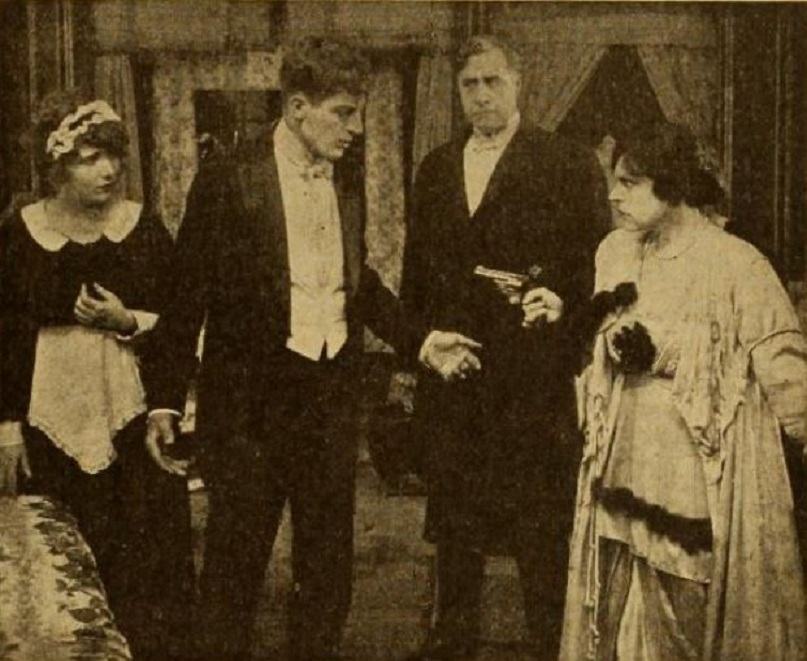
Now, the auction. Forget every cliché of mustache-twirling villains and swooning heroines—this sequence is clinical. The set drips with Belle-Époque excess: Aubusson carpets, champagne cut-crystal, a string quartet sawing out a waltz that sounds like a death-rattle in ¾ time. Women are numbered, catalogued, turned on rotating platforms so bidders may inspect dental work and deportment alike. The film’s intertitle card, stark white on black, reads: “Lot 23: Age 18, amenable temperament, skilled in domestic sciences.” The dispassionate jargon anticipates twentieth-century bureaucracies of evil; you half-expect IBM punch-cards to flutter across the screen.
Race, or rather the fiction of race, is the film’s third rail.
Whitcomb never confirms Nan’s genealogy; the accusation itself is the weapon. In 1915, when Birth of a Nation’s toxic propaganda still reeked in projector beams, Sold at Auction dares to stage miscegenation panic as a strategic lie. The film knows that in America’s ledger, blood quantum is an accountant’s fiction that can nonetheless debit a life. When Nan absorbs the lie, her body language folds like a snapped umbrella; she exits frame left, re-entering society as a phantom twice displaced—orphan and alleged outcast.
Structurally, the picture is a triptych: exile, eros, exhibition. Each panel rhymes visually. The cellar where Nan scrubs linens mirrors the auction dais where she stands scrubbed by klieg lights. Hal’s first gift to her—an inexpensive cameo brooch—reappears later as a diamond pendant dangled by a bidder, proving how easily sentiment can be monetized. Even the infant’s cradle in the opening scene finds its antithesis in the gilded cage of Lot 23.
Composer (or rather, the house musician who improvised at premières) would have underscored these echoes with leitmotifs—perhaps a lullaby soured into ragtime. Today, in the print’s eerie silence, you supply the score yourself; your pulse suffices.
Compare it to contemporaneous melodramas: Assigned to His Wife treats marriage as contract law; The Banker’s Daughter monetizes filial devotion; yet neither dares the full anarchic howl of Sold at Auction. Even Dante’s Inferno, with its baroque hellscapes, ultimately reassures: sin punished, order restored. Here, the inferno is bidirectional—father buys daughter, daughter buys freedom, audience buys ticket—nobody exits unscorched.
Some cavil that the dénouement—Hal bursting in, identity revealed, gavel frozen mid-air—reeks of Dickensian contrivance. I counter: melodrama at its apex is theology without God, a cosmos where coincidence is karma’s understudy. The film earns its flourish because every preceding frame insists that identity is fungible, love a transaction, flesh a commodity. When the auctioneer’s hammer pauses, time itself holds breath; the fantasy of reunion is the only currency left uncounterfeited.
Technically, the print survives in 35mm at 18 fps, though reels 3 and 5 bear nitrate necrosis—bubbling emulsion like smallpox scars. These scars speak. They remind us that cinema, too, is auctioned: salvaged, bid upon by archives, restored, re-exhibited. We are all complicit collectors of shadows.
Feminist readings blossom like nightshade here.
Nan’s agency is curatorial: she chooses exile over subjugation, chooses the unknown over the authored narrative of racial stain. Her fugitivity is a proto-modernist rupture; she rewrites herself by erasing the footnotes others staple to her skin. Yes, she ends up on a pedestal, but it is a guillotine pedestal—her neck is never truly safe until she steps off it into Hal’s ink-stained arms.
Yet Hal is no stainless savior. Note the subtle visual rhyme: his press pass dangles like a backstage laminate, mirroring the numbered plaque around Nan’s neck at auction. Reporter and captive share the same visual grammar of commodity; one merely peddles sentences while the other is sentenced. The film whispers that even the Fourth Estate barters in flesh—headlines sold by the column inch, women by the pound.
Religious iconography festers beneath the surface.
Hopkins clutches rosary beads the way a gambler fingers chips; Stanley’s mansion looms like a cathedral whose god has filed bankruptcy. The auction scene is staged on a raised dais—an altar where the Host is human. When the father claims his ‘property,’ the blocking evokes Abrahamic sacrifice, except the knife is financial, the burnt offering filial love itself.
Sound historians insist silents were never silent; nickelodeons roared with chatter, clacking shoes, vendor cries. Yet Sold at Auction demands hush. Its horror festers in negative space—those intertitles that refuse to moralize, the long take on Nan’s mute horror as bids ascend. The absence of synchronized voice weaponizes viewer imagination; you hear the gavel though none exists.
Legacy? Tragically sparse. No glossy Criterion release, no TCM festival slot. Yet fragments haunt later cinema: the white-slavery panic of Traffic in Souls (1913) is its direct ancestor; the auction of Scarlett O’Hara’s dignity in Gone with the Wind owes it a sordid debt; even Kiarostami’s Taste of Cherry replays the existential auction—what price a life? And in Jordan Peele’s Get Out, the bingo-scene bidding on Black bodies feels like a macabre echo, updated for post-racial America that isn’t.
Should you track it down? Absolutely. Expect no pristine restoration; expect fever-dream tinting—amber for domestic ‘safety,’ viridian for the horror of public space, crimson for the auction. Expect your own moral certainties to wobble like a gyroscope losing spin. Expect to emerge asking what, in our gig-economy present, we still auction that we pretend not to.
Final paradox: a film titled Sold at Auction cannot be bought; it can only repossess you.
IMDb 4.4
1927
Community
Log in to comment.