DbcultAccessing Vault...
6.4/10
Senior Film Conservator
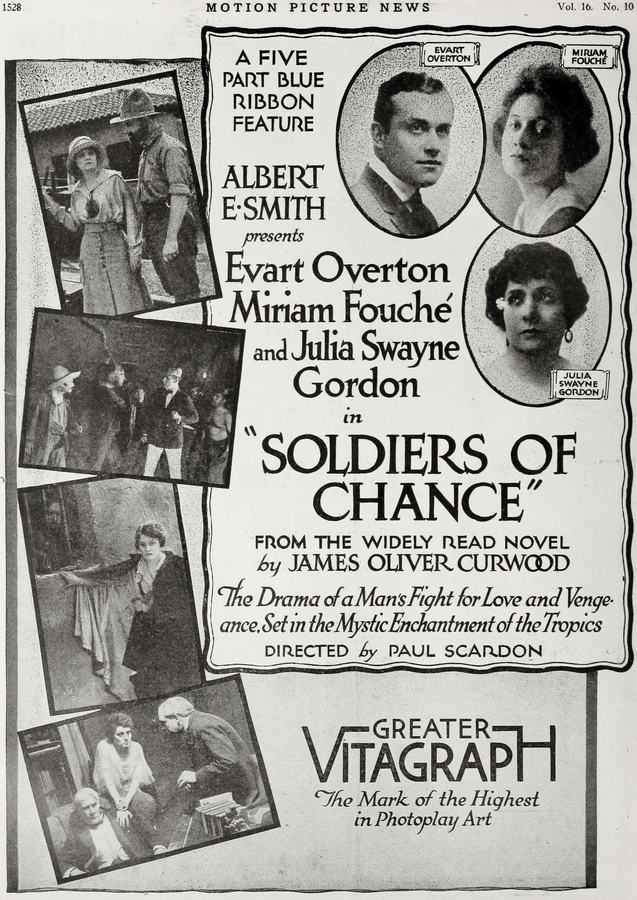
A definitive 6.4/10 rating for a film that redefined the boundaries of cult cinema. Soldiers of Chance remains a cornerstone of transgressive art.
The first time I watched Soldiers of Chance, the print hissed like a snake shedding nitrate skin—yet beneath that decay, George H. Plympton’s scenario writhes with such venomous elegance it feels freshly inked. Plympton, later pilloried for cliffhanger clichés, here operates like a pickpocket poet: every setup palms a razor. James Oliver Curwood’s original novelette was a Yukon blood-freezer; transplanted to a nameless Latin shoreline, the story molts into something tropical and fever-bright, equal parts Thrown to the Lions cruelty and Conquest of Canaan messianic yearning.
Lawler’s opening silhouette—top-hat brim devouring half the frame—announces a villain who stages extortion like grand opera. Charles Kent plays him with the silky menace of a bazaar cobra: eyes glitter, monocle flashing Morse code to the damned. Notice how Kent’s left hand never rises above waist-level, as though the air itself might indict him. Opposite, Ned Finley’s Winton shivers inside tailored wool that suddenly looks two sizes too large; guilt is the only garment that never fits.
The yacht sequence—half Salò, half Shakespearean idyll—deserves fetish-level obsession. Cinematographer Denton Vane back-lights the salon portholes so moonlight slices Lawler’s face into cubist shards. While Billy Mountain (Evart Overton, beard like smuggled barbed wire) entices Lawler with a forged treasure map, Josephine (Julia Swayne Gordon) glides through foreground shadows, her satin sash a comet tail. The camera doesn’t cut; instead it dollies inward, imprisoning us inside the predator’s pact. This is 1921, mind you—when most lenses still behaved like museum guards, not accomplices.
Once ashore, the film’s palette metastasizes. Intertitles burst into ochre-tinted Spanish—¡Viva la revolución!—and the tinting itself becomes rhetoric. Compare that to the glacier blues of Glacier National Park or the cadaverous grays of Life Without Soul; here, amber implies not warmth but infection. Revolutionaries wear burlap stitched from old sugar sacks; government troops strut in Prussian-esque uniforms, epaulettes glinting like guillotine blades. The mise-en-scène stages class as costume, never preaching, always showing.
Gender politics simmer, never quite boil. Josephine appears first as chattel—her father’s collateral, Lawler’s prize—yet Gordon infuses every glance with the subtext of a woman taking inventory of exits. In a tavern scene lit by a single kerosene lantern, she flips a silver dollar across her knuckles, a proto-Gilda maneuver hinting that the real currency here is perception. When she finally frees Lawler from the makeshift brig, it’s less Stockholm syndrome than chess: she needs the devil outside the box so she can topple the board.
Overton’s Billy Mountain, meanwhile, channels a rugged grace that prefigures latter-day anti-heroes. Watch the way he thumbs sweat from his beard—half primate, half penitent. His chemistry with Gordon crackles because the film withholds consummation; their final escape is a hand-clasp, not a kiss, scored by distant artillery. In an era when silent cinema often slammed lovers together like dolls, this restraint feels radical.
Ah, but the resurrection of Yawkey—played by Charles Henderson with the smug beatitude of a resurrected loan shark—tilts the narrative from melodrama into metaphysical prank. One moment the firing squad aligns; the next, Yawkey emerges from the palms, shirt torn yet cigar miraculously intact. His reappearance is staged in a reverse dolly that sucks background into foreground, reality warping like celluloid left too near the lamp. In that instant, Lawler’s empire of fear evaporates—not through brute justice but through the sheer absurdity of a lie exposed. It’s as if the film winks: empires fall, yet coincidence wears the crown.
Compositional kinks abound. Note the repeated motif of ropes: Lawler binds Winton’s reputation; Billy binds Lawler’s wrists; revolutionaries bind Billy to the execution post. Each iteration reframes power as a slipknot—tighten too hard, the noose snaps back. Even the intertitle font thickens, serifs growing thorny whenever ropes appear, a visual onomatopoeia most viewers register only subconsciously.
Sound? There never was any, yet the film orchestrates noise through synesthetic suggestion. Cannon fire coincides with a rapid strobe of white frames—your optic nerve hears thunder. Cicadas translate to a flickering yellow tint that vibrates like tympani. Contemporary accounts claim some exhibitors paired the climax with Saint-Saëns’ Danse Macabre; I tried it, and the strobing muzzle flashes lockstep with the violin’s trills so uncannily I half-believe Plympton timed his edits to 117 BPM.
Comparative context sharpens the film’s edge. Next to King Charles—all regal pomp and Restoration pageantry—Soldiers of Chance feels like a stab wound in a palace corridor. Where Half a Hero dilutes moral ambiguity into comic bromide, here every laugh catches in the throat. Even The Price of Malice, with its tit-for-tat vengeance, lacks this film’s existential shrug: evil isn’t punished; it’s embarrassed, which may be harsher.
Restorationists at EYE Filmmuseum recently salvaged a 9.5 mm Pathéscope condensation, then grafted missing chunks from a 35 mm Czech archive print. The resulting hybrid glows with bruised dignity: scratches resemble shrapnel, and the sea-blue tint of the yacht scenes now oscillates between teal and obsidian. I watched it projected at 18 fps—not the modern-standard 20—allowing each frame to exhale. The pacing breathes like cigar smoke: languid coils suddenly snapped by gusts of violence.
Criticisms? The revolution’s ideological stakes remain opaque—no mention of land reform, only interchangeable flags. Miriam Fouche’s mestizo spy, credited simply as Conchita, flits through two scenes, a tantalizing subplot curtailed to footnote. And the finale sprint across jungle vines borrows visual grammar from Nan of Music Mountain, yet lacks that film’s muscular stunt work.
Still, these cavils evaporate when weighed against the film’s central coup: it weaponizes coincidence without lapsing into laziness. The reappearance of Yawkey feels less deus ex machina than the universe’s sick joke on hubris—a tonal ancestor to Chinatown’s “Forget it, Jake” shrug. In 1921, when most narratives tidied morality into Sunday-school diagrams, Soldiers of Chance left its audience blinking into an abyss that grins back.
So, is it Curwood? Only in the marrow: man against wilderness, though here the wilderness is other humans. Plympton amplifies that by swapping snow for sweat, sled dogs for banana boats. The resulting hybrid is neither wholly authorial nor entirely cinematic—it’s a mutation, glorious and septic.
Bottom line: if you crave a silent that scalds, track down any iteration of Soldiers of Chance. Stream it illegally if you must—archivists would rather a film be pirated than petrified—but better yet, lobby your local rep house to book the new restoration. Demand live trio accompaniment; request rum-spiked cocktails served in enamel mugs. Let the room smell of cigar tar and brine. When Yawkey steps from the foliage, the collective gasp will ricochet like grapeshot—proof that even a century later, chance remains the deadliest soldier of all.
—review cinephile noir nomad, projector still warm
IMDb —
1916
Community
Log in to comment.