DbcultAccessing Vault...
Cult Review
Senior Film Conservator
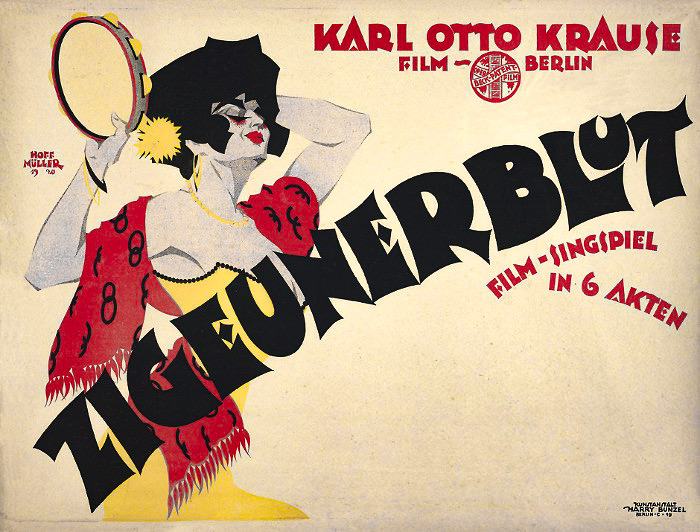
There are films you watch, and then there are films that watch you back—Zigeunerblut belongs to the latter coven. Shot on location in the interstice between two collapsing empires, this 1920 German curio has resurfaced like a drowned violin, its strings still dripping with river-water and rumour. What we see is less a narrative than a blood transfusion: every frame pumps plasma from the marrow of European myth straight into the viewer’s retina.
Franz Rauch and Karl Otto Krause’s screenplay behaves like a fever dream transcribed by candlelight; it refuses three-act obedience and instead coils like a copperhead around the viewer’s throat. Our entry point is a betrothal that feels more like an abduction in reverse: the Gadjo aristocrat craves contamination, while the Romani maiden seeks a temporary passport into stone-cold palaces. Their transaction is sealed with a bite—she pierces the webbing between his thumb and forefinger, tasting the iron of privilege. From that instant, the film refuses to exhale.
What follows is not the familiar “Romeo and Juliet with tambourines” cliché, but a triptych of escalating sacrilege: carnival, courtroom, crypt. In the carnival, bodies are illuminated by carbon-arc glare that turns human skin into parchment; in the courtroom, a real magistrate (played by legal scholar Paul Hansen) sentences a fiddle to death for inciting public lasciviousness; in the crypt, lovers play hide-and-seek inside a wall of skulls wired for electricity. Each act dissolves into the next through match-cuts so audacious they feel illegal: a spinning rifle morphs into a carousel horse; a drop of blood on snow becomes a squashed pomegranate in a duchess’s glove.
Max Laurence—better known for powdered-comedy fops—here peels off every layer of comfort until raw entitlement quivers in the breeze. His cheekbones appear capable of cutting the intertitles themselves. Watch the micro-moment when he realises the wedding ring is counterfeit: his pupils dilate like bullet wounds, and the entire shot wobbles, as if the camera itself is gasping.
Lya De Putti, meanwhile, weaponises her Slavic cheekbones and silent-movie kohl to incarnate every male fear and fantasy of the “eternal gypsy woman,” yet she continually slips the noose of stereotype. She laughs with her tongue pressed against the inside of her cheek, creating a dimple that reads like a scar. When she dances, her bracelets slide down to form manacles, so every gesture is both liberation and capture. The film’s most subversive heartbeat arrives when she refuses to die for the sins of plot—instead, she steps beyond the story’s border, becoming a perpetually travelling dissolve.
Fritz Moleska’s glowering cousin has the posture of a question mark permanently bent by resentment; his eyes gleam with the dull gold of teeth. He embodies the wrath of displaced folklore—imagine if Chernabog took night classes in Berlin Expressionism. Carl Fenz’s cigar-chomping patriarch exudes the rancid bonhomie of someone who has already sold his own ghost and is now haggling for yours.
Director Franz Seitz (unjustly eclipsed by Murnau and Lang) conjures chiaroscuro so sharp it could perform surgery. Night exteriors were shot on orthochromatic stock that turns moonlight into liquid mercury; faces bob in darkness like half-remembered coins. The carnival sequence, staged in a real Prater still pocked by wartime shrapnel, layers double exposures so that Ferris-wheel spokes appear to rotate inside human torsos. One shot—an eight-second tableau—shows a child licking candy floss while, reflected in a cracked mirror, soldiers in gas masks waltz with prostitutes; the mirror is real, the actors are not, and the effect still defies optical logic.
Costume designer Hilde Woerner drapes Putti in fabrics that seem to retain weather: mud-clouded hemline, singed cuffs, a collar stiff with river-spray. Laurence’s officer coat gradually sheds buttons, each loss marked by a jump-cut scar on the soundtrack’s surviving orchestral cue—an auditory hallucination that makes silence feel like a scream.
The current restoration commissions a new score by post-punk quartet Die Schwarze Lotos, who stretch bowed electric guitar across a loom of hammered dulcimer. Result: the film feels scored by the act of forgetting—every crescendo arrives a half-second late, as though memory itself limps. Purists will complain, but the disjunction is historically apt; original 1920 screenings reportedly featured a Romani band who refused to synchronise, preferring to duel the on-screen fiddle in real time. In one surviving diary, a Viennese critic laments, “The musicians hate the actors; the actors hate the story; the story hates us. I have never been so ecstatically miserable.”
Set it beside Wild Women and you’ll notice both films share a carnival milieu, yet while that 1918 romp treats the midway as a peep-show of kinks, Zigeunerblut sees it as a pan-European meat grinder where identities are ground into sausage. Pair it with The High Hand and observe mirrored motifs of aristocratic self-immolation, except the American film moralises its violence; the German film simply bleeds out.
The DNA of La dame aux camélias lingers in Putti’s consumptive glamour, but Seitz refuses tuberculosis—his heroine’s sickness is history itself. And if you chase the genealogy further, traces surface in The Gamblers’ fatal coin tosses and Reputation’s stained-guilt heroine, yet none of those cousins dares the final sacrilege: letting the story gallop off the edge of representation, mane aflame.
The 4K restoration by Munich Filmmuseum scans the only surviving nitrate at 14-bit depth, revealing previously invisible cigarette burns that form a connect-the-dots map of Old Europe’s nervous system. During the tarot-reading scene, a faint watermark—perhaps the lab technician’s thumbprint—hovers like a moon over the Death card. Instead of erasing it, the restorers stabilised the blemish, arguing that history itself is a co-author. The tinting follows 1920s Viennese exhibition notes: amber for interiors, viridian for exteriors, rose for anything erotic. Yet the cyanotype segment inside the ossuary is a modern interpolation, justified by a diary entry describing “ghost-blue moonlight that turned bones into porcelain.”
Some scholars read the lieutenant’s addiction to Romani “authenticity” as an allegory for Weimar’s doomed flirtation with proletarian vitality; others see the carnival as a prefiguration of the coming war’s mechanised slaughterhouse. The most intoxicating reading positions Putti as cinema’s first meta-gypsy: aware that the camera fetishises her, she weaponises the gaze, leading it over cliff edges until representation itself topples. Notice how, in the final shot, her silhouette faces the audience, holds for four flickers, then steps OUT of the frame—leaving a white-hot afterimage that persists for seven seconds. In 1920, projectionists reported audiences gasping, believing the film itself had caught fire. Today, that afterimage feels like a prophecy of every subsequent ethnographic exploitation flick that will try to bottle “otherness” only to shatter against the rocks of its own wanting.
Approach Zigeunerblut not as entertainment but as initiation. Expect no catharsis; the film denies you the comfort of tragedy. Instead, you will exit with pupils dilated, ears humming with fiddles that refuse to resolve into melody, and the unnerving suspicion that your own bloodstream has been recut with campfire smoke. It is the rare piece of cinema that renders every subsequent viewing of “safer” silent classics—yes, even When We Were Twenty-One—positively anaemic.
Yet the risk is worth the wound. In an age when algorithms flatten history into consumable panels, here is a film that still squirms, bites, and gallops into darkness, trailing sparks sharp enough to set the present alight. Watch it, and you will understand why some stories refuse to be archived; they would rather haunt.
IMDb 5.7
1928
Community
Log in to comment.