DbcultAccessing Vault...
Cult Review
Senior Film Conservator
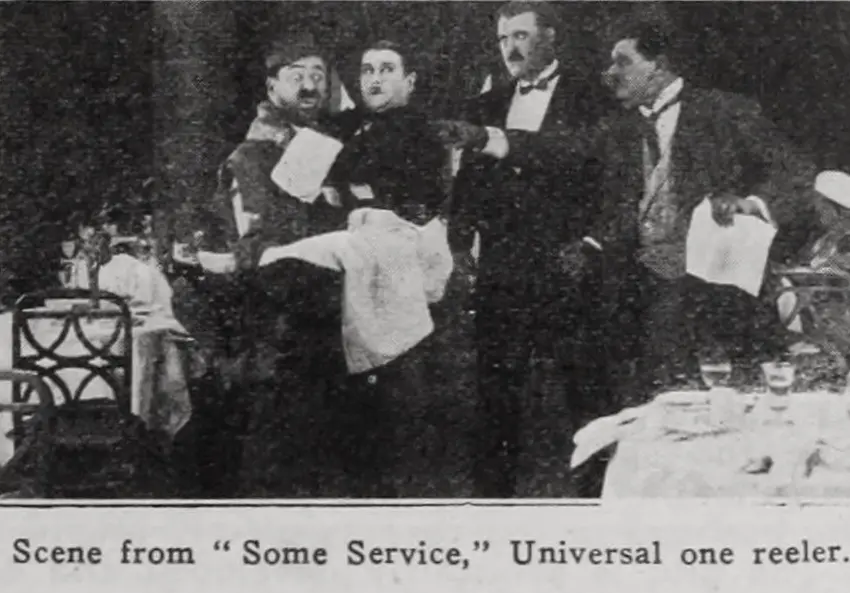
Stepping back into the hallowed, flickering halls of early cinema, one occasionally stumbles upon a forgotten gem that, despite its simplicity, speaks volumes about the era's comedic sensibilities and the universal nature of human foibles. William Watson's 'Some Service' (1923), a modest yet profoundly engaging silent short, is precisely such a find. It's a film that, on paper, presents a premise so utterly mundane – a process server attempting to deliver a summons – yet, through the sheer kinetic energy and expressive prowess of its cast, particularly Neely Edwards and Bert Roach, transforms this prosaic task into an uproarious, almost philosophical, exploration of persistence, evasion, and the comedic absurdities inherent in the legal system.
The very essence of 'Some Service' lies in its stripped-down narrative. There's no grand romance, no sweeping epic, no moral quandary demanding deep introspection. Instead, we are given a singular objective: serve the papers. And it is in the relentless, often futile, pursuit of this objective that the film finds its genius. Neely Edwards, as our indefatigable process server, embodies the everyman hero, a figure of earnest dedication pitted against the forces of recalcitrance. His performance is a masterclass in silent comedic acting, relying heavily on exaggerated physical reactions, a perpetually exasperated facial landscape, and a resilient spirit that borders on the Quixotic. He isn't merely chasing a man; he's chasing the very concept of legal compliance, a phantom that perpetually slips through his grasp.
Bert Roach, as the unwilling recipient of said summons, provides the perfect foil. His character is not malicious, perhaps just deeply inconvenient. He represents the natural human inclination to avoid unpleasantness, especially when it arrives in the form of official documentation. Roach's portrayal is less about active villainy and more about a passive, almost accidental, genius for evasion. He sidesteps, dodges, and disappears with an almost balletic grace, turning the simple act of existing into a formidable barrier to justice. The dynamic between Edwards' frantic pursuit and Roach's unwitting escape forms the comedic backbone of the entire piece, a beautifully choreographed dance of intention and avoidance.
What truly elevates 'Some Service' beyond a mere slapstick routine is its subtle commentary on the bureaucratic machinery. The process server is a cog, a vital yet often thankless part of a larger system. His success or failure hinges not on grand gestures or heroic deeds, but on the meticulous, often frustrating, execution of a very specific, very minor legal task. The film, in its own understated way, highlights the absurdity that can arise when abstract legal principles collide with the messy, unpredictable reality of human behavior. It’s a microcosmic view of law and disorder, played out with an infectious, lighthearted spirit.
The comedic techniques employed are quintessential silent era. Physical gags abound, from near-collisions to elaborate hiding places, all executed with a precision that belies the apparent spontaneity. The use of intertitles is sparse but effective, often delivering punchlines or advancing the plot with a pithy wit. The pacing is relentless, building a momentum that keeps the audience engaged, even through the most repetitive of Edwards' futile attempts. This film, though perhaps not as widely known as masterpieces by Chaplin or Keaton, shares their fundamental understanding of visual storytelling and the power of non-verbal communication to elicit laughter and empathy.
Comparing the relentless, almost obsessive pursuit in 'Some Service' to other films of the era illuminates its unique charm. While it doesn't possess the grand, often dangerous stunts of a Buster Keaton, or the profound pathos interwoven with humor found in a Charlie Chaplin feature, it excels in its focused, single-minded comedic premise. One might draw a parallel to the persistent, often chaotic, physical comedy seen in shorts like The Savage, where characters find themselves in increasingly improbable situations, relying on their wits and physical agility to navigate the mayhem. Similarly, the character-driven humor of a film like Blinky, where personality clashes and misguided intentions drive the narrative, finds a spiritual cousin in the dynamic between Edwards and Roach. The beauty of 'Some Service' is its ability to extract maximum comedic mileage from a relatively simple setup, a hallmark of well-crafted silent shorts.

The 'chase' motif is a timeless comedic device, and 'Some Service' demonstrates its effectiveness with admirable clarity. It's a primal form of humor, tapping into our innate understanding of effort versus reward, and the often-frustrating gap between the two. The film doesn't rely on complex plot twists or intricate character arcs; its strength lies in the sheer spectacle of the pursuit itself, the escalating desperation of the server, and the increasingly ingenious (or accidental) evasions of the served party. This simplicity is, paradoxically, its greatest sophistication. It understands that sometimes, the most profound humor comes from the most straightforward situations, amplified by skilled performers.
William Watson, as the writer, deserves commendation for crafting a scenario that is both endlessly repeatable and consistently entertaining. The narrative doesn't tire, even as Edwards' character grows visibly more fatigued. This speaks to the strength of the core concept and the universal appeal of watching someone struggle valiantly against an insurmountable, or at least highly inconvenient, obstacle. It’s a testament to the power of a well-conceived premise that can sustain an entire narrative, even a short one, through sheer comedic force.
Neely Edwards' performance as the process server is the engine of this film. His range of expressions, from hopeful determination to utter despair, is captivating. He doesn't just act; he emotes with his entire body, conveying the physical toll and mental anguish of his Sisyphean task. There's a particular moment, a subtle slump of the shoulders after yet another failed attempt, that communicates volumes about the character's internal struggle without a single intertitle. This is the magic of silent film acting, and Edwards is a superb practitioner of the craft.
Bert Roach complements Edwards perfectly. His character isn't a villain; he's simply a man who doesn't want to deal with whatever legal entanglements await him. His evasions are often less deliberate and more opportunistic, adding to the comedic charm. He’s the unwitting antagonist, a force of nature that our protagonist simply cannot pin down. Their chemistry, built on conflict and frustration, is palpable and provides a solid foundation for the film's comedic beats. It's a testament to their individual talents and their collective ability to play off one another's energy.
While 'Some Service' might not feature on every canonical list of essential silent films, its enduring appeal lies in its unpretentious charm and its masterful execution of a simple idea. It reminds us that comedy doesn't always need grand narratives or complex psychological insights. Sometimes, the most effective humor comes from observing the everyday struggles of ordinary people, amplified for comedic effect. It's a film that celebrates the sheer tenacity of the human spirit, even when that tenacity is directed towards something as seemingly trivial as serving a legal document.
In an age saturated with digital effects and intricate storytelling, there's something refreshingly pure about 'Some Service'. It relies solely on performance, timing, and a clever premise. It's a reminder of the foundational elements of cinema, where the moving image itself was enough to captivate and entertain. For anyone with an appreciation for the history of film, or simply a love for well-executed physical comedy, 'Some Service' offers a delightful, albeit brief, journey into the past. It's a film that, despite its age, still delivers on its promise of genuine, heartfelt laughter, proving that some services, indeed, are timeless. It’s a small, perfect package of comedic ingenuity, a testament to the fact that even the most straightforward of plots can yield rich dividends of entertainment when handled with skill and affection. The film, in its quiet way, asserts that the mundane can be magnificent, and the bureaucratic, brilliantly absurd.
IMDb 5.8
1923
Community
Log in to comment.