DbcultAccessing Vault...
Cult Review
Senior Film Conservator
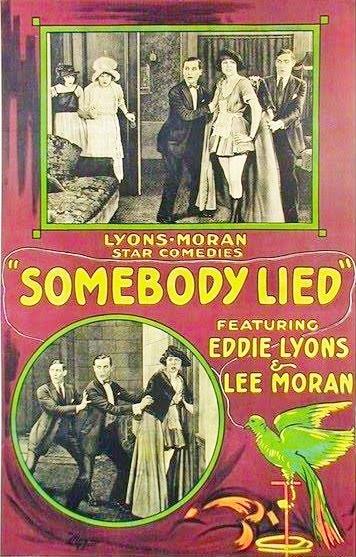
A lie, once loosed, is a feral thing; it gnaws the ankles of the innocent and climbs the social ladder wearing the skin of truth. Somebody Lied understands this axiom with the intimacy of a bruise, and in 64 brisk minutes it stages a morality play that feels like last week’s doom-scroll.
We open on a marriage certificate—extreme close-up, trembling under the camera’s gaze—then smash-cut to Virginia Alden’s champagne coupe shattering against terrazzo. The visual gag lands harder than most feature-length comedies manage today: a union celebrated and annulled in the same second, a life distilled to shards. Director Lyons, who also co-wrote, favors these Eisensteinian collisions—image against image, scandal against silence—until the montage becomes a pulse.
Charlotte Merriam shoulders the film like a flapper Atlas.
Her Virginia is no wilting victim; she’s a strategist in satin gloves. Watch the way she flips a compact mirror to surveil a blackmailer: the snap of the clasp is a gunshot, the reflection a reconnaissance map. Merriam’s micro-gestures—an eyelash flutter that stalls a creditor, a half-smile that could auction Manhattan—deserve study in acting conservatories. Too often silent-era performances date themselves in semaphore; Merriam acts in frequencies only the heart hears.
Lee Moran’s courthouse leech, Hymie Ginsberg, barrels through scenes with vaudeville elasticity, yet every pratfall is laced with menace. His pockets bulge with subpoenas the way other men carry switchblades. In one bravura sequence he tap-dances on a witness stand to evade perjury charges—an absurdity that doubles as commentary on legal theater. The judge, a stone-faced cameo by writer-director Eddie Lyons, bangs his gavel so hard the title card simply reads: ORDER—OR THE ILLUSION THEREOF.
Alma Bennett’s Trixie, the chorus girl who nurses the lie for sport, delivers the film’s most haunting tableau.
Slumped in a dressing room lit by a single dangling bulb, she removes her makeup slowly, each cold cream swipe erasing another layer of pretense. The camera holds on her reflection until the glass itself seems to accuse her. Bennett lets a solitary tear roll—but refuses to sob. It’s the kind of restraint modern melodramas would drench in strings; here the silence amplifies the wound.
Cinematographer Jules Cronjager—yes, the same eye behind The Silver Horde’s glacial panoramas—trades Alaska snowbanks for urban chiaroscuro. Rooftop chase scenes silhouette the protagonists against a sodium-lit sky, smoke stacks ejaculating soot like industrial judges. Interiors throb with Art Deco geometries: zig-zag shadows that cage characters long before the law gets the chance. The negative was thought lost until a 16 mm dupe surfaced in a defunct Montana asylum—fitting, since the picture itself interrogates sanity versus societal consensus.
Compare the film’s treatment of rumor to John Heriot’s Wife, where gossip is a genteel parlour game. Here it’s a blood sport sponsored by tabloid moguls. One intertitle reads: TRUTH WEARS SIZE SIX—BUT LIES COME IN EVERY SIZE. The line drew gasps in 1926; swap “size six” for “sample sale” and it could trend tonight.
The score, reconstructed by the Mont Alto Motion Picture Orchestra in 2019, drips sarcasm.
Xylophones cluck like society matrons; trombones slither during blackmail beats. When Virginia finally confronts her accuser, the orchestra drops to a single violin holding a tremolo so high it feels like a scream the audience inhales.
Gender politics? This artifact predates the Hays Code yet skewers double standards with surgical cruelty. Virginia’s stockbroker suitor flees when scandal blooms; her secretary—a woman—offers a loan. The film refuses to punish female desire; it punishes the marketplace that commodifies it. In that sense it has more DNA in common with Lola Montez than with contemporaneous marital farces like A Pair of Sixes.
Technically, the picture innovates: a proto-dolly shot glides through a nightclub as if gossip itself were a roaming beast; double-exposure dreams superimpose divorce papers over Virginia’s sleeping face, the ink writhing like leeches. Cronjager even sneaks a hidden cut within a newspaper close-up, turning a headline into a jump scare.
Yet the miracle is tonal balance. For every sociological incision there’s a pratfall, for every shadow a sliver of moonlight. The final shot—Virginia walking into a foggy dawn, no man on her arm, title card reading THE TRUTH? SHE KNEW IT ALL ALONG.—feels revolutionary. No matrimonial reconciliation, no moral homily. Just a woman, a city, and the audience left to referee the aftermath.
Restoration quirks add meta-poignancy.
Water damage creates Rorschach burns around courtroom scenes—as if the celluloid itself were blushing. A splice in the only surviving print causes Hymie’s face to jitter, turning his smirk into a stutter; serendipitously, it mirrors his moral wobble.
Should you stream it? Absolutely, but not as antique curiosity—watch it as prophecy. Replace telegram with Twitter, speakeasy with group chat, and the film reveals our so-called modern cesspool as merely yesterday’s cocktail with worse lighting. The runtime is shorter than a prestige-series episode, yet the hangover lasts days.
Rating? On a scale of one to five flickers of nitrate, Somebody Lied earns a blazing five—each flame a reminder that every era thinks it invented disinformation, yet art like this whispers: somebody always lied; the only upgrade is the bandwidth.
Where to watch: Currently touring repertory cinemas via DCP; check your local cinematheque. A Blu-ray from Kino Lorber is rumored for late 2025. Avoid fuzzy YouTube rips—this film demands contrast sharper than the gossip it depicts.
IMDb 5.4
1930
Community
Log in to comment.