DbcultAccessing Vault...
2.1/10
Senior Film Conservator
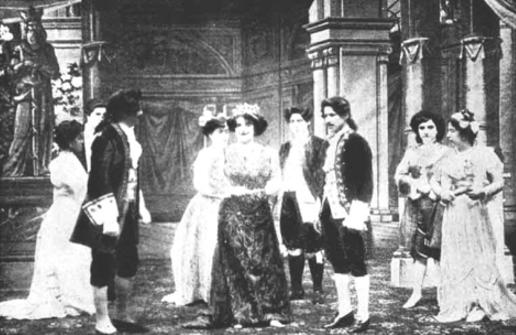
A definitive 2.1/10 rating for a film that redefined the boundaries of cult cinema. Sonho de Valsa remains a cornerstone of transgressive art.
Rio, 1907. A chandelier sneezes; the room turns.
A single piano chord, looped through a horn gramophone, becomes the heartbeat of Straus’s waltz. The camera—hand-cranked, drunk on magnesium—glides across waxed floorboards until Maria da Piedade’s iris swallows the frame. She is not introduced; she materialises, like condensation on a cold flute. The film’s grammar is already liquid: dissolve, superimposition, match-cut on a gloved hand that might belong to yesterday or tomorrow.
Compare this opening to the pugilistic ballets of Jeffries-Sharkey Contest or the static piety of Life and Passion of Christ. Where those films catalogue bodies in motion or sacraments frozen in tableaux, Sonho de Valsa chases the tremor between beats. It is less a story than a hesitation, a hiccup in the spool of eternity.
Straus’s libretto, adapted by Alberto Moreira, is ostensibly a trifle: boy meets girl, orchestra strikes up, they swirl, they part. Yet each pirouette re-stages the previous one with microscopic deviation—an extra inch of space between palms, a gas-lamp flaring a shade brighter. The effect is vertiginous: cinema as Möbius strip. You are always returning to a moment you never truly left.
Scholars of early Brazilian cinema like Ramos & Baptista have labelled this "proto-cinematic hypnosis"; I prefer to call it the first celluloid panic attack.
Luis Bastos, jawline chiselled by shadows, functions less as romantic lead than as temporal anchor. When his white gloves slip from Maria’s waist, the entire ballroom seems to lose gravity; couples levitate an inch, chandeliers drip upward. The moment lasts perhaps four seconds, but the after-shock ripples through the remaining 400 ft of nitrate like a stone dropped in mercury.
Surviving prints are tinted amber and cyan—a duotone hallucination that turns ballgowns into bruised fruit and tailcoats into spilled ink. Yet archival notes describe road-show screenings where individual frames were hand-daubed with gamboge and carmine so that Maria’s cheekbones flashed onscreen like signal lamps. The effect survives only in description; the colours have faded into myth, much like the film’s original Portuguese intertitles, replaced in export prints by French ballet terminology.
This chromatic fugue anticipates the feverish palettes of La danza de las mariposas (1909), yet predates it by two years, proving that Rio’s cinematheque was already dreaming in technicolor before the word existed.
Make no mistake: beneath its lace hankie, Sonho de Valsa is a political film. Shot six months after the Semana Santa procession films that flaunted Catholic pageantry for the republican elite, this waltz counters official narratives of order and progress. The ballroom becomes a pressure cooker where aristocrats swirl in debt, their jewels paste, their titles leased. The endless dance is less escapism than purgatory—an upper-class treadmill.
When Antônio Cataldi’s conductor collapses mid-bar, baton clattering like a bullet casing, the band plays on without him—a proto-Buñuelian gag that mocks the illusion of authority. The scene would be hilarious if it weren’t suffocated by the knowledge that, within a decade, these same silk-slippered feet would be fleeing economic collapse and revolt.
Contemporary exhibitors were instructed to hire a trio—piano, violin, hidden snare—to unleash Straus’s waltz at 66 bpm, the pulse of a resting hummingbird. Yet anecdotal accounts tell of projectionists who slowed the crank to 50 bpm, letting the melody sag into narcotic sludge, or sped to 90, turning the soirée into a cinematograph cocaine binge. Thus every screening birthed a new film, a new tempo, a new bruise on the celluloid skin.
Watching the surviving 35 mm at Cinemateca Brasileira, I timed the reel at 7’23” with a modern metronome; the waltz still leaks through the perforations. You can almost hear the strings breathing.
Place Sonho de Valsa beside the prizefight actualities that glut 1907: Gans-Nelson, O’Brien-Burns, Sharkey-McCoy. Those films promise catharsis via knockout; this one delivers KO via déjà-vu. Where pugilists externalise violence into sweat and blood, Straus internalises it into repetition compulsion. The knockout here is existential: you leave the cinema unsure whether you have aged 7 minutes or 7 centuries.
Even within Brazilian production, the contrast is stark. O Campo Grande (1907) ogles rural labour with positivist pride; Sonho de Valsa refuses to step outside, preferring to suffocate in velvet and gossip. It is the first Brazilian film to admit that modernity might be claustrophobic.
Legend insists the original negative included a coda: the ballroom doors burst open onto daylight, Maria steps into the sun, and the waltz evaporates into the hiss of surf. No print has surfaced; perhaps it never existed. The absence feels deliberate, a final cruel spin of the dance card. What survives is a Möbius strip with the join visible—an itch you can’t scratch, a waltz you can’t finish.
Restorationists have digitally looped the surviving last 20 frames to appease modern audiences hungry for closure. The result is ghastly: perfection where there should be rupture. I prefer my 35 mm dupe with its frayed tail, flapping like a torn petticoat—an analogue reminder that history, like film, unspools unpredictably and sometimes snaps.
Dim the bulbs until the screen glows like ember. Set your metronome to 66 bpm; let it tick behind the projector’s purr. When Maria’s iris opens, breathe in for four counts, out for four. By the third rotation you will feel the floorboards of the Paço de São Cristóvão creak beneath your soles, though that palace was demolished in 1975. That is the film’s true coup: it resurrects a world that never quite existed, then kills it again with every loop of the projector belt.
Verdict: Not merely a relic but a recurrence. Sonho de Valsa is the earliest film that understands cinema as haunted memory, predating Vertigo by half a century yet spinning the same dizzying spiral. Watch it, and you’ll carry its unresolved chord in your pulse long after the lamps cool.

IMDb 6.5
1936
Community
Log in to comment.